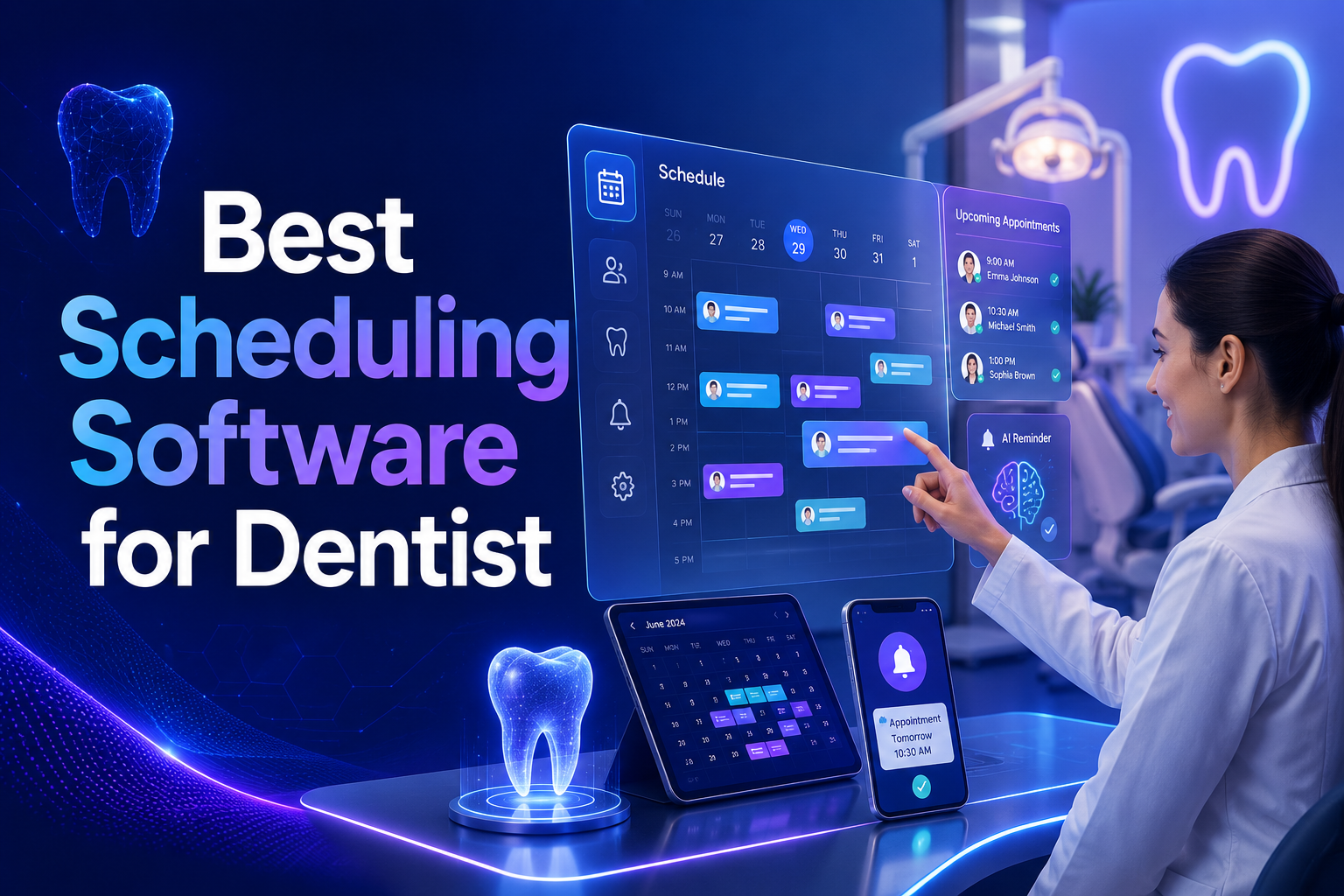
Most clinics do not lose time because the calendar is “full.” They lose time because the calendar is fragile. A single late cancellation creates dead chair time, staff scramble, and a ripple into billing and patient experience. The uncomfortable truth is that scheduling is not an admin problem. It is a throughput, revenue quality, and patient trust problem. That is why the best scheduling software for dentist decisions in 2026 look less like “which calendar is easiest” and more like “which system makes capacity predictable.”
Scheduling only looks simple when you ignore the second-order effects. The calendar controls how cleanly you convert demand into completed visits, how often you reschedule, and how much staff time you burn on confirmations.
When no-shows sit around the mid teens, a clinic can lose meaningful chair time without realizing it. Some dental workflow analyses cite average no-show rates around 15%, with some practices experiencing up to ~30% depending on patient mix and context. Even small improvements compound because recovered chair time is often sold at higher-margin procedures, not just hygiene slots.
Consequence: If your calendar tool cannot actively reduce volatility, you will compensate with overtime, overbooking, or underutilization. All three are expensive.
Many clinics add a Dental appointment reminder system and expect attendance to “fix itself.” Reminders help, but not uniformly. Studies and reviews across outpatient settings show that reminder design, timing, and the surrounding workflow matter.
In dentistry specifically, automated reminders have been reported to reduce no-shows materially in some implementations (one widely cited practice study reported about a ~23% reduction after implementation). But the bigger operational win is not the reminder itself. It is what happens next.
A robust dental appointment scheduling software stack does four things consistently:
Consequence: A reminder tool without confirmation workflows and rapid backfill is a partial fix that still leaves chair time exposed.
Online dental scheduling software is increasingly a baseline expectation, not a premium add-on. Industry data points to accelerating patient self-scheduling usage in broader healthcare, with reported year-over-year increases in adoption. At the same time, many practices still see low penetration: an MGMA poll (multi-specialty, not dentistry-specific) found most practices reported under 25% of patients using digital self-scheduling tools.
That gap matters because the operational value of online booking is not simply “after-hours bookings.” It is reduced inbound call load, fewer back-and-forth confirmations, and better slot utilization.
Where clinics get burned is “open” self-scheduling without guardrails:
Consequence: The goal is not more online bookings. The goal is controlled access to capacity, using rules that protect production and clinical flow.
In 2026, the meaningful decision is not cloud versus on-premise as a technology preference. It is cost structure and operational resilience.
Many market guides place cloud dental software in a recurring range roughly comparable to hundreds of dollars per provider per month, while on-premise models often require much higher upfront costs plus ongoing IT overhead. The specific numbers vary widely by geography, clinic size, and included modules, but the pattern is stable: cloud shifts spending from capex to opex, and it typically reduces update friction.
What to scrutinize in pricing, beyond the headline subscription:
Consequence: The cheapest monthly plan is often the most expensive choice if it locks you into manual workarounds or paid add-ons for basics like confirmations and cancellation backfill.
Most vendors can show a calendar view, color codes, and basic recall lists. The separating features are the ones that reduce operational risk.
If you are evaluating the best scheduling software for dentist use, prioritize capabilities that change outcomes:
1) Demand capture without staff bottlenecks
Look for patient-facing booking with rule-based slot types, deposit options if relevant, and frictionless intake. This is where ai appointment booking software for dental clinics can be valuable, not as a gimmick, but as workflow automation that routes the right patient to the right slot.
2) Two-way communication that closes loops
One-way SMS reminders are table stakes. Two-way confirmations and cancellations that update the schedule automatically are what protect chair time.
3) Backfill intelligence, not just waitlists
A “waitlist” that requires staff to call 20 people is not a waitlist. Strong systems sequence candidates, send offers, and stop when the slot is filled.
4) Schedule integrity controls
You need templates, provider-specific rules, procedure duration standards, and buffers that reflect real chair time. Otherwise, the calendar becomes a fiction your team pays for every day.
5) Operational reporting that matches business decisions
Do not settle for vanity metrics like “appointments booked.” You want actionable visibility: short-notice cancellation rate, confirmation rate by provider, lead time trends, and production lost to no-shows.
Consequence: The right dental scheduling software reduces volatility. The wrong one digitizes the volatility.
Dental AI is increasingly present across the patient journey, not just clinical interpretation. The scheduling layer is where AI can reduce repetitive work: triaging requests, predicting likely no-shows, timing reminders, and prioritizing backfill.
The practical question is not “does it have AI.” It is:
Tissue AI is often discussed in clinical contexts, but operationally it raises a systems question: can your scheduling and patient engagement stack support preventive workflows smoothly, including follow-ups and patient communication, without staff rebuilding processes every time you add a new service line?
Consequence: AI that does not translate into fewer steps, fewer calls, and fewer gaps is not operational intelligence. It is decoration.
In 2026, scheduling is no longer a background function. It is the clinic’s capacity engine. Clinics that choose tools based on surface-level usability often end up compensating with human effort: more calls, more follow-ups, more firefighting. Clinics that choose based on schedule predictability build calmer operations, cleaner production, and a more reliable patient experience.
Forward-thinking practices are closing these gaps with integrated systems that act as an operational intelligence layer, for example platforms like scanO Engage, combining automated appointment scheduling, reminders, and confirmations with broader practice visibility, workflow management, and even clinical-adjacent capabilities such as soft tissue screening integration and disease-wise insights. The point is not the software brand. The point is recognizing that a stable calendar is built, not wished into existence.
1. How do I choose the best scheduling software for dentist practices?
Evaluate confirmation tracking, clinical integration, analytics visibility, and recall automation rather than just calendar features.
2. Does AI appointment booking actually reduce no shows?
AI appointment booking for dental clinics improves confirmation rates through automated reminders and real time tracking.
3. How does scheduling software integrate with Dental AI systems?
Modern platforms connect with tools like Tissue Ai and screening devices to trigger structured follow ups and recall cycles.
4. Can scheduling software improve treatment acceptance rates?
When reports, reminders, and follow ups are automated and visible, patients are more likely to proceed with recommended care.
An AI-powered co-author focused on generating data-backed insights and linguistic clarity.
Dr. Vidhi Bhanushali is the Co-Founder and Chief Dental Surgeon at scanO . A recipient of the Pierre Fauchard International Merit Award, she is a holistic dentist who believes that everyone should have access to oral healthcare, irrespective of class and geography. She strongly believes that tele-dentistry is the way to achieve that.Dr. Vidhi has also spoken at various dental colleges, addressing the dental fraternity about dental services and innovations. She is a keen researcher and has published various papers on recent advances in dentistry.