
Most dental clinics do not lose revenue because of a lack of patients.
They lose revenue because of fragmented scheduling systems.
A typical day reveals the inefficiency clearly. The receptionist is answering calls while checking the chair calendar. A patient calls to reschedule. Another does not show up. A third confirms verbally but fails to arrive. The dentist finishes a procedure only to find a 20 minute gap before the next patient. By evening, the team feels busy. Yet chair utilization tells a different story.
This is not a staffing issue. It is a systems issue.
As clinics adopt Dental AI tools such as AI diagnostic support and Tissue AI for disease detection, operational infrastructure often remains outdated. Clinical intelligence is advancing, but scheduling workflows are still manual or semi automated. That mismatch creates friction.
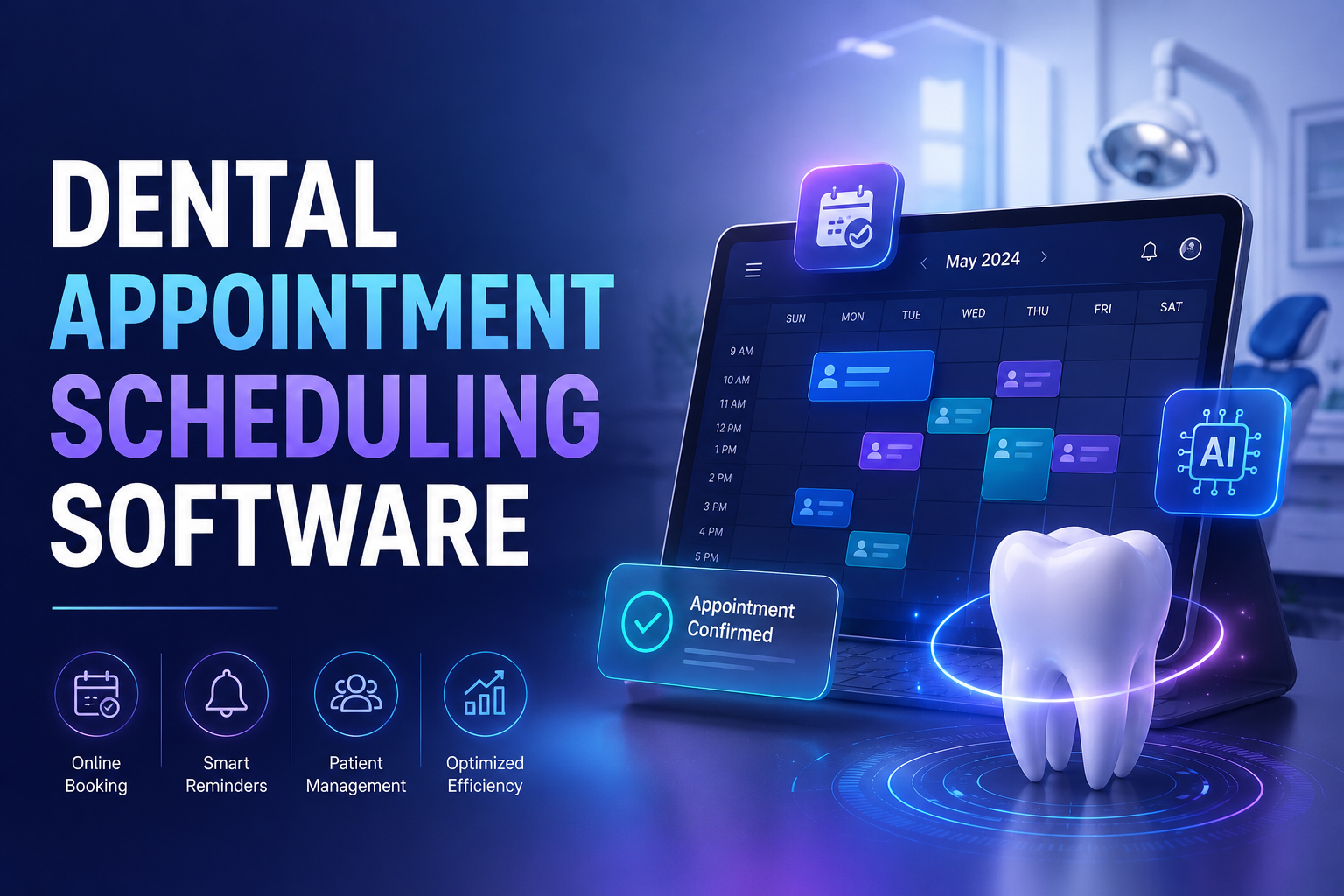
Dental appointment scheduling software has moved from convenience to strategic necessity. It is now foundational infrastructure for modern dental practice management.
Patient behavior has changed.
Consumers book flights, medical consultations, and even legal appointments online. They expect immediate confirmation, reminders, and digital communication. Waiting for business hours to call a clinic feels outdated.
At the same time, clinic economics have tightened. Rising operational costs, higher patient acquisition spend, and increased competition mean every chair hour matters. Idle time is no longer tolerable.
Modern dental scheduling software must therefore serve two masters:
Online dental scheduling software is no longer just a calendar. It is a system that determines:
Clinics that treat scheduling as an administrative function struggle with inconsistency. Clinics that treat it as infrastructure build stability.
Many inefficiencies are not visible in daily workflow. They appear only when examined through data.
A cancelled appointment does not always get refilled.
A patient who fails to confirm is not replaced in time.
A short gap between appointments remains unused.
Individually, these seem minor. Collectively, they reduce monthly revenue capacity significantly.
Without structured tracking, clinics cannot measure:
AI appointment booking software for dental clinics addresses this by enabling patients to book directly online, reducing dependency on manual call handling. When integrated with real time confirmation tracking, as in scanO Engage, the clinic receives automated alerts for confirmations, cancellations, and upcoming appointments. This allows faster backfilling of cancelled slots and reduces chair downtime.
Business outcome: Improved chair utilization and stabilized daily revenue flow.
Manual scheduling systems rely heavily on human tracking.
Follow up reminders are sometimes missed.
Recall cycles are inconsistent.
Even the best front desk teams cannot manage thousands of patient recall timelines without system support.
A Dental appointment reminder system built into dental appointment scheduling software ensures that reminders are sent automatically. scanO Engage supports automated reminders while also alerting the clinic about upcoming appointments and pending confirmations.
The shift here is not about convenience. It is about consistency.
Business outcome: Stronger confirmation rates and reduced no show percentages.
Most clinics underperform in recall management.
Patients who complete treatment often disappear until pain returns. Preventive visits are not tracked systematically. This weakens lifetime value and continuity of care.
When dental scheduling software integrates with clinical data, it creates structured recall pathways. scanO Engage connects appointment data with scanO Air screening reports and clinical records. When disease indicators are detected, follow up reminders can be scheduled systematically.
This becomes especially relevant when Tissue AI identifies soft tissue concerns or risk markers. Automated recall based on risk category ensures preventive consistency.
Business outcome: Increased recall compliance and higher lifetime patient value.
Many clinics operate across multiple platforms:
Fragmentation increases error risk and consumes administrative time.
The best scheduling software for dentist practices centralizes communication. scanO Engage consolidates patient records, prescriptions, communication logs, and reports into one system. It also sends PDF reports directly to patients via WhatsApp, reducing manual file handling.
When appointment scheduling, communication, and reporting exist within one ecosystem, staff workload decreases and information gaps reduce.
Business outcome: Administrative efficiency and improved patient experience.
Most clinics cannot accurately forecast:
Without analytics dashboards, scheduling becomes reactive.
Modern dental appointment scheduling software should provide structured analytics. scanO Engage offers dashboards that combine appointment data with disease wise insights and treatment patterns. This allows clinic owners to identify:
Business outcome: Predictable revenue planning and improved capacity allocation.
The shift from basic scheduling to intelligent scheduling is structural.
AI appointment scheduling allows patients to book directly through online portals. Instead of waiting for a receptionist, patients secure their own slot.
When integrated with automated reminders and confirmation tracking, this reduces manual dependency and improves reliability.
Online booking also captures after hours demand. Many patients prefer scheduling at night. Without online dental scheduling software, that demand is lost.
Strategic impact:
scanO Engage enables this AI driven appointment flow while linking it to the clinic’s broader management ecosystem.
Confirmation rates are a measurable metric.
An automated Dental appointment reminder system sends timely reminders while tracking confirmation responses in real time. The clinic receives alerts for:
This allows proactive follow up before the appointment day.
Strategic impact:
Scheduling cannot operate in isolation from diagnosis.
When scanO Air generates AI screening reports, those insights inform future scheduling. High risk patients can be flagged for earlier follow up. Treatment planning appointments can be scheduled automatically.
Tissue AI detection results can trigger structured recall protocols for monitoring.
Strategic impact:
Modern clinics need documentation clarity.
scanO Engage centralizes:
When all interactions are documented within the scheduling system, there is accountability and continuity.
Strategic impact:
For multi location clinics, fragmented scheduling becomes more damaging.
Standardized dental scheduling software allows centralized oversight while maintaining branch level autonomy. scanO Engage enables aggregated dashboards across locations.
Owners can compare:
Strategic impact:
Below is a structured translation of system features into financial outcomes:
AI Appointment Booking
Business Impact: Captures after hours demand and reduces front desk dependency, leading to higher booking conversion and reduced labor strain.
Online Patient Scheduling
Business Impact: Improves accessibility and increases appointment volume without increasing marketing spend.
Automated Reminders
Business Impact: Reduces no show rate and stabilizes daily revenue predictability.
Real Time Confirmation Alerts
Business Impact: Enables proactive slot replacement and reduces idle chair time.
Integration with scanO Air
Business Impact: Aligns diagnosis with scheduling, improving treatment follow up compliance.
Tissue AI Triggered Recall
Business Impact: Strengthens preventive care retention and long term patient value.
Analytics Dashboards
Business Impact: Enables revenue forecasting, peak time optimization, and structured growth planning.
Centralized Records and Communication
Business Impact: Reduces administrative duplication and improves operational clarity.
WhatsApp PDF Reports
Business Impact: Improves patient transparency and treatment acceptance.
Call, Video, and Chat Support
Business Impact: Expands consultation access and improves patient engagement.
Each of these capabilities supports operational predictability. None are cosmetic enhancements. They reduce uncertainty.
Dental clinics that scale successfully share one characteristic: predictable operations.
Predictability depends on:
Dental appointment scheduling software is not an expense category. It is operational infrastructure.
When integrated with AI diagnostics, disease analytics, and centralized communication, scheduling becomes a control center.
scanO Engage functions in this capacity. It connects AI appointment scheduling, real time confirmation tracking, integrated clinical insights, communication centralization, and analytics dashboards into one ecosystem.
The outcome is not faster booking alone.
The outcome is structured growth.
Clinics that adopt integrated dental scheduling software experience:
In a competitive market, operational consistency becomes the differentiator.
The question is no longer whether a clinic should adopt dental appointment scheduling software.
The strategic question is whether scheduling is being treated as a tool or as infrastructure.
1. How does dental appointment scheduling software improve revenue predictability?
By tracking confirmations, cancellations, and recall cycles in real time, it reduces idle chair time and stabilizes daily appointment flow.
2. Is online dental scheduling software suitable for small single location clinics?
Yes, because automated booking and reminders reduce administrative load while improving confirmation consistency even in smaller teams.
3. How does AI appointment booking for dental clinics reduce no shows?
It combines automated reminders with confirmation tracking, allowing proactive follow up before appointment day.
4. Can scheduling software integrate with diagnostic systems like Tissue AI?
When integrated properly, diagnostic insights can trigger structured follow ups and preventive recall scheduling based on clinical risk.
An AI-powered co-author focused on generating data-backed insights and linguistic clarity.
Dr. Vidhi Bhanushali is the Co-Founder and Chief Dental Surgeon at scanO . A recipient of the Pierre Fauchard International Merit Award, she is a holistic dentist who believes that everyone should have access to oral healthcare, irrespective of class and geography. She strongly believes that tele-dentistry is the way to achieve that.Dr. Vidhi has also spoken at various dental colleges, addressing the dental fraternity about dental services and innovations. She is a keen researcher and has published various papers on recent advances in dentistry.