Dental Autoclave: Classes, Price in India and Buying Guide (2026)
Quick answer: A dental autoclave is a steam sterilizer that kills bacteria, viruses and spores on reusable dental instruments using pressurised steam, usually at 121°C or 134°C. For most clinics in India, a front-loading Class B dental autoclave of 17 to 23 litres is the safest choice, because it can sterilize wrapped, hollow and porous loads such as handpieces and pouched kits. Based on Indian dealer listings in October 2026, Class B units cost roughly ₹75,000 to ₹1.8 lakh, Class N units roughly ₹20,000 to ₹1.3 lakh, and basic top-loading units ₹5,000 to ₹20,000.
This guide explains how a dental autoclave works, what the B, N and S classes mean, how to size one for your patient load, what it really costs to own, and how to monitor it so every cycle is a cycle you can trust.This guide is written by the Dr.Rajalaxmi at scanO, Growth Specialist of scanO air, an AI dental screening kiosk built for Indian clinics. The focus is on what works in a real, busy practice.
What is a dental autoclave?
A dental autoclave is a sealed pressure chamber that heats water into saturated steam and holds instruments at a set temperature and pressure for a set time. Steam under pressure transfers heat far faster than dry air, which is why steam sterilization is the standard method for heat-tolerant dental instruments.
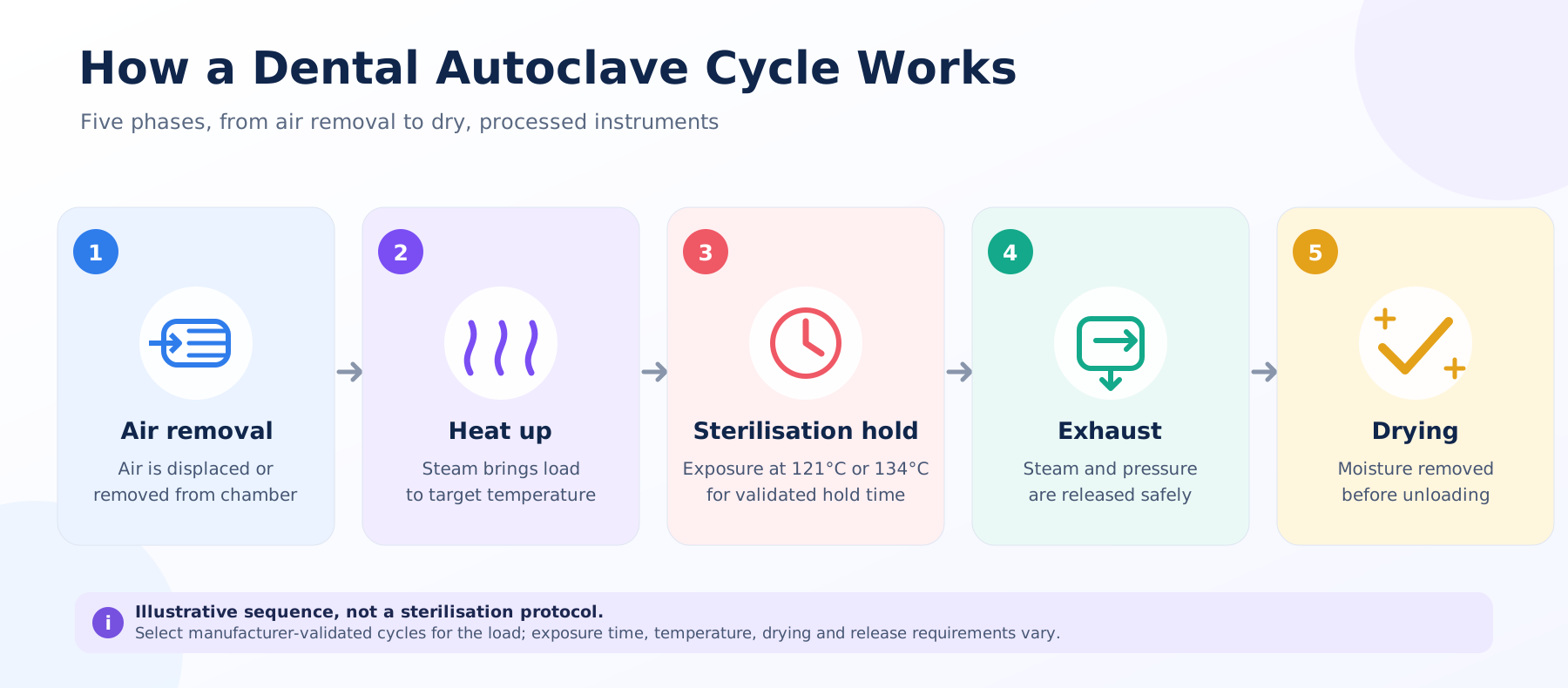
Every autoclave cycle has the same basic phases:
Air removal: air is pushed or pulled out of the chamber so steam can reach every surface.
Heat up and pressurisation: the chamber reaches the target temperature, typically 121°C or 134°C.
Holding (sterilization) time: the load stays at temperature for the time set by the manufacturer for that cycle.
Exhaust: steam is released and pressure returns to normal.
Drying: remaining moisture is removed so pouches stay sterile in storage.
The difference between a basic and an advanced dental autoclave lies mostly in the first and last phases. How well a machine removes air and dries the load decides which instruments it can safely sterilize.
Dental autoclave classes: B vs N vs S
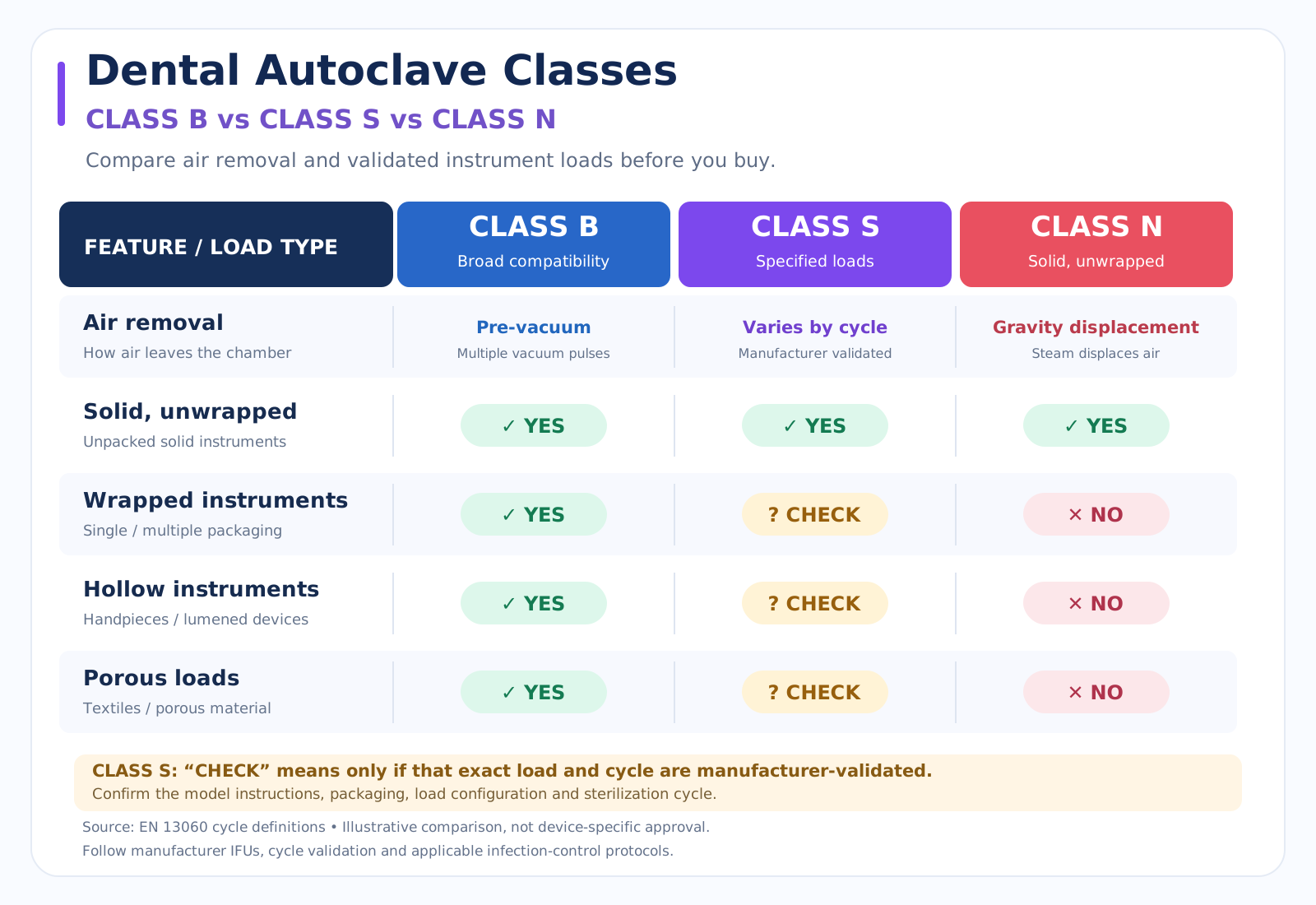
Most dental autoclaves sold in India are described using the classes defined in the European standard EN 13060 for small steam sterilizers. The class tells you which kinds of load the machine is validated to sterilize.
Dental Sterilization Guide
Class B vs Class S vs Class N Autoclaves
Understand how each autoclave class removes air, which instrument loads it supports, and where it fits best in a dental clinic.
Autoclave Class
How It Removes Air
Validated Loads
Best Suited For
01
Class B
Uses repeated, fractionated vacuum pulses to remove air before sterilization.
Most versatile
Wrapped and unwrapped, solid, hollow (lumened), and porous items within validated load specifications.
Most general and specialist dental clinics, especially those sterilizing handpieces and pouched instrument kits.
02
Class S
Air removal method varies by model and manufacturer specifications.
Model-specific
Only the instrument and packaging load types specifically validated by the manufacturer.
Clinics whose instrument loads match the manufacturer's validated list and sterilization cycles.
03
Class N
Uses gravity displacement, where steam pushes air out of the chamber.
Solid loads only
Unwrapped, solid instruments only. Not suitable for wrapped or hollow loads requiring validated air removal.
Backup use or immediate-use sterilization of eligible solid instruments, where permitted by applicable infection-control protocols.
Practical Takeaway
Class B:
Generally the most versatile option for dental clinics that routinely sterilize pouched kits, handpieces, and hollow instruments.
Class S:
A suitable choice when the clinic's instruments and packaging requirements match the manufacturer's validated load specifications.
Class N:
Limited to unwrapped solid instruments, making it unsuitable as the sole sterilizer for many modern dental workflows.
Important: Autoclave class alone does not guarantee compatibility with every dental instrument. Always verify manufacturer-validated sterilization cycles, load configurations, packaging requirements and instrument reprocessing instructions. Immediate-use sterilization should not replace routine wrapped-instrument processing and must follow applicable infection-control guidelines.
The practical point: handpieces, reusable suction tips and air-water syringe tips have narrow hollow channels where air gets trapped. Gravity-type machines cannot reliably clear that air, so steam may never touch the inner surface. Wrapped kits create the same problem inside the pouch. If you sterilize handpieces or store instruments in pouches, a Class B autoclave, or a Class S unit validated for those exact loads, is the appropriate choice. Always follow the instrument manufacturer's reprocessing instructions as well.
Basic top-loading "cooker type" autoclaves work on the gravity principle and usually have no validated drying stage. They are low cost, but they are not a substitute for a Class B machine in a clinic that reprocesses handpieces or wraps kits.
How much does a dental autoclave cost in India?
Prices vary with class, chamber size, build quality, brand origin and service network. The bands below are indicative, based on listings from Indian dental dealers seen in October 2026. Prices change often, so get two or three written quotes before you buy.
Dental Equipment Price Guide
Dental Autoclave Prices in India
Compare typical chamber capacities, indicative prices and features across different types of dental autoclaves.
Autoclave Type
Typical Chamber
Indicative Price
Key Features & Notes
01
Top-loading / Cooker Type
Small, often 10 to 13 L
₹5,000 – ₹20,000
Gravity type, suitable for unwrapped solid instruments, with limited drying capability.
02
Front-loading Class N
Approximately 16 to 18 L
₹20,000 – ₹1.3 lakh
Offers automatic sterilization cycles, but remains limited to unwrapped solid loads.
03
Front-loading Class B
Approximately 17 to 23 L
₹75,000 – ₹1.8 lakh
Uses vacuum air removal and drying. Supports wrapped and hollow loads within the manufacturer's validated specifications.
04
Imported Premium Class B
Approximately 17 to 28 L
₹3 lakh+
Faster cycles, data logging and integrated printers are more commonly available.
Important Price Note
These are indicative Indian market price ranges, not verified current quotations. Actual costs vary depending on brand, chamber capacity, sterilization class, features, installation, GST and after-sales support.
Before purchasing: Request a written dealer quotation, verify validated load types and sterilization cycles, and confirm warranty and local service availability.
The purchase price is only part of the cost. Before comparing quotes, add the running costs that every autoclave carries:
Water: most units need distilled or demineralised water. Tap water leaves scale that damages heating elements and valves.
Consumables: sterilization pouches, chemical indicator strips, and biological indicators (spore tests).
Servicing: door gaskets, filters and valves wear out. Ask what the annual maintenance contract (AMC) covers and costs.
Power: check the electrical load and whether your clinic wiring and stabiliser can support it.
Downtime: if the only autoclave fails, you cannot see patients. A local service engineer matters more than a small price difference.
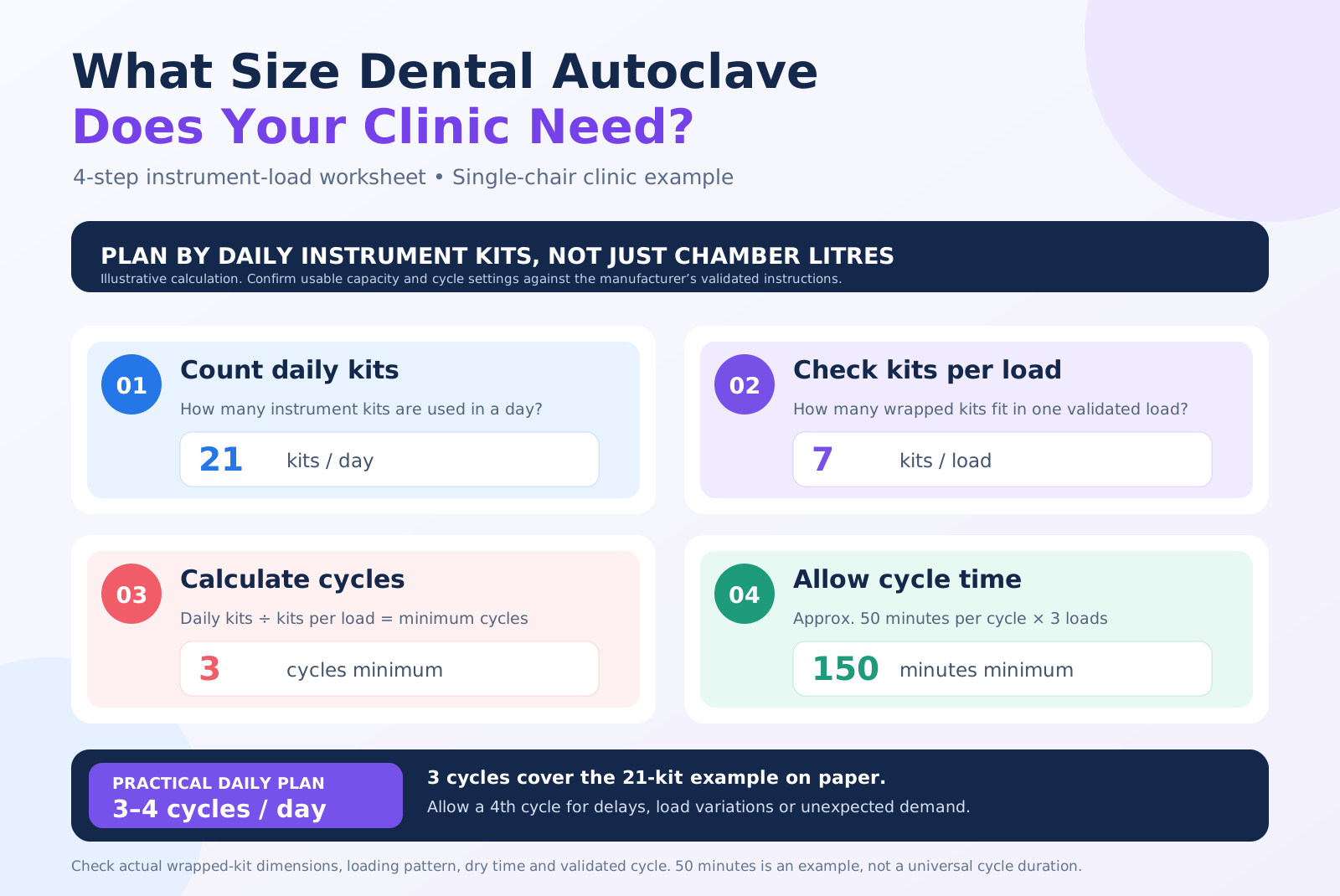
Chamber size should be decided by how many instrument kits you reprocess each day, not by guesswork. Use this four-step calculation with your own numbers.
Count kits per day. Patients per day multiplied by the average number of kits each patient uses. Include handpieces as separate items.
Find kits per load. From the manufacturer's specification, note how many pouched kits fit on the trays without overloading. Overloading blocks steam and drying.
Find cycle time. Use the full time for a wrapped Class B cycle, including drying, not just the holding time.
Check the fit. Cycles needed per day = kits per day divided by kits per load. Multiply by cycle time and compare with your working hours, leaving room for the daily test cycles.
Example scenario (illustrative numbers only):
Autoclave Capacity Planning
How Many Autoclave Cycles Does Your Clinic Need?
An illustrative comparison of daily sterilization workload for single-chair and two-chair dental clinics.
Workload Factor
Single-Chair Clinic
Two-Chair Clinic
Patients per day
14 patients
28 patients
Instrument kits per patient
1.5 kits
1.5 kits
Kits requiring reprocessing
21 kits/day
42 kits/day
Handpiece reprocessing
4 runs
Approximately 8 runs
Autoclave capacity
18 L Class B
18 L Class B
Pouched kits per load
7 kits
7 kits
Wrapped cycle duration
Approximately 50 minutes
Approximately 50 minutes
Estimated daily cycles
3–4 cycles
6–7 cycles
Estimated autoclave time
2.5–3.3 hours/day
5–5.8 hours/day
Capacity recommendation
An 18 L Class B autoclave may be sufficient with proper scheduling.
Consider a larger chamber or a second autoclave to reduce bottlenecks.
Practical Takeaway
For a single-chair clinic:
Three to four cycles per day may fit comfortably into a normal working day.
For a two-chair clinic:
Six to seven daily cycles can create scheduling pressure. A larger chamber or second sterilizer may improve throughput.
Backup advantage:
A second, smaller unit provides additional sterilization capacity when the main autoclave is undergoing maintenance or servicing.
Note: All figures are illustrative. The two-chair scenario assumes patient volume and instrument demand double. Estimated cycle counts assume handpieces can be processed within the planned loads. Actual requirements depend on instrument sizes, validated loading configurations, handpiece instructions, drying time, instrument inventory and clinic workflows. Additional loads may be necessary.
Dental autoclave buying checklist
Use these questions when comparing quotes. A good dealer will answer every one in writing.
Class and validation: Is it Class B, S or N, and against which standard? Ask for the validation or test documentation.
Cycles: Which cycles are pre-programmed (wrapped, unwrapped, prion, rapid)? What is the full time of each, including drying?
Test programmes: Does it have built-in Bowie-Dick or Helix test cycles and a vacuum leak test?
Records: Does it log cycle data by USB or printer? Paper or digital records help you prove every load was sterilized.
Water system: Does it need distilled water? Is there a separate used-water tank, and how is it drained?
Chamber and trays: Chamber size, number of trays, and how many standard pouches fit per tray.
Service: Where is the nearest service engineer? What is the response time? Are spare parts stocked in India?
Warranty and AMC: What does the warranty cover, for how long, and what does the AMC cost after that?
Installation: Power rating, space needed for ventilation, and whether staff training is included.
Building out your clinic? Sterilization keeps every visit safe. What patients remember is what they see. scanO air gives each patient an AI screening and a visual report of their own oral findings in minutes, which makes treatment conversations easier from day one.
How do you monitor a dental autoclave?
An autoclave that completes a cycle has not necessarily sterilized the load. Monitoring is what proves it. The US Centers for Disease Control and Prevention (CDC) recommends three layers of monitoring in dental settings, as set out in its best practices for sterilization monitoring:
Sterilization Quality Control
Three Types of Autoclave Monitoring
A reliable sterilization process uses mechanical, chemical and biological monitoring together.
Monitoring Type
What It Checks
How Often
01
Mechanical
Verifies the time, temperature and pressure recorded on the autoclave display or cycle printout.
Every load
02
Chemical
Uses indicators that change colour when specified sterilization process conditions are reached.
Inside every package
03
Biological
Spore test
Tests whether the sterilization cycle can inactivate highly resistant bacterial spores, providing direct evidence of sterilization effectiveness.
At least weekly
Also test every load containing an implantable device.
Important:
No single monitoring method is sufficient on its own. Mechanical readings, chemical indicators and biological testing work together to verify the sterilization process. A chemical indicator changing colour does not independently prove sterility. Follow the manufacturer's instructions and applicable infection-control protocols, including requirements for implantable-device loads.
If a spore test is positive, the CDC guidance is to take the sterilizer out of service, review how it was loaded and operated, and repeat the spore test straight away using the same cycle. If the repeat test is also positive, the unit stays out of service until it is inspected or repaired and passes further spore tests. Keep a simple logbook with the date, cycle number, operator, indicator results and any action taken.
A daily sterilization workflow for a small clinic
The autoclave is the last step of a chain. If an earlier step fails, sterilization can fail too. A practical one-way flow from dirty to clean looks like this:
Receive and hold: used instruments go to a marked dirty zone, never back to the operatory.
Clean: remove debris in an ultrasonic cleaner or washer. Steam cannot sterilize through dried blood or cement.
Rinse, dry and inspect: check hinges and tips for residue and damage.
Package: seal kits in pouches with a chemical indicator and write the date and cycle details on the pouch.
Sterilize: load trays without overcrowding and run the cycle the manufacturer specifies for that load.
Dry, check and store: confirm the indicators changed, let pouches dry fully, then store them in a clean, closed cabinet.
Waste generated during this process, such as used gloves, tubing and sharps, must be segregated into the colour-coded containers required under India's Bio-Medical Waste Management Rules, 2016. Our dental equipment list for new clinics covers the full set of sterilization equipment, including the ultrasonic cleaner, pouch sealer and waste containers.
Common dental autoclave mistakes
Buying on price alone: a low-cost gravity unit cannot reliably sterilize handpieces or wrapped kits, whatever the cycle display says.
Overloading the chamber: tightly packed trays stop steam reaching every surface and leave pouches wet.
Skipping cleaning: sterilizing dirty instruments bakes debris on and protects microorganisms underneath it.
Using tap water: scale build-up shortens the life of the machine and can cause cycle failures.
Opening the door early: wet pouches wick in contamination. Let the drying phase finish.
No records: without a logbook or cycle printouts, you cannot show that a load was sterilized if a patient or inspector asks.
Why visible infection control builds patient trust
Patients rarely see your sterilization room, but they notice its results: a sealed pouch opened in front of them, a clean operatory, and staff who explain what they are doing. Showing patients that instruments come from a sealed, dated pouch is a simple, honest way to build confidence before treatment.
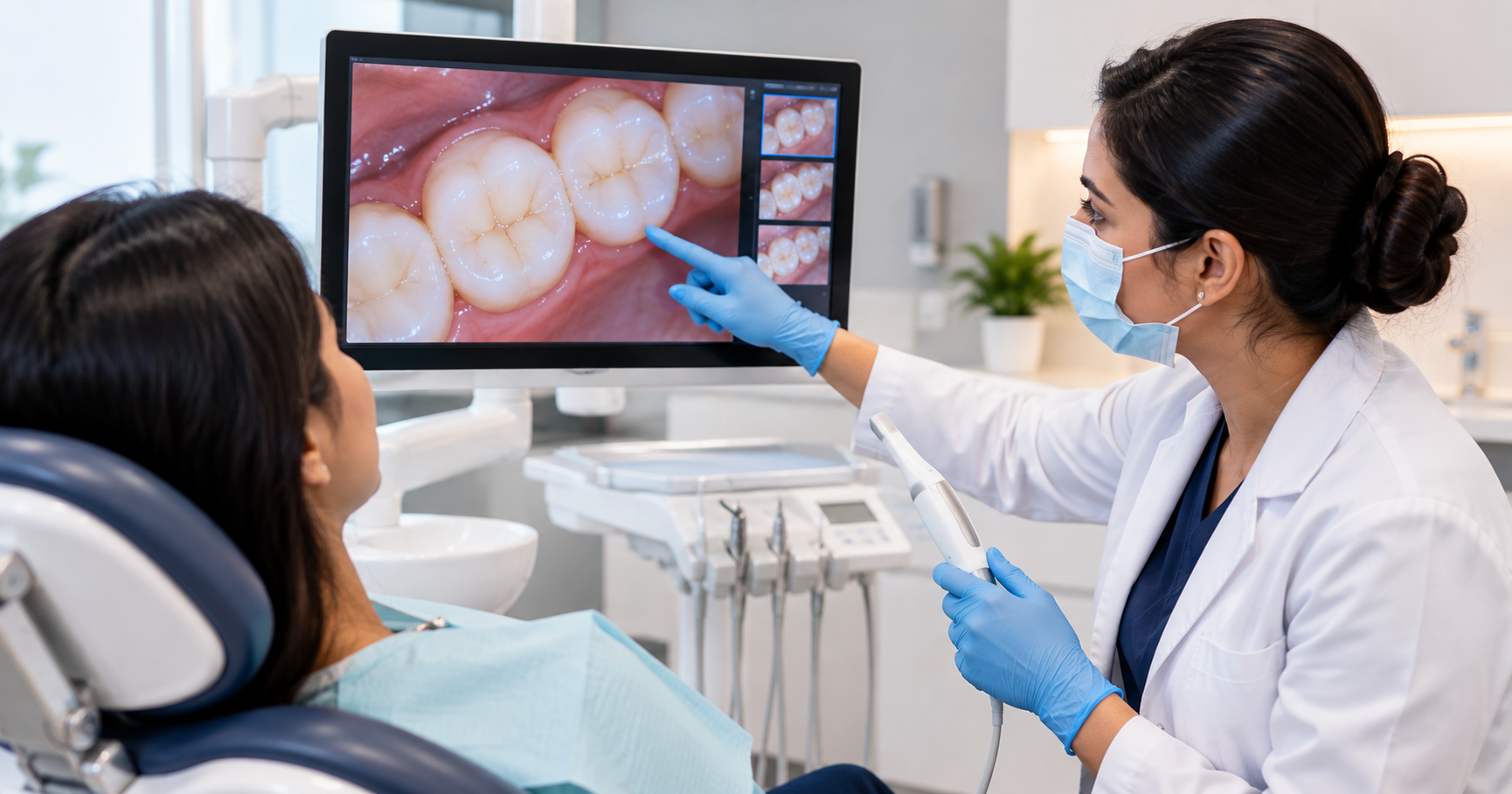
The same principle applies to the rest of the visit. Clinics that make each step visible, from sterilization to examination findings, tend to have easier conversations about treatment. Tools such as scanO air AI dental screening help here by showing patients images of their own oral findings and a clear visual summary at the start of the visit. Screening supports the conversation; diagnosis and treatment decisions stay with the dentist.
Frequently asked questions
Which class of autoclave is best for a dental clinic?
For most dental clinics, a Class B autoclave is the best choice because it is validated for wrapped, hollow and porous loads, including handpieces and pouched kits. A Class N unit only suits unwrapped solid instruments, so it works as a backup rather than a main sterilizer.
How much does a dental autoclave cost in India?
Based on Indian dealer listings in October 2026, basic top-loading units cost about ₹5,000 to ₹20,000, front-loading Class N units about ₹20,000 to ₹1.3 lakh, and front-loading Class B units about ₹75,000 to ₹1.8 lakh. Imported premium Class B models can cost ₹3 lakh or more.
What temperature does a dental autoclave use?
Dental autoclaves typically sterilize at 121°C or 134°C using saturated steam under pressure. The holding time depends on the temperature, the cycle and whether the load is wrapped, so always use the cycle the manufacturer specifies.
How often should a dental autoclave be spore tested?
The CDC recommends a biological (spore) test at least once a week, plus a spore test on every load that contains an implantable device. Mechanical checks should be done for every load and a chemical indicator used inside every package.
Can a pressure cooker type autoclave sterilize handpieces?
Not reliably. Cooker-type and other gravity autoclaves cannot consistently remove air from the narrow channels inside handpieces, so steam may not reach the inner surfaces. Use a Class B autoclave or a unit validated for hollow loads, and follow the handpiece manufacturer's reprocessing instructions.
What size autoclave does a single-chair clinic need?
Many single-chair clinics manage well with a 17 to 18 litre Class B autoclave. To check, divide the number of kits you reprocess each day by the kits that fit in one load, then multiply by the full wrapped cycle time and compare it with your clinic hours.
Next steps
Start with your load: count how many kits and handpieces you reprocess each day, decide whether you need Class B (most clinics do), and size the chamber with the calculation above. Then compare two or three written quotes on service support and running costs, not just the price. Set up a logbook and weekly spore testing from day one, so every patient gets instruments you can stand behind.
Once your sterilization setup is in place, look at the first five minutes of every patient visit. Book a free scanO air demo to see how AI screening helps patients understand their oral health and say yes to the care they need.