
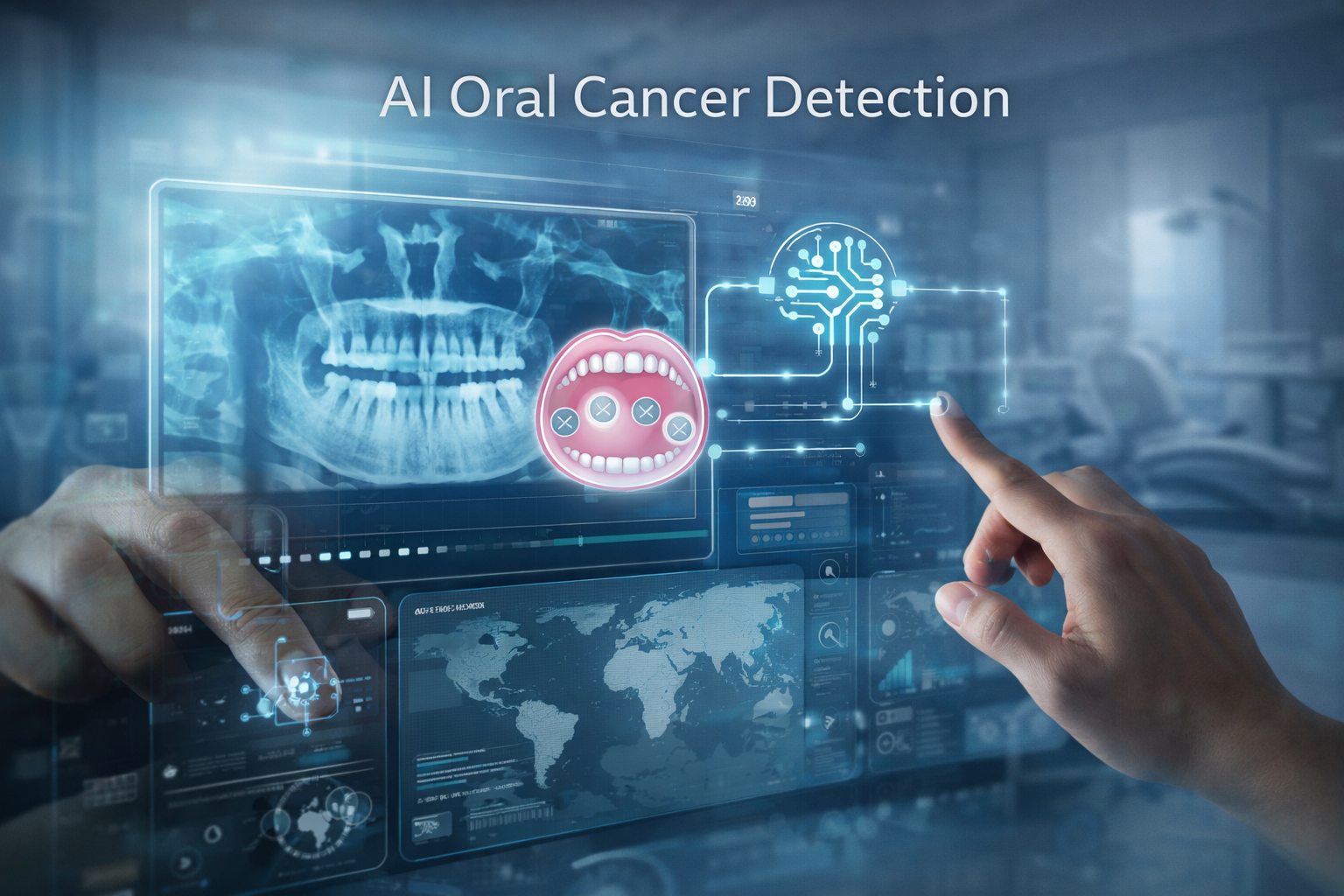
Many clinic owners still treat oral cancer screening as an occasional “clinical check.” That framing is why early lesions are missed, referrals get delayed, and documentation stays inconsistent. AI oral cancer detection is changing outcomes less by “finding magic signals” and more by making early detection repeatable, auditable, and easier to execute at scale.
Globally, cancers of the lip and oral cavity account for roughly 390,000 new cases and 188,000 deaths per year (2022). That is not a niche edge case. It is a high-stakes operational reality that shows up in general practice, especially when risk factors are common and follow-up behavior is inconsistent.
Clinics often rationalize inconsistent screening because the visible positives are infrequent. But low visible frequency does not mean low business impact.
The financial risk is asymmetric. One missed early lesion can lead to delayed diagnosis, more complex treatment, worse prognosis, and reputational consequences that travel faster than any clinical explanation. Survival also varies sharply by stage. For oral cavity and oropharyngeal cancers, localized disease has materially higher 5-year relative survival than regional or distant disease, which is exactly why “early” is the only lever that reliably changes the curve.
The implication for decision-makers is simple: if early detection depends on individual clinician vigilance alone, it will remain variable by definition.
Traditional screening is heavily dependent on three unstable factors: lighting, time, and pattern recognition under fatigue. Even highly capable clinicians will disagree on what looks “suspicious enough” on a busy day.
The gold standard for diagnosis remains biopsy with histopathology, not visual confidence. The problem is the long gap between “something looks off” and “this was verified and acted on.” That gap is where early lesions become late cases.
AI-based oral cancer screening does not remove clinical judgment. It standardizes the first step: consistent capture, consistent prompting, and consistent triage logic so fewer lesions are dismissed as “watch and wait” without structure.
Owners often attribute late diagnosis to patients waiting too long. That is sometimes true, but it is incomplete.
Evidence on diagnostic delay in oral cancer repeatedly shows multi-week to multi-month lags across pathways. A 2024 review notes average delays commonly cited around 3 to 4 months (12 to 16 weeks) in parts of the literature. Even when the first visit happens, secondary care steps, referrals, and follow-ups create additional friction.
The operational consequence is predictable: without structured tracking, “refer” becomes “lost to follow-up,” and the clinic cannot even measure the leakage.
Dental AI systems help here in a non-glamorous way: by improving documentation quality (images, lesion localization, risk flags), and by making follow-up measurable rather than assumed.
A practical way to evaluate artificial intelligence in oral cancer is to ask: does it reduce variation, and does it improve the handoff from suspicion to action?
Systematic reviews of deep learning in oral cancer report high performance in many studies, with accuracy often reported in the 85% to 100% range depending on dataset and task type. But owners should treat performance claims as conditional, not absolute:
In other words, AI accuracy in oral cancer screening matters, but workflow reliability usually matters first.
Adopting AI oral lesion detection without governance creates a different kind of risk: over-referral, under-referral, or inconsistent reliance.
High-quality reviews also emphasize limitations in study design, reporting heterogeneity, and risk of bias, which affects how confidently results translate into routine clinical use. Owners should look for evidence of external validation, clarity on intended use (screening support vs diagnosis), and auditability.
The clinic-level benefit of AI is strongest when it supports a defensible process:
That is how “AI” becomes risk reduction rather than a gadget.
Clinics that operationalize AI-based oral cancer screening treat it as an intelligence layer across the patient journey, not a standalone test.
One example is using systems like scanO Engage as operational infrastructure: integrating AI soft tissue screening into routine visits, pairing it with a dashboard for visibility, and backing it with execution tools like automated scheduling and recall, smart patient calling, digital prescriptions, and workflow management so suspicious findings turn into documented follow-up rather than good intentions.
The deeper shift is this: early detection improves when it stops being a heroic act by an individual clinician and becomes a repeatable clinic system. That is what AI oral cancer detection is really transforming.
An AI-powered co-author focused on generating data-backed insights and linguistic clarity.
Dr. Vidhi Bhanushali is the Co-Founder and Chief Dental Surgeon at scanO . A recipient of the Pierre Fauchard International Merit Award, she is a holistic dentist who believes that everyone should have access to oral healthcare, irrespective of class and geography. She strongly believes that tele-dentistry is the way to achieve that.Dr. Vidhi has also spoken at various dental colleges, addressing the dental fraternity about dental services and innovations. She is a keen researcher and has published various papers on recent advances in dentistry.