



Most practice owners assume growth is primarily a marketing problem. More leads. More patients. More chairs filled.
That logic worked when demand was the constraint. In many mature clinics, it is not.
Growth is increasingly limited by conversion, productivity, and clinical consistency. Not by footfall.
That is why Dental AI is showing up in growth conversations even when the clinic is already busy.
A full schedule creates the appearance of performance. It can also mask structural leakage.
The common leak points are predictable: inconsistent diagnosis capture, uneven case acceptance, poor recall conversion, and untracked treatment mix.
When volume rises, inefficiency compounds. Overtime increases. Clinician fatigue rises. Redo work grows quietly.
The consequence is familiar: revenue climbs while margin stays flat, or declines.
AI-driven practice intelligence changes the growth equation by shifting attention from activity to yield.
It treats growth as an output of better decisions, not just more appointments.
Most clinics believe the main growth lever is chair utilization. The hidden constraint is decision-quality across hundreds of micro-decisions every week.
What to diagnose. What to document. What to prioritize. What to follow up. What to recommend again, and when.
When those decisions are guided by memory, habit, or subjective judgment, performance becomes clinician-dependent.
That creates variability the business cannot manage.
Dental data analytics converts clinical and operational activity into comparable signals.
The consequence is simple: you stop running the clinic on anecdotes, and start managing it like a measurable system.
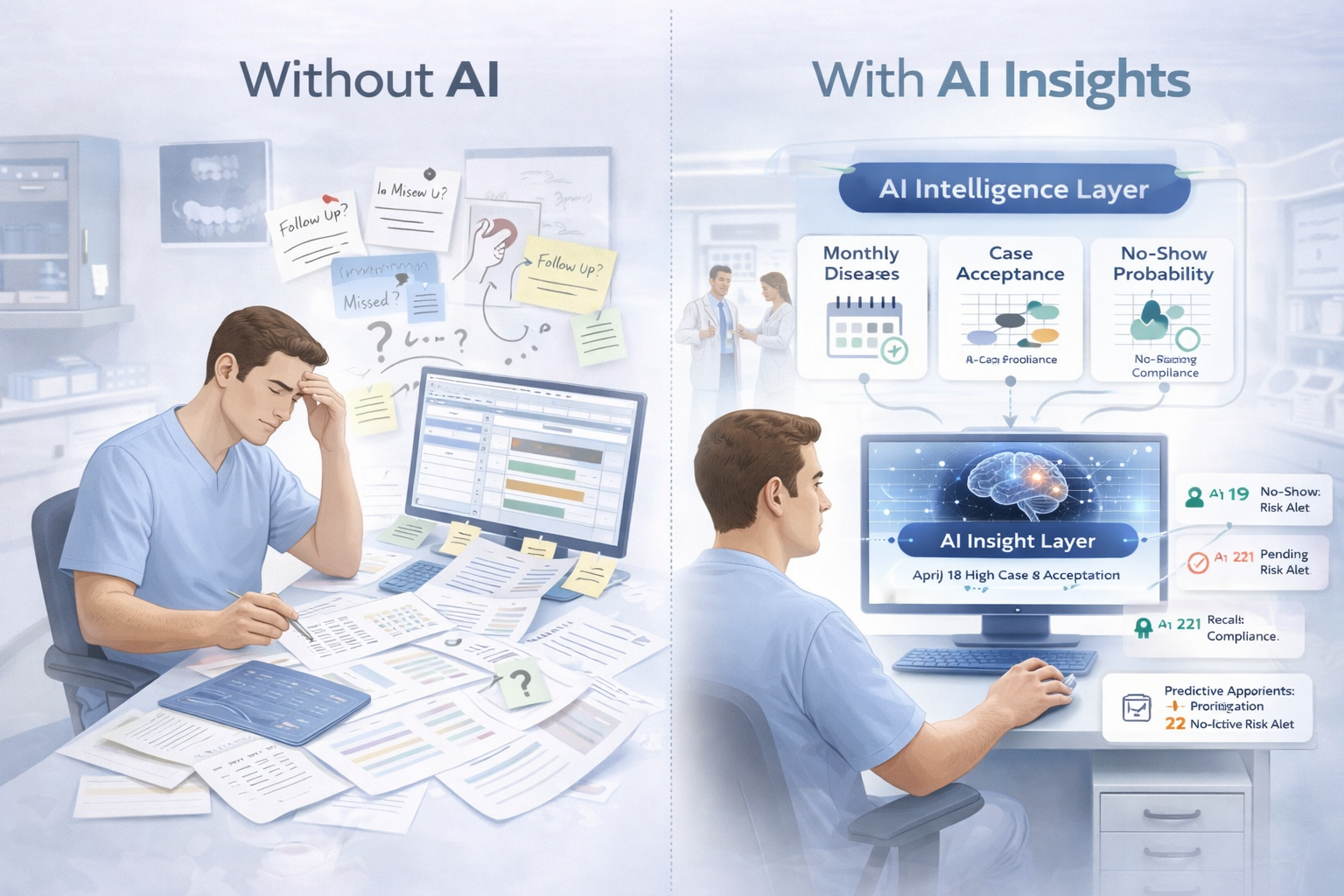
A practice can generate thousands of records and still lack visibility.
Because raw data is not management information.
Appointments, billing, prescriptions, radiographs, soft tissue observations, and treatment notes typically sit in different places, recorded in different formats, with different levels of discipline.
Even when everything is “in the software,” the owner often cannot answer basic operational questions without manual work.
How many diagnosed caries cases were untreated last month.
Which clinician’s plans convert.
Which preventive services are under-delivered relative to disease signals.
Where follow-up is failing.
This is where Data Analytics in Dentistry becomes practical rather than academic.
The consequence is time saved in decision-making, and faster correction of revenue leakage that otherwise persists for quarters.
Many clinics underestimate how sensitive profit is to small improvements in conversion and treatment mix.
A modest lift in case acceptance can outperform an expensive patient acquisition push, especially when the schedule is already tight.
Industry benchmarks vary by geography and specialty, but a commonly cited range for case acceptance sits around 30% to 60%, depending on how “proposed” and “accepted” are defined and how treatment is packaged.
Even a 5 to 10 point improvement can materially change monthly collections without adding a single new patient.
This is why AI Insights Drive Dental Practice Growth in mature practices.
It does not create demand. It improves the yield from demand you already have.
Owners often believe they understand their clinic’s disease profile because they see it daily.
But what they see is a stream of individual cases, not a distribution.
Dental Disease analytics looks at patterns: incidence, severity mix, progression risk, and treatment gaps across cohorts.
It shows, for example, whether your hygiene pipeline is aligned to actual gingival and periodontal findings, or whether restorative demand is being underdiagnosed, under documented, or poorly followed up.
When disease patterns are not measured, preventive strategy becomes generic.
The consequence is predictable: you miss predictable revenue, and you miss predictable outcomes.
Most owners attempt to solve leakage with training and tighter SOPs.
SOPs help, but they require consistent human execution.
AI for automated Dental analysis reduces reliance on perfect compliance by making insight generation systematic.
Instead of expecting staff to manually tag every case type, run reports, and chase follow-ups, the system can surface actionable exceptions.
This is not about replacing staff judgment. It is about reducing the operational tax of running a clinic through reminders and spreadsheets.
The consequence is fewer missed follow-ups, fewer revenue gaps, and less managerial time spent reconciling what happened.
Many clinics hear “predictive” and assume it requires complex models or large enterprise datasets.
In practice, Predictive Analytics in Dentistry often starts with simple, high-signal forecasting.
Given a patient’s disease indicators, past acceptance behavior, and time since last visit, what is the likelihood they will convert if contacted now.
Which patients are at higher risk of no-show or drop-off.
Which cohorts are likely to return only when symptomatic.
Even basic prediction improves prioritization.
The consequence is that your team spends effort where it actually converts, not where it feels busy.
Soft tissue screening is often treated as separate from growth discussions, as if it belongs only to clinical governance.
In reality, it affects trust, documentation quality, referral behavior, and the perceived seriousness of comprehensive care.
When soft tissue findings are inconsistently recorded, continuity breaks.
When they are recorded but not integrated into workflows, follow-up depends on memory.
When they are surfaced clearly, patients understand risk sooner, and clinicians can standardize triage pathways.
This is where Tissue AI fits operationally.
Not as a marketing feature, but as a consistency layer that reduces missed documentation and strengthens clinical defensibility.
The consequence is fewer “invisible” cases, and a more reliable standard of care that does not vary by operator or day.
Clinics often attribute low acceptance to patient affordability or awareness.
Those factors matter, but many declines are communication failures disguised as “patient behavior.”
When diagnosis is not visual, quantified, and consistent, patients default to delay.
When treatment options are not staged, patients default to confusion.
When follow-up is not systematic, patients default to inertia.
Insight-led workflows make care easier to understand and easier to act on, even if the patient is unchanged.
The consequence is improved conversion from your existing patient base, without adding volume pressure to the schedule.
The practical shift is not “use AI.”
It is to stop running the clinic on partial visibility.
When you can see disease patterns, treatment gaps, and operational bottlenecks clearly, growth becomes less about pushing harder and more about correcting leakage faster.
That is the core reason AI Insights Drive Dental Practice Growth without needing more patients.
Forward-looking clinics are increasingly closing these gaps by adopting AI-enabled practice intelligence layers such as scanO Engage, typically as an operational dashboard that connects disease-wise analysis, soft tissue screening signals, and workflow execution. Common examples include:
Used well, these systems are not “software features.”
They are the difference between a clinic that stays busy and a clinic that becomes measurably better every month.
1. How can a dental clinic boost its income without seeing more patients or staying open longer?
This question tackles the main misunderstanding the article challenges and paves the way to talk about conversion, treatment yield, and operational visibility instead of volume.
2. Why do dental clinics with lots of patients still face issues with low case acceptance and unsteady profits?
This links straight to the article's argument that high foot traffic often masks gaps in decision-making, uneven diagnosis, and missed follow-ups that hold back real growth.
3. How do dental data analytics help to improve treatment conversion and follow-through? This connects to how well-organized insights, not raw data, allow clinics to spot untreated diagnoses, stalled plans, and workflow issues that affect income without increasing demand.
4. What role does Tissue AI play in expanding a practice beyond clinical screenings? This connects Tissue AI to the article's main idea by presenting soft tissue visibility as a way to boost consistency, build trust, and improve follow-up habits rather than just a clinical safety measure.
An AI-powered co-author focused on generating data-backed insights and linguistic clarity.
Dr. Vidhi Bhanushali is the Co-Founder and Chief Dental Surgeon at scanO . A recipient of the Pierre Fauchard International Merit Award, she is a holistic dentist who believes that everyone should have access to oral healthcare, irrespective of class and geography. She strongly believes that tele-dentistry is the way to achieve that.Dr. Vidhi has also spoken at various dental colleges, addressing the dental fraternity about dental services and innovations. She is a keen researcher and has published various papers on recent advances in dentistry.