
Most dental analytics still explain the past instead of shaping the next decision
Many clinics believe they are practicing Data Analytics in Dentistry because they can generate reports on collections, procedures, and patient volumes. Those reports have value. But their value is limited by timing.
When insights arrive after appointments are completed and treatment plans are already accepted or declined, analytics becomes descriptive, not decisive. The clinic learns what happened, not what to change. The real issue is not the absence of data. It is the absence of analytics that intervene early enough to influence outcomes.
This gap is where dental AI begins to matter, not as a trend, but as a timing advantage.
A hidden problem in dental operations is not the lack of numbers. It is the lack of consistent measurement rules. Two clinicians can label the same finding differently. Two front-desk staff can close the same appointment outcome with different statuses. The result is clean-looking charts that quietly mix incomparable data.
That matters because disease, diagnosis, and treatment are not interchangeable categories. If your inputs are inconsistent, Dental Disease analytics becomes a narrative exercise, not a management tool. The consequence shows up as misleading conclusions like “caries is down” when the real issue is that documentation behavior changed, not disease incidence.
The fix is not to reduce reporting. It is to define clinic-wide measurement standards that link clinical findings to outcomes you can manage.
Many owners track revenue and collections closely but miss the operational drivers that shape them. Dentistry is high fixed-cost work. Overhead for many practices often sits in the 55 to 65% range, leaving limited room for avoidable inefficiency.
In that context, small workflow losses compound. A consistent no-show pattern, weak reactivation, or treatment plans that stall are not “admin issues.” They are margin issues. If your analytics cannot separate controllable operational leakage from uncontrollable demand variation, you will treat symptoms instead of causes.
The consequence is a clinic that feels busy, yet experiences uneven profitability because it cannot identify which processes reliably create completed care.
A common misconception is that missed appointments are just patient behavior you have to tolerate. Benchmarks suggest otherwise. Many dental settings see no-show rates commonly around the mid-teens, with some higher depending on population and scheduling practices.
If the clinic measures no-shows only as a monthly percentage, it misses the decision point: which appointment types, lead sources, time slots, and patient cohorts drive the misses. This is where AI for automated Dental analysis becomes practical rather than theoretical, because pattern detection across appointment history is difficult to do manually at scale.
The consequence of not treating no-shows as a predictable pattern is straightforward: lost chair time, schedule instability, and avoidable stress on staff who are forced into last-minute patchwork.
Clinics frequently assume treatment acceptance is mainly about how well the dentist explains. Explanation matters, but the acceptance rate behaves like a system metric, not a personality metric.
Multiple industry references place average case acceptance for general dentistry often around 50 to 60%, with variation by practice and patient type. When the clinic does not measure acceptance by procedure category, price band, clinician, and time-to-follow-up, it cannot tell whether the constraint is trust, financing, sequencing, or follow-up discipline.
This is the operational role of Predictive Analytics in Dentistry. It does not predict disease in a science-fiction sense. It predicts workflow outcomes: which treatment plans are likely to stall, which patients are likely to postpone, and which follow-up steps typically recover conversion.
The consequence of ignoring acceptance as a system is that clinics chase training and scripts while the real issue is inconsistent follow-up, unclear staging, or weak visibility into outstanding care.
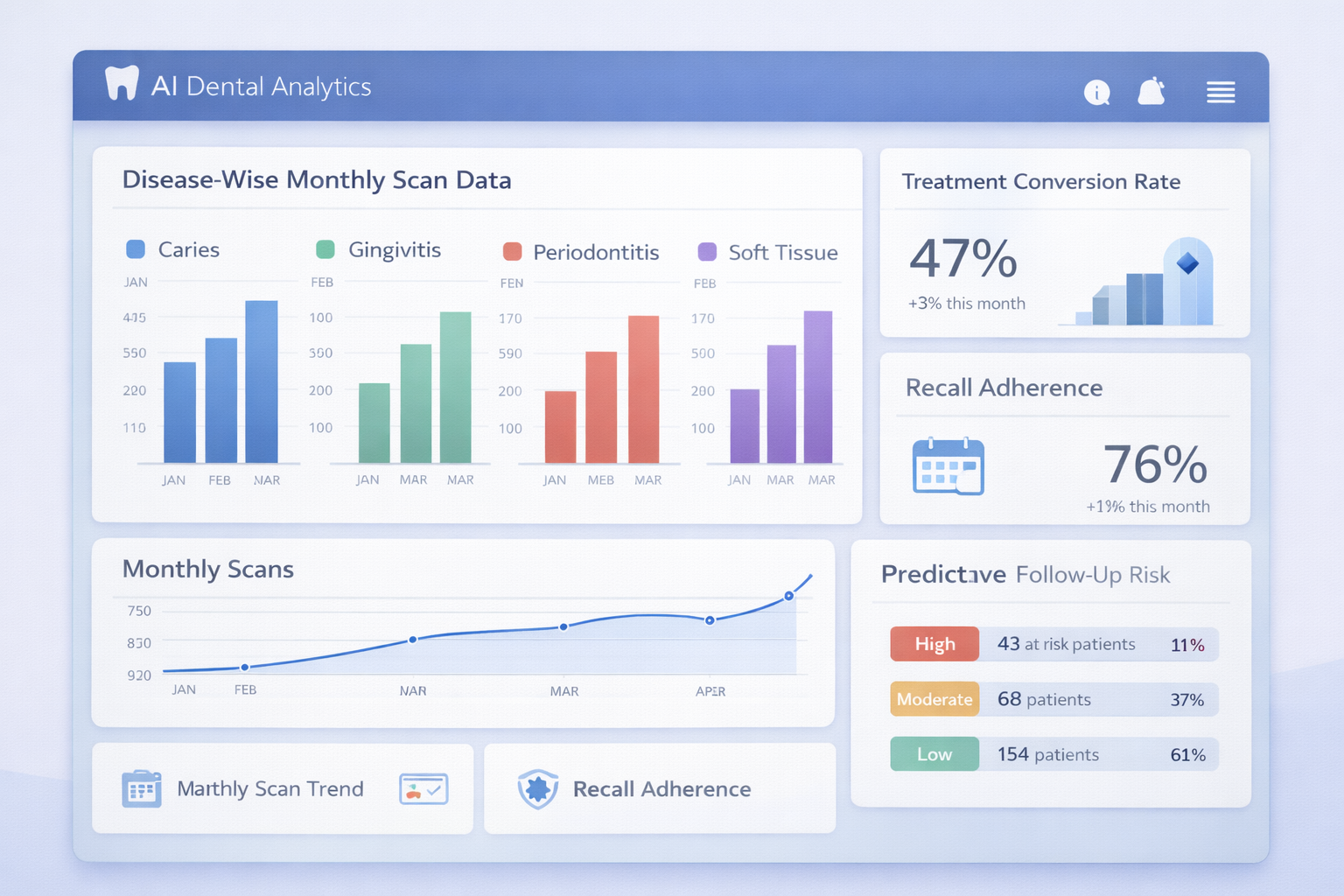
Most clinics have some idea of what they diagnose frequently. Few can quantify it in a way that supports staffing, inventory, recall, and patient education decisions.
Good Dental Disease analytics answers practical questions:
One, what is the clinic’s disease mix and how does it shift by age group, location, or acquisition channel?
Two, which diagnoses reliably convert into completed treatment, and where does the pipeline break?
Three, what is the expected future load for hygiene, restorative, perio, and prostho work based on diagnosed but incomplete treatment?
If disease analytics stays at the level of counts, it becomes trivia. When it links disease findings to treatment completion, time-to-treatment, and recall adherence, it becomes operational planning.
The consequence is significant: better scheduling templates, better delegation of clinical tasks, and fewer surprises where the clinic discovers capacity constraints only after demand materializes.
Many owners are cautious about AI because they associate it with new tools, more screens, and more work. That concern is valid when AI is implemented as another layer of reporting.
The more useful model is narrower: AI should reduce ambiguity in routine decisions. It should highlight exceptions, not flood the team with metrics. It should turn scattered signals into a short list of operational risks: patients likely to no-show, high-value plans stuck without follow-up, disease clusters increasing in a cohort, and workflow bottlenecks in billing or daily task completion.
This is the practical meaning of AI Insights Drive Dental Practice Growth. Growth is not a motivational outcome. It is what happens when visibility improves and leakage decreases across scheduling, diagnosis-to-treatment conversion, and collections.
The consequence of using AI without an operational frame is predictable: staff ignore it. The consequence of using AI as decision support is equally predictable: fewer missed opportunities that quietly accumulate every week.
The shift happening in Data Analytics in Dentistry is not about prettier reports. It is about treating the clinic like a system where clinical findings, patient behavior, and operational execution are measured together, so decisions improve before the next day begins.
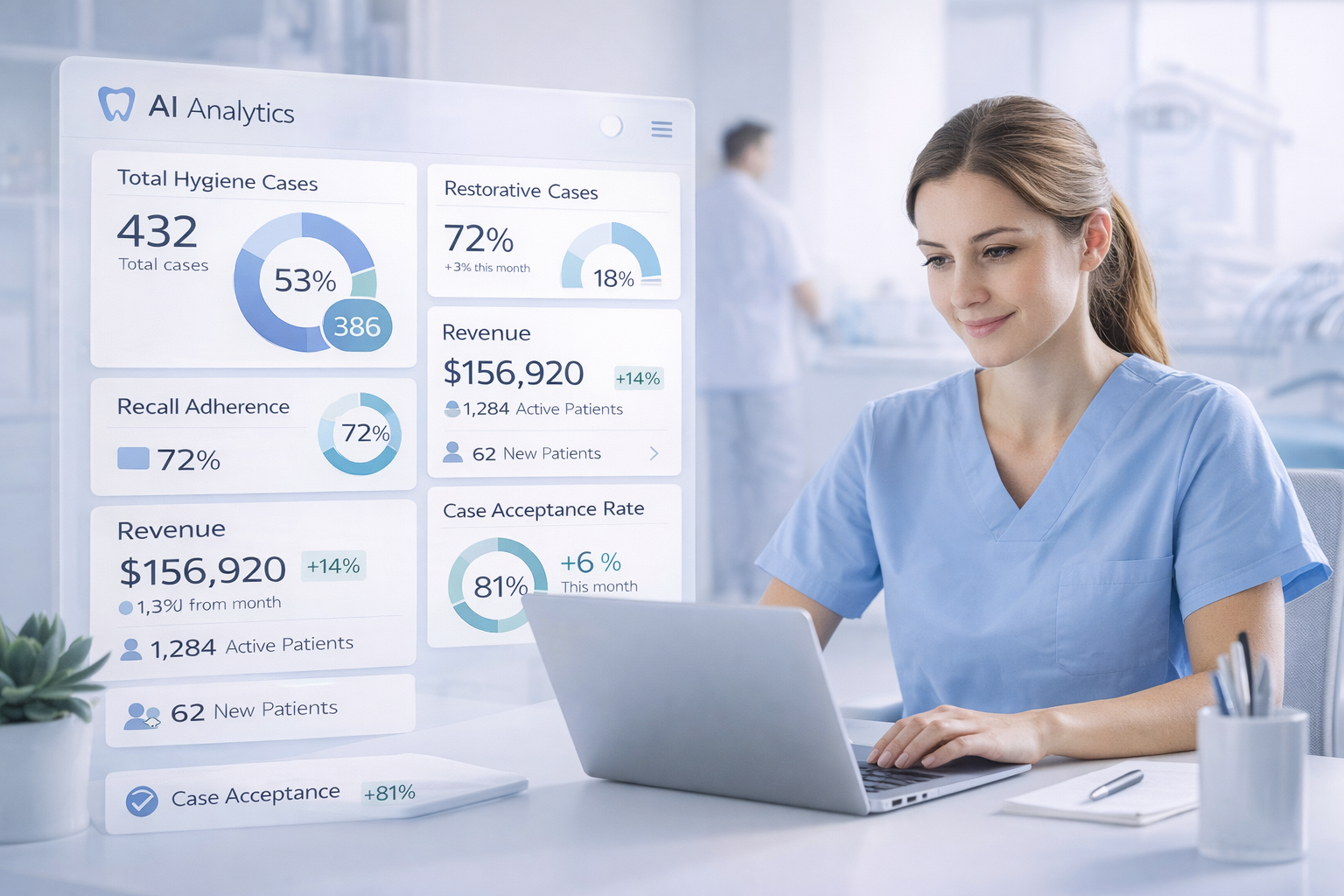
Forward-thinking practices are increasingly closing the gap with AI-enabled practice intelligence platforms like scanO Engage, used as an operational intelligence layer rather than a “feature add-on.” In practical terms, that looks like an AI-powered dashboard that gives practice visibility, disease-wise analysis tied to follow-up outcomes, and workflow support across daily task management, smart patient calling, automated appointment scheduling, digital prescriptions, and invoice and billing routines. When soft tissue screening signals and clinic operations live in the same decision environment, the clinic stops debating what happened and starts managing what is likely to happen next.
The clinics that outperform are rarely the ones with the most data. They are the ones that turn data into fewer blind spots, fewer delays, and fewer avoidable losses in the path from diagnosis to completed care.
1. How does Data Analytics in Dentistry improve a clinic beyond just making reports?
Most clinics already create reports. Data Analytics in Dentistry becomes useful when it plays a role in scheduling, follow-ups, and treatment choices before patients settle into habits. The real improvement happens when it provides earlier insights into risks, delays, or missed chances.
2. What makes dental AI different from regular dental data analytics?
Regular analytics looks at past events. Dental AI goes further by spotting trends in diseases, appointments, and how patients act. It gives clinics a clearer idea of what might happen soon helping them step in sooner rather than just reacting afterward.
3. Why do many dental clinics find it hard to use Dental Disease analytics effectively?
The issue is not with having enough disease data. The challenge comes from a missing link between early diagnosis, treatment progress, and day-to-day workflows. If analytics about diseases stays separate from scheduling, follow-ups, or billing, it stays as just information instead of becoming actionable steps.
4. How does Tissue AI help in clinical decisions without adding complexity at the dentist’s chair?
Tissue AI works well by blending into current clinical routines. It helps with early spotting and recording of soft tissue changes and adds structured insights to bigger analytics. Its main strength is how it offers consistency and early detection without extra work.
5. Can Predictive Analytics in Dentistry actually boost case acceptance and attendance?
Predictive analytics does not take the place of clinical expertise. Instead, it helps with timing. It pinpoints which patients or treatment plans might delay or skip appointments. This allows clinics to focus on follow-ups and cut down on avoidable gaps in care.
An AI-powered co-author focused on generating data-backed insights and linguistic clarity.
Dr. Vidhi Bhanushali is the Co-Founder and Chief Dental Surgeon at scanO . A recipient of the Pierre Fauchard International Merit Award, she is a holistic dentist who believes that everyone should have access to oral healthcare, irrespective of class and geography. She strongly believes that tele-dentistry is the way to achieve that.Dr. Vidhi has also spoken at various dental colleges, addressing the dental fraternity about dental services and innovations. She is a keen researcher and has published various papers on recent advances in dentistry.