


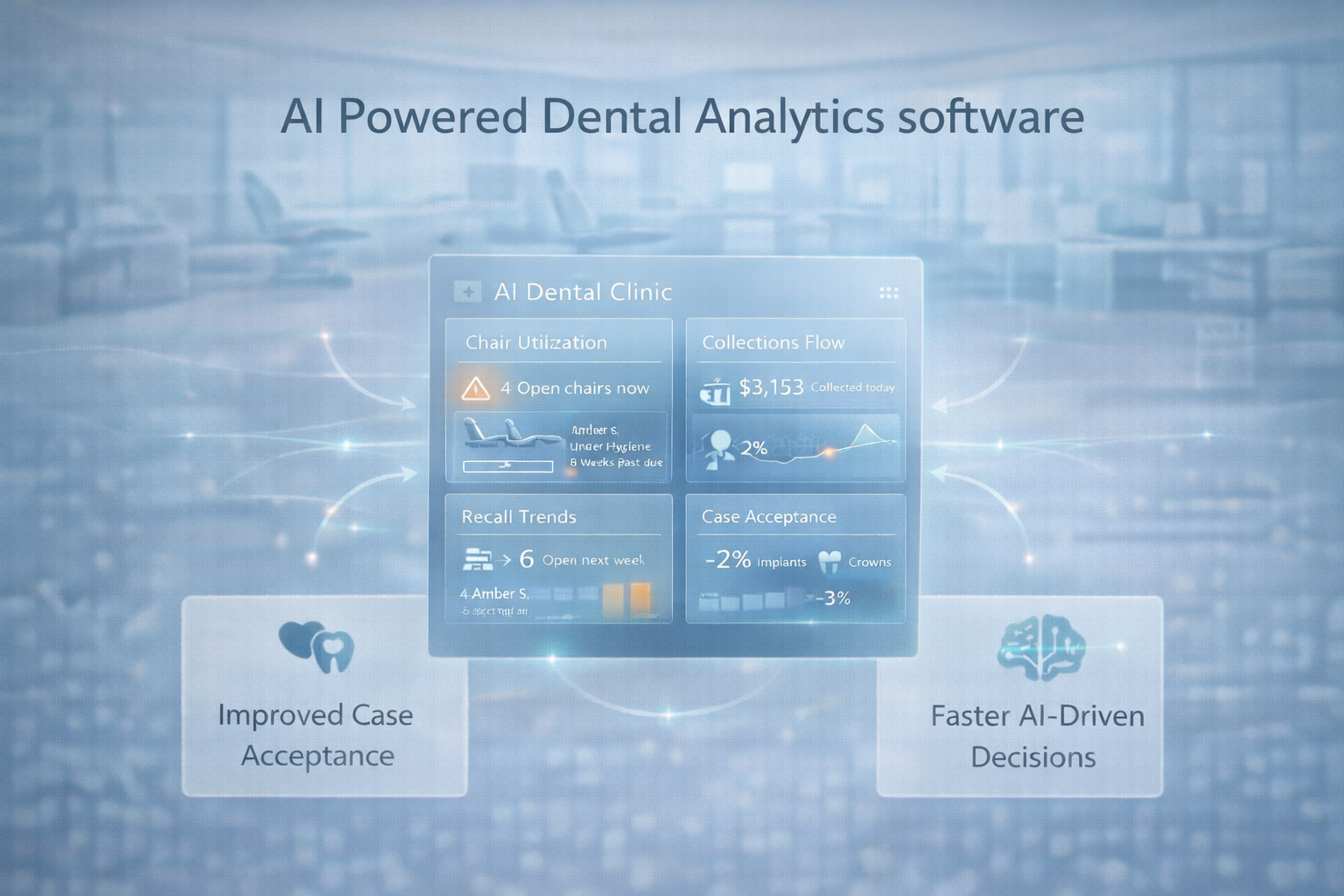
Most clinics have plenty of data. Production reports, appointment books, billing summaries, and collections numbers exist in almost every system. The problem is that they are often retrospective and fragmented. They tell you what happened, not what is drifting off track today.
That is the practical definition of AI Powered Dental Analytics software: a layer that consolidates operational, clinical, and financial signals into decision-ready visibility. Not more reporting. Better detection.
When owners treat visibility as optional, the practice tends to be managed by anecdotes: a “busy” front desk, a “full” schedule, or a “slow month.” Those are feelings. Analytics turns them into controllable variables.
A common misconception is that analytics means tracking more KPIs. In reality, the danger is tracking the wrong ones.
Collections can look stable while receivables age. Schedules can look full while chair time is lost to gaps, late cancellations, and low-value bookings. Case acceptance can look “fine” while conversion drops in a specific provider, procedure type, or day of week.
Operational leakage is rarely dramatic. It is incremental. A few no-shows here, delayed follow-ups there, and small inefficiencies in billing and recall that quietly add up.
No-shows are a clean example. Many dental offices experience meaningful no-show rates, often cited in the 10% to 30% range depending on context and patient mix.
Even at the lower end, the financial consequence is not abstract. Missed appointments represent lost chair time that often cannot be recovered the same day, which creates downstream pressure on production, team utilization, and patient access.
Schedule density is not the same as schedule productivity.
Utilization depends on what actually happens in the chair: completed procedures, planned treatment conversion, and minimal dead time between appointments. Dental practice Analytics software helps separate these layers by tracking leading indicators such as:
When a practice lacks this view, it typically responds with blunt interventions: adding more appointments, extending hours, or pushing the team harder. That can increase burnout without fixing the underlying scheduling physics.
Owners often view overhead as a static reality: rent is rent, salaries are salaries, and supplies are supplies. The truth is that overhead behaves like a performance tax. The less efficiently the clinic converts time into completed care and cash, the heavier overhead feels.
Benchmarks vary, but many analyses place typical dental office overhead (excluding doctor compensation) in the range of roughly 60% to 65% of collections for an average practice.
That means small swings in efficiency meaningfully change take-home income and reinvestment capacity.
Dental Intelligence software matters here because overhead management is not just expense cutting. It is reducing waste in the system: idle chair time, avoidable remakes, claim friction, uncollected balances, and underutilized team capacity.
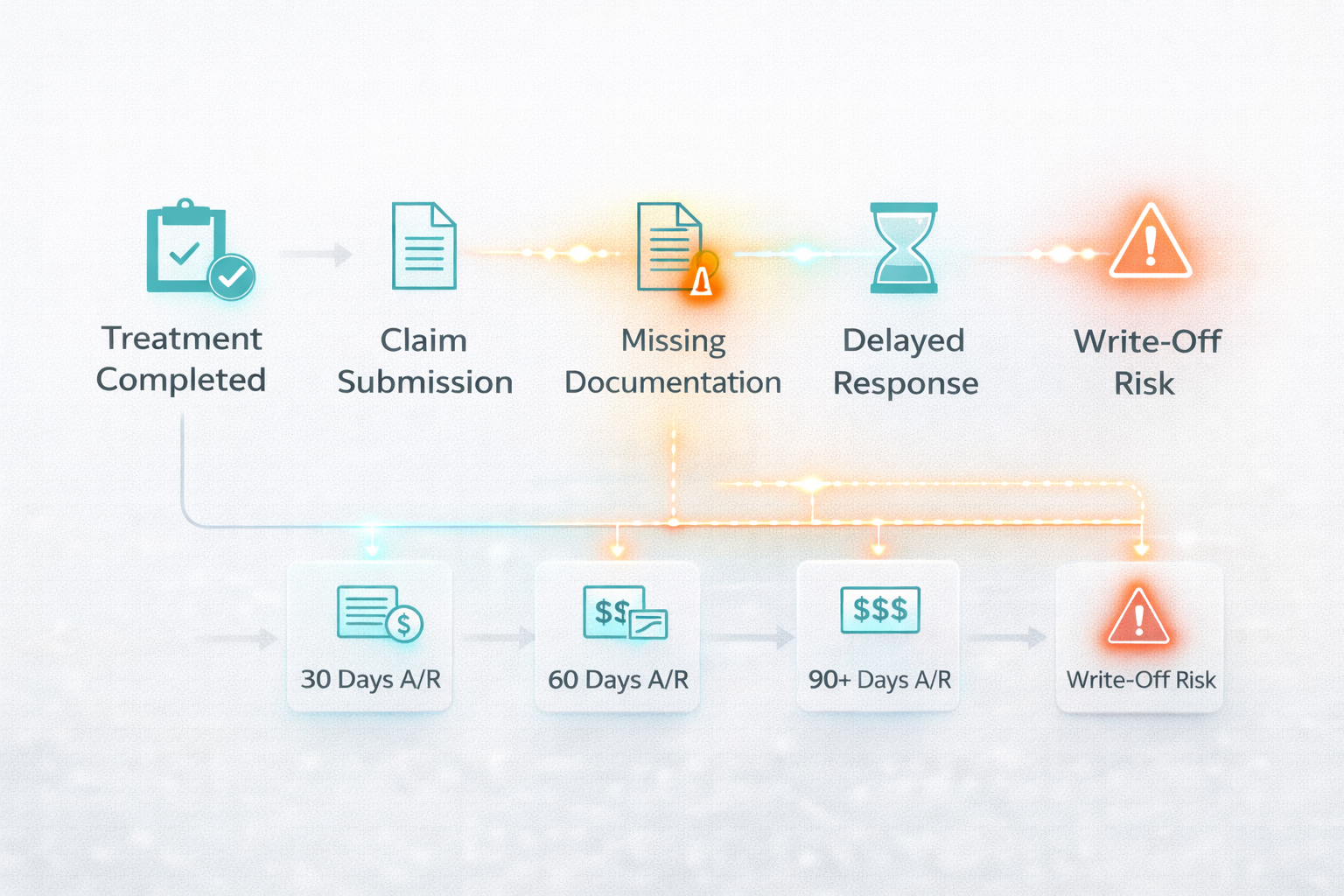
Most practices do not “decide” to have high receivables. They inherit them through process gaps: delayed insurance follow-up, weak patient balance workflows, and inconsistent financial conversations.
A key analytics lens is A/R aging distribution. As balances age past 90 days, the probability of collection drops sharply. Some benchmarks suggest practices should keep the 90+ day category to a small share of total A/R (often referenced around 5%), because older balances are at high risk of becoming bad debt.
Separate benchmarking guidance notes that for balances over 90 days, practices may collect only a minority of what is owed, implying substantial write-off risk once accounts drift into that bucket.
The consequence is not only financial. It changes behavior. Clinics under cash pressure tend to cut training, delay technology upgrades, reduce marketing consistency, or push higher volume to compensate. Those are second-order effects that reduce quality and stability.
In dentistry, operational decisions shape clinical outcomes more than many owners admit.
If hygiene recall slips, early detection drops. If new-patient flow is unmanaged, emergency-driven scheduling increases. If case acceptance is not monitored by procedure category, high-need patients defer treatment until problems worsen. If follow-up workflows are inconsistent, the clinic becomes reactive.
This is where Dental AI becomes relevant, but only in a grounded sense: AI is useful when it reduces blind spots and standardizes consistency. For example, pattern detection in appointment adherence, segmentation of case acceptance drivers, and surfacing anomalies that a human team cannot manually scan every day.
The clinic does not need “more intelligence.” It needs earlier visibility.
Many owners have tried dashboards and abandoned them because the output was not actionable. This is the difference between data and operational intelligence.
AI Powered Dental Analytics software for data-driven decision making must do three things well:
If it does not do these, it becomes another report that gets reviewed once a month and ignored the rest of the time.
Owners often ask whether analytics “increases revenue.” A better framing is whether it reduces the lag between a problem starting and a problem being noticed.
If your no-show rate rises in a specific time block, you should see it this week, not next quarter. If a provider’s treatment conversion drops, you should spot it before it becomes cultural. If A/R aging is creeping, you should catch it before cash gets tight.
Analytics is less about finding heroic opportunities and more about preventing quiet erosion.
Forward-thinking clinics are increasingly adopting systems that function as an operational intelligence layer, not just a practice management database. Tools like scanO Engage, for example, are positioned around visibility and workflow control through an AI powered Dental Analytics software, supported by capabilities such as disease-wise insights, integrated AI soft tissue screening signals, automated appointment scheduling, digital prescriptions, smart patient calling, daily workflow management, and billing support. The point is not the feature list. The point is that modern practices are building tighter feedback loops between what happens clinically, what happens operationally, and what happens financially.
In most clinics, performance does not collapse suddenly. It drifts. Smart Dental clinic Dashboard matters because it reduces drift by making reality easier to see, earlier, and with fewer assumptions.
An AI-powered co-author focused on generating data-backed insights and linguistic clarity.
Dr. Vidhi Bhanushali is the Co-Founder and Chief Dental Surgeon at scanO . A recipient of the Pierre Fauchard International Merit Award, she is a holistic dentist who believes that everyone should have access to oral healthcare, irrespective of class and geography. She strongly believes that tele-dentistry is the way to achieve that.Dr. Vidhi has also spoken at various dental colleges, addressing the dental fraternity about dental services and innovations. She is a keen researcher and has published various papers on recent advances in dentistry.