

.png)
In today's fast-moving dental landscape, consideration is given to every way in which clinic owners and dentists can provide better, efficient care. AI is no longer a topic of science fiction but is very actively playing a role in reshaping diagnostics and reporting. The best AI dental software improves patient communication, streamlines workflows, produces structured reports, and assists dentists in more accurate image analysis.
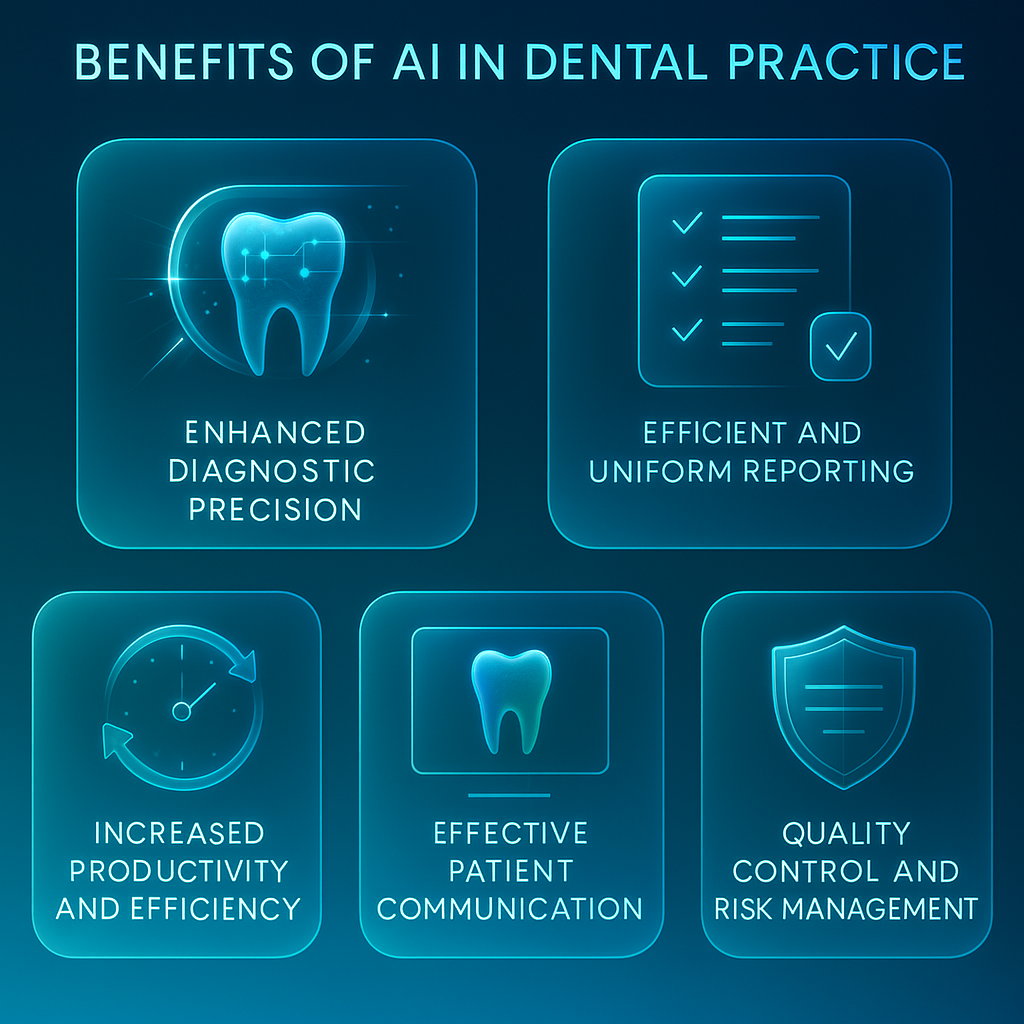
The main strength of the best AI dental software is the precise interpretation of dental images, including X-rays, bitewings, and CBCT scans.
Early caries detection: AI algorithms, trained on a large number of bitewing radiographs, identify subtle caries that may even be missed by experienced dentists.
Panoramic X-ray interpretation: Diagnocat and similar systems scan panoramic views to indicate pathologies in the full arch, thereby increasing diagnostic coverage.
Structured summaries: To give a brief but accurate overview, AI can automatically generate structured findings that list the treated teeth, restorations, and other anomalies.
AI's early detection reduces chair time, allows for prompt intervention, and improves long-term patient outcomes.
Beyond detection, AI enhances reporting by making it consistent, structured, and clinically actionable.
Overjet uses color-coded overlays on X-rays to identify cavities, bone loss, and the proximity of nerves. This clarity works for both the dentist and the patient.
Structured reports: Diagnocat provides reports on dozens of 2D and 3D pathologies, in order to assist users with confident treatment planning.
Automated Documentation: scanO Engage, our proprietary software, generates comprehensive patient reports from images and voice-assisted inputs, reducing manual charting errors while saving considerable chairside time.
AI-powered structured reporting helps a clinic uphold high standards, enhance patient reproducibility, and improve communication.
It improves diagnostics, increasing their speed and precision.
Faster image review: AI can identify issues with an image in a matter of seconds. AI can reduce diagnostic time by more than 30%, according to numerous studies.
Automated administrative support tailored to a particular area of expertise: AI-driven scheduling, EMR updates, and reminders allow staff members to spend time with patients.
Practice-wide viewpoints: Clinic owners can spot trends, improve staffing, and track treatment acceptance with AI dashboards that collect patient and treatment data.
These upgrades increase the clinic's efficiency, freeing up dentists to concentrate on patient care rather than paperwork.
Diagnostics are only impactful if patients understand and trust them. The best AI dental software makes communication clearer and more persuasive.
Patient-friendly visuals: Colour-coded overlays, such as those found in scanO Engage or Overjet, help patients better understand the locations of cavities, bone loss, and other problems.
Objective second opinions: These AI tools can serve as a second set of eyes to reassure patients and validate findings.
Customised reporting: scanO Engage produces reports with recommendations tailored to each patient, which facilitates the explanation of treatment options and raises acceptance rates.
AI helps bridge clinical findings with patient comprehension and trust, leading to better and more accepted treatments.
AI also fortifies clinical quality, reducing errors.
Error reduction: Even experienced dentists can miss very minor disease signs. AI offers non-biased, consistent analyses to find issues that were missed.
Benchmarking Performance: Analytics from AI reports highlight trends, discrepancies, and staff performance-together providing more focused training and refinement of protocols.
Regulatory support: The majority of AI solutions include compliance-ready documentation right out of the box, which makes audits easier and reduces liability risks.
It guarantees operational transparency and clinical safety in any dental office.
An outline of the most popular AI tools in modern dentistry is provided below:
scanO Engage: X-rays, panoramic photos, and CBCT scans are scanned by the AI dental software, which generates structured reports with easily comprehensible graphics for the patient. Voice-assisted charting and auto-alerts for important discoveries are features of this AI solution.
Overjet: FDA-cleared X-ray analysis with visual overlays that improve accuracy and communication.
Diagnocat reads 2D or 3D scans and identifies multiple pathologies, generating structured reports.
Denti.AI: Automates charting, transcription, and image-based diagnostics, reducing manual documentation.
DentalMonitoring: The remote monitoring platform helps monitor tooth movement and gingival changes from patient-submitted scans.
EasyClinic (India): AI-driven EMR, appointment scheduling, predictive insights, and inventory management in one platform.
These examples illustrate how the Top AI dental software is practical, widely deployable, and designed to improve clinical and operational performance.
Although the advantages are great in magnitude, limitations need to be considered in clinics:
False positives: AI could indicate potential issues that are not clinically significant. Human judgment remains important.
Integration challenges: AI should be easily integrated with the imaging systems as well as practice management software.
Cost: Licensing fees and training can be substantial. Return on investment also depends upon the volume of patients or the efficiency of adoption.
Data Privacy: Information regarding a patient must be kept safe, especially when cloud-based AI solutions are concerned.
Validating life can be a little different from research conditions; thus, pilot testing is advised. Addressing these considerations assures that AI adoption adds value, not risk.
The future of AI in Dentistry is very bright:
Multimodal AI: Integration of Imaging with Patient Data for Context-Aware Diagnostics. Continuous learning: AI systems improve over time based on anonymized data coming from your practice.
Integration of tele-dentistry: remote AI monitoring platforms extend care beyond the clinic. Improved patient engagement: AI reports and their visualization will only further enhance patient comprehension and acceptance of treatment.
As AI technology continuously improves, dental clinics with the best AI dental software can realize some key advantages in terms of accuracy and efficiency, patient trust, operational transparency, and increased practice growth.
Choosing the top AI dental software will completely change how your clinic views reporting and diagnostics. AI is a vital component of contemporary dentistry, whether it is used to improve patient communication, streamline reporting, increase efficiency, or improve diagnostic accuracy. scanO Engage and other proprietary tools are leading the way in demonstrating that AI is not merely a theoretical idea but rather a clinically useful tool for more intelligent, quicker, and dependable patient care.
For results validation, AI tools can be tested in parallel with the current workflows used by dentists and clinic owners, progressively incorporating those applications that will optimize benefits. When applied properly, AI can help your practice provide consistent, excellent care while allowing your staff to concentrate on what really counts: your patients.