

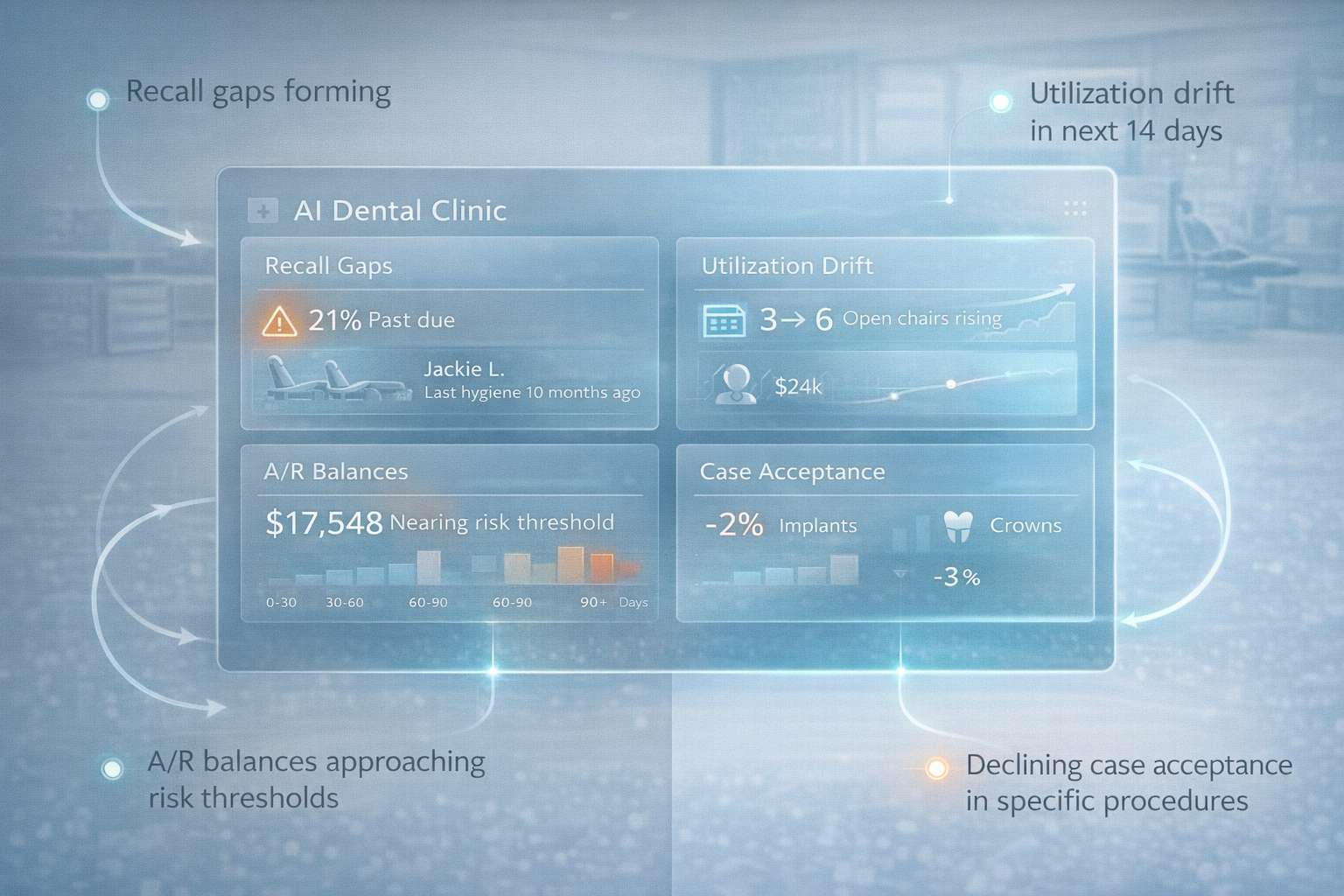
Most dental clinics do not struggle because they lack effort. They struggle because they run on partial visibility. When decisions are made from schedules, collections totals, and busy staff activity, performance can look stable while leaks quietly grow underneath.
This is where dental data analytics software becomes an operational advantage. Not because it “adds data,” but because it turns the data you already generate into signals that show what is truly happening in the business.
Below are five benefits that matter to clinic owners and decision makers, explained through practical cause and effect.
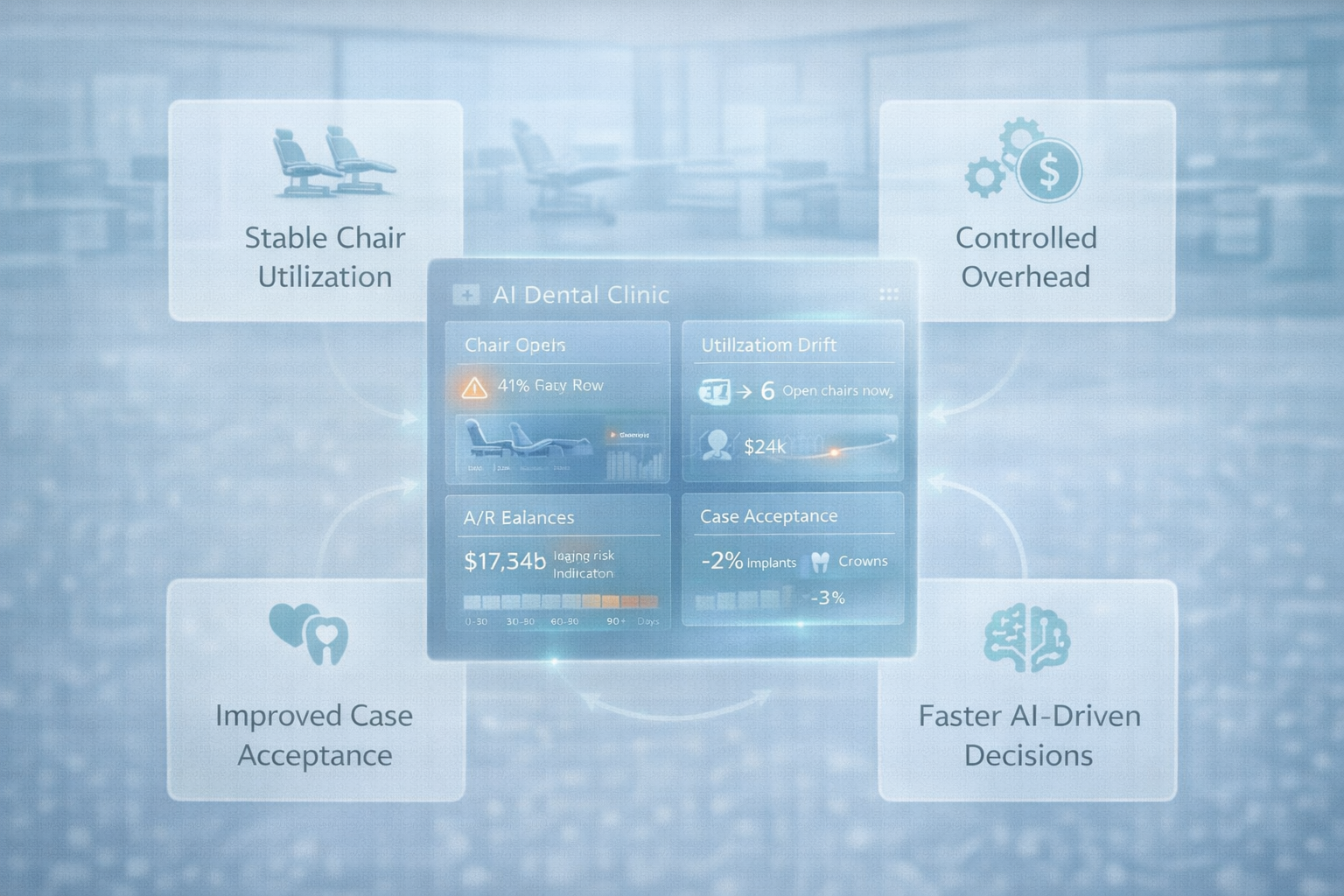
A full book can hide unstable utilization. Many clinics lose production through short-notice cancellations, no-shows, and poorly matched appointment lengths. The calendar stays visually full, but chair time is not fully monetized.
Industry sources commonly cite dental no-show rates around 15%, with some practices experiencing 30% in certain contexts. Even conservative no-show levels create a compounding loss because the cost base remains fixed while output drops.
Analytics changes the problem from “no-shows happen” to “no-shows have patterns.” The clinic can see:
The consequence is structural. With visibility, scheduling becomes a capacity management system, not a calendar. That is what enables predictable daily production rather than optimistic planning.
Many owners accept overhead as a fixed reality, then focus only on top-line revenue. But dental overhead commonly sits in the 60% to 65% range in industry benchmarking discussions. When overhead is that high, small operational leaks can disproportionately reduce take-home income.
This is why Dental practice analytics software is valuable. It does not “reduce overhead” directly. It identifies which operational drivers are inflating it, such as:
When a clinic sees cost drivers tied to specific workflow points, it can decide what to standardize and what to stop doing manually. The benefit is not theory. It is margin defense in a high-fixed-cost business.
Revenue is not the same as cashflow. A clinic can produce well while silently building a collections problem through aging receivables, delayed claim follow-ups, and inconsistent financial policies.
A key reality is that collectability drops sharply as balances age. Some benchmarking guidance notes that for balances over 90 days past due, practices may collect only 15% to 25% of those amounts. Other operational guidance suggests keeping the 90+ day bucket to a small portion of total A/R, often framed around 5% as a threshold.
Dental data analytics software for data-driven decision making creates two advantages:
The consequence is that collections become proactive. Instead of reacting to aged accounts, the clinic fixes upstream process breaks while the money is still recoverable.
Case acceptance is often framed as chairside communication alone. Communication matters, but the clinic’s system matters too. Patients say “not now” for many operational reasons: unclear sequencing, confusing estimates, inconsistent follow-up, or lack of visual clarity.
Benchmarks vary by source and market, but published industry references frequently place average case acceptance around 50% to 60%, with higher-performing practices pushing 70% to 80% or more.
Analytics shifts the conversation from “our team needs to explain better” to “where is acceptance breaking down in our process?” For example:
The benefit is management leverage. When you can pinpoint where acceptance falls, you can fix the operational bottleneck rather than blaming individual performance.
Many owners treat Dental AI as a clinical add-on. But in a modern practice, AI’s most durable value is often operational. It can reduce the time between “something is happening” and “we know what it is and what to do next.”
This is where Dental AI and analytics converge:
The benefit is not futuristic. It is faster decision cycles and more consistent execution across staff and locations. In business terms, it reduces variance. Variance is what makes outcomes unpredictable even when effort stays high.
Most clinics do not need more activity. They need clearer signals about what is working, what is leaking, and what is silently becoming expensive. That is the practical case for dental data analytics software: it converts operational complexity into manageable visibility, so decisions become less reactive and more repeatable.
Forward-thinking practices are increasingly closing these gaps with integrated systems like scanO Engage, used as an operational intelligence layer: an AI-powered dashboard for practice visibility, disease-wise insights, automated appointment scheduling, digital prescriptions, smart patient calling, daily workflow management, plus invoice and billing support. The point is not “more software.” The point is fewer blind spots where performance quietly slips.
In dentistry, results rarely collapse overnight. They drift. Analytics helps you see drift early enough to correct it while the clinic still feels “busy.”
An AI-powered co-author focused on generating data-backed insights and linguistic clarity.
Dr. Vidhi Bhanushali is the Co-Founder and Chief Dental Surgeon at scanO . A recipient of the Pierre Fauchard International Merit Award, she is a holistic dentist who believes that everyone should have access to oral healthcare, irrespective of class and geography. She strongly believes that tele-dentistry is the way to achieve that.Dr. Vidhi has also spoken at various dental colleges, addressing the dental fraternity about dental services and innovations. She is a keen researcher and has published various papers on recent advances in dentistry.