


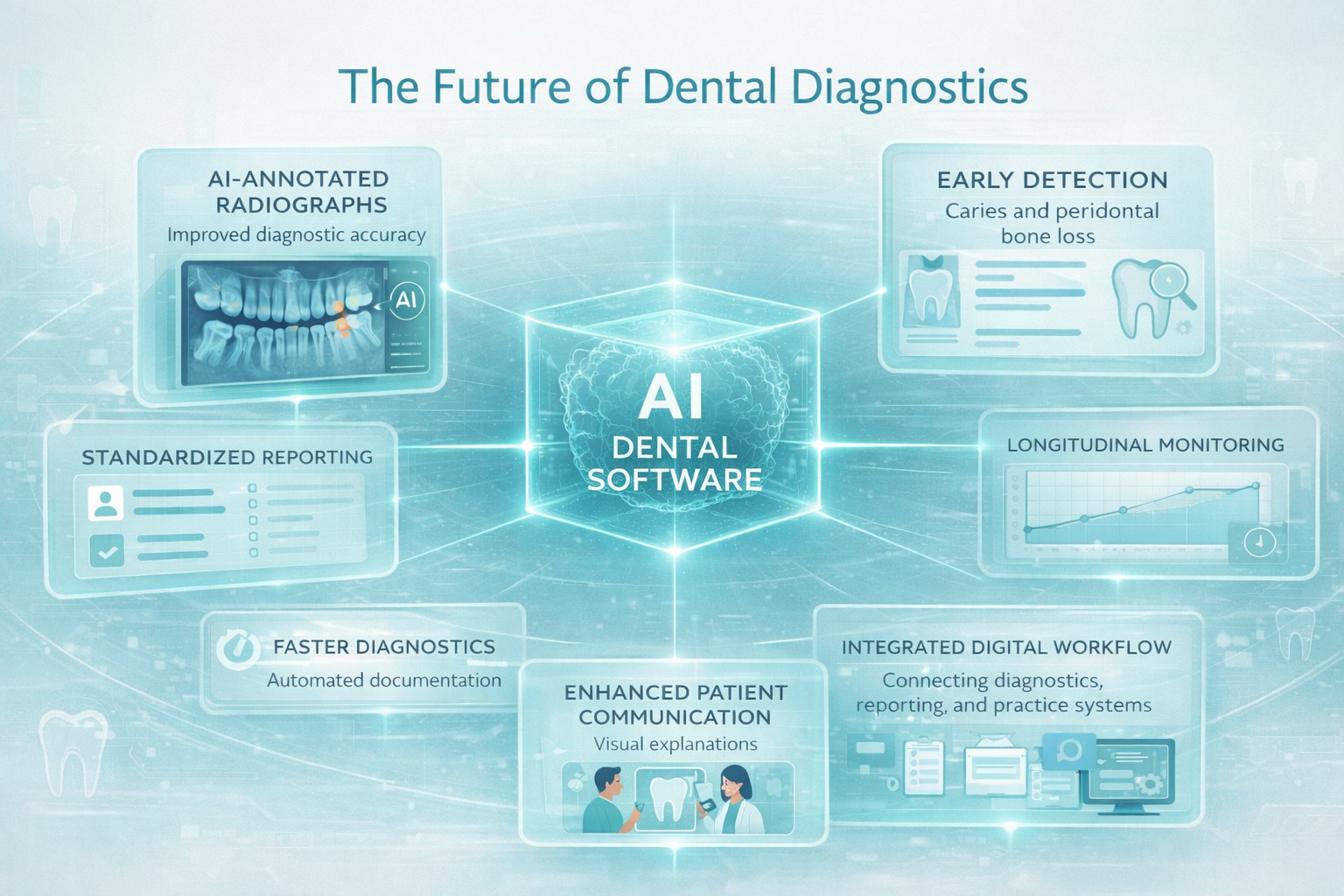
In dentistry, artificial intelligence does not belong in the realm of the future anymore. For a number of years now, AI in dentistry has been discreetly integrated into a very functional tool in the profession. AI dental software can nowadays be observed in modern dental facilities in the dental industry that help with diagnosis, accuracy in report writing, as well as smooth running in a dental practice. Furthermore, AI would not replace a dentist in a dental practice. AI assists dentists in being consistent in a dental practice.
Diagnosis and reporting are among the most critical phases of dental practices. Inconsistency, incongruity, and any kind of delay in this stage can have a direct impact on dental planning and a lasting impact on dental results, and, more importantly, on building trust with patients. The conventional method of diagnosis relies entirely on personal discretion, which, owing to its subjective nature, should logically change with experience, workload, and timing constraints.
The following seven points define how the AI dental software enhances the diagnosis and reporting of results in a dental clinic.
Radiographic analysis is a fundamental step in dental diagnostics, and, at the same time, one of the most error-susceptible steps. These are conditions that can easily be overlooked, particularly when working in a busy dental office setting. The AI dental solution evaluates intraoral radiographs, panoramic radiographs, and CBCT studies based upon sophisticated algorithms trained on large databases of labeled examples of disease and non-disease patterns associated with dental problems that often go unnoticed by dental professionals.
It assists in the following by making use of artificial
However, the risk of misses being overlooked is eliminated by the use of AI to point to areas of concern on the images. The final diagnosis is still made by the dentist, but the additional check ensures that consistency and accuracy are maintained.
Early detection remains an essential component of preventive dental care. Most of the diseases and conditions affecting the dentition and the periodontium tend to progress slowly and asymptomatically; hence, radiographic indicators of changes tend to be easily missed during observation. AI dental software has proven useful for their ability to pick up subtle changes which may not easily be noticeable during observation. When it comes to evaluation of periodontal status, AI software measures bone levels and percentages of bone loss and allows comparison of results over several observation visits.
In caries, AI detects early involvement of enamel and dentin before the formation of a caries lesion/cavity. Early detection of the caries lesion means the lesion/cavity could be addressed by preventive/ minimal therapies to treat the dental problem. Early caries lesion/cavity detection is a means of improving the prognosis of dental treatments/operations.
The variation in the type of diagnoses entered into practice systems is an old issue in dentistry. Various practitioners are known to use different terms to describe the same diagnosis. The use of different terms to detail diagnoses may pose difficulties, generated by the aspect of having several dentists to handle the same patients. The AI in dentistry application offers the aspect of standardized diagnoses to avoid the above challenge. The diagnoses are documented in standardized terms.
Standardized reporting is most beneficial for:
Uniform documentation helps ensure better communication between healthcare professionals. In addition, it also assists in creating medico-legal documents as well as audits.
The process of manual diagnosis takes some time and adds to the administrative burden of the clinical professionals as well. The process of note-writing, radiograph annotation, and preparing diagnosis reports adds to the list of activities that hamper the efficiency of clinics by reducing the interaction time of professionals with patients. AI dental software has the benefit of automating most of this process for dental clinics.
This results in less delay when reporting to the dentist and overall efficient use of clinic time. By reducing the need to repeat administrative task cycles manually, AI helps the dentist dedicate more time to decision-making as well as engagement with the patient. This eventually translates to less fatigue as well.
Patient understanding plays an important role in treatment acceptance. Most patients have difficulty visualizing clinical explanations that are purely verbal. AI dental software enhances communication through the presentation of diagnostic findings in a visual and organized manner. Annotated radiographs, highlighted problem areas, and structured reports assist the patient in clearly seeing what is happening.
When patients can see for themselves where the problems lie, how a condition is developing, and why certain treatment is indicated, trust rises. This clarity underpins informed consent and shared decision-making. Clinics using AI-assisted diagnostics often experience increased rate of acceptance for restorative, periodontal, and surgical treatments.
The traditional diagnosis can only represent and signify the current status of a patient’s dental condition at a given point in time, whereas the AI dental software has the potential of detecting improvements and developments in a patient’s dental condition based on a series of diagnoses performed during a series of office visits.
This becomes especially crucial for:
The objective data enables the healthcare provider to assess the effectiveness of the treatment methods adopted and thereby make provisions for future developments. It also enables the healthcare provider to motivate patients through graphical representation.
The goal of modern AI software for dentists is its perfect integration with practice management software. The functionality of diagnostics, reporting, treatment planning, and communication with patients is merged into a computer system. Thus, duplication and errors while preparing documents and bugs while opening diagnostics results will be eliminated.
These may also facilitate remote viewing of the information related to the diagnosis, such that the healthcare provider professionals would be able to access this information remotely in case the need arises. ScanO Engage is one such solution offering patient engagement services.
It will not only improve the diagnosis, but there can be benefits resulting from the AI dental software. There could be an improved efficiency in the dental practice, quality documentation, and patient satisfaction with the use of the software. There is also a possibility that the doctor may be more confident with heightened consistency in diagnoses and reduced variability among healthcare professionals.
It does not replace knowledge. Dentists will be the only ones responsible for diagnosis and treatment. It can assist in these two aspects with more precision and elucidation.
The AI dental software technology has the capacity to improve the diagnosis and reporting services by emphasizing accuracy, standardization, efficiency, and communication with patients. The complexity of patients in the medical field means that the application of AI diagnosis facilities will become more prominent in the dental field. Dental services with the application of AI diagnosis technology possess the requisite potential to deliver dental services of high standard. The dental field has the future of utilizing human expertise and AI technology for effective decision-making and communication with patients.