
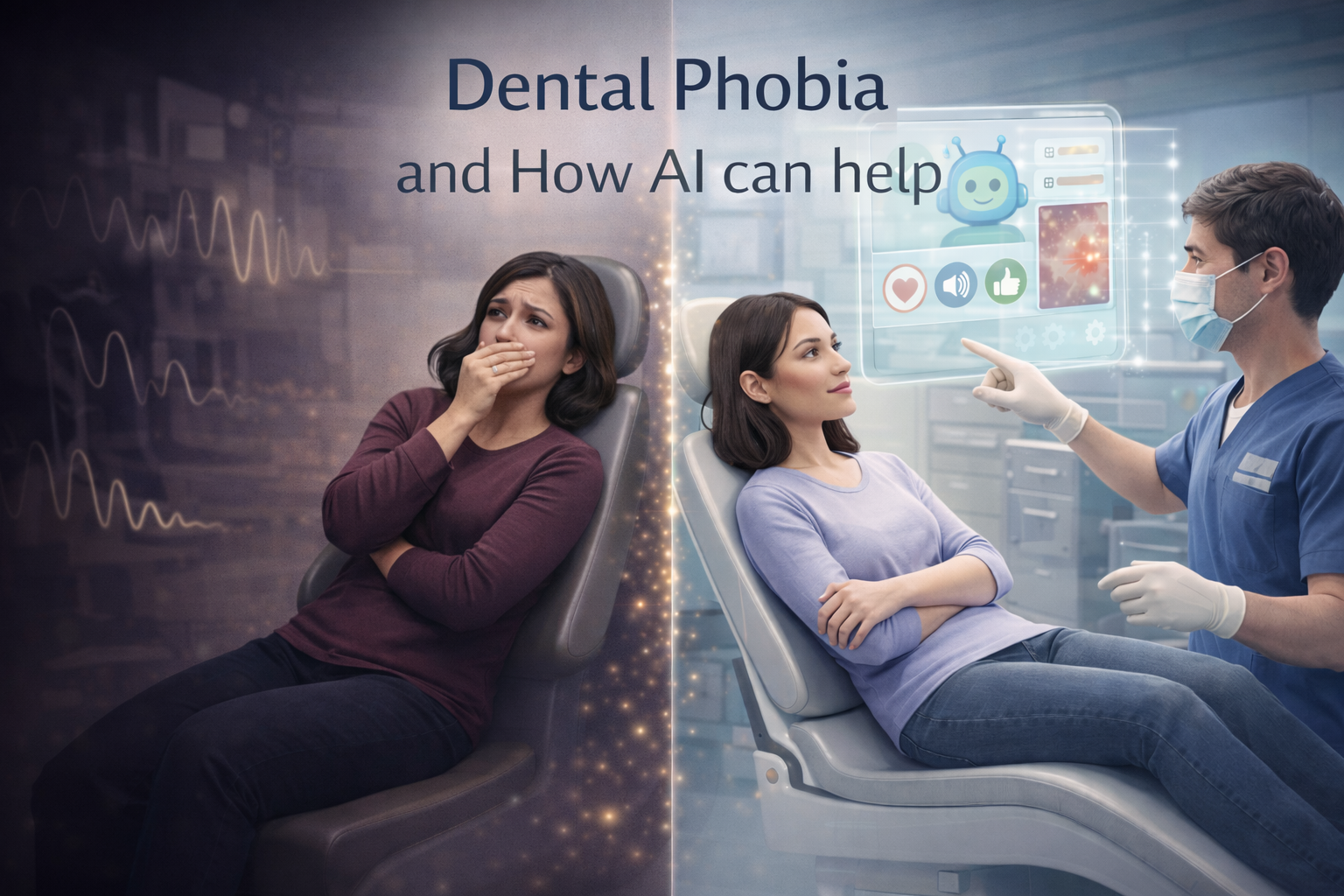
Dental phobias and dental avoidance are more common than you might think. Around 15% of the global population has dental fear and anxiety, and within that, 3% have a dental phobia. Patients with dental fear and anxiety are also more likely to delay visiting the dentist and experience poor oral health. Unfortunately, I’m part of that statistic. Like others in this category, I’ve avoided getting treatment for known dental problems for years, even when I know a visit would fix my symptoms.
Since much of my work involves solving real-world problems with AI-augmented systems, I started wondering: Can dentalAI help improve the patient experience for patients with dental phobias? Better yet, can it help get those patients into offices, improve preventative care methods, or lessen anxiety around procedures? The answer is “yes.”
For patients with dental fear and anxiety, sitting in the waiting room is sometimes worse than sitting in the chair. You can hear the sounds of the drilling. You overhear snippets of conversation between patients and staff at the front desk. You know what is coming. You were already dreading just being in the space, and you can’t even tune out the office noises for risk of not hearing staff call your name when it is your turn. It’s agonizing, and it makes the level of patient anxiety when they’re finally in the chair much higher than it was when they first came in.
Dental AI systems can help dentists give patients who may prefer to be isolated from the regular dentist waiting room aviable means to do so. Imagine this: a patient opens your office doors into a vestibule that is separate from the regular waiting room. It’s well removed from the clinical area, so the patient has a moment of transition before they enter the rest of the office.
This vestibule has a multilingual AI agent ready to collect data about how each patient would like to be treated. They can skip this step and go straight to the front desk if they’d like, but they could also choose to tell the AI things like:
● I’d prefer to wait outside or in the vestibule
● I’ll have headphones on, so pleasetap me on the shoulder when it’s my turn
● I do well when the dentistexplains every step to me (or the inverse for patients who prefer as littletalking as possible)
It could also help collect patient history and symptoms depending on how complex the implementation is, but that is less important here. Allowing the patient to choose how much they want to engage with the office and letting them dictate that in their own natural voice can ease them into the visit while preventing an extra dose of waiting room anxiety.
Not every patient with dental fear and anxiety needs the same level of information. Some want to know every single step before it happens from what tool you're using to what sensations they might feel to how long each phase will take. Others prefer minimal communication and just want to get through the procedure as quickly as possible. Dentists are busy, though, and remembering each patient's communication preferences across dozens of appointments per day is unreasonable.
This is where dental AI systems can step in to support trauma-informed care. An AI system can store and recall individual patient preferences, then help dentists tailor their approach accordingly. Before a procedure, the system could remind the dentist: "This patient prefers step-by-step explanations" or "This patient does better with minimal talking."
But the support doesn't have to stop at the chair. Dental AI systems can extend trauma-informed communication beyond the office visit through:
● Personalized take-home packets: Instead ofgeneric aftercare instructions, dental AI can generate materials that match thepatient's literacy level, language preference, and anxiety triggers. A patientwho gets overwhelmed by medical jargon receives simpler language. A patient whoneeds detailed information gets comprehensive explanations.
● Portal interactions: When patients log into their patient portal with questions, an AIagent can respond in a way that matches their documented preferences.
● Website chat support: Before a patient evenbooks an appointment, AI chat support can answer questions about procedures inlanguage that reduces anxiety rather than amplifying it. It can recognize whensomeone is expressing fear and adjust its tone to be more reassuring without needing to intake any patient information.
● Appointment reminders: Rather than standard reminder texts, AI can craft messages that acknowledge the patient's anxiety and include specific comfort measures available at the practice. For example: "Your appointment is tomorrow at 2pm. Remember, you can wait in the quiet vestibule, and we'll tap your shoulder when we're ready for you."
● Supporting patient memoryrecall: A 2018 study found that patients only recallabout 49% of important information from ambulatory care visits without prompting.
● More importantly, there was a bigdifference in the amount recalled depending on the patient’s education level.Patients without a high school education recalled 38% of items, while patients with a college degree recalled 65%.
● While the number of items to berecalled and the number of times the item was repeated in the appointment madea difference, the quality of the explanation also mattered. AI can deliver tailored reminders based on the patient’s literacy, anxiety level, and learningstyle.
This level of personalization allows busy dental practices to provide consistently trauma-informed care by supporting staff and reducing their workload in trying to manually customize every interaction. With an AI-powered support system inplace, anxious patients can feel seen and understood at every step of their journey. And that level of support makes the time they have to spend in thechair much more bearable.
Getting patients with dental fear and anxiety to schedule their first appointment is hard enough. Getting them to come back can be even harder. These patients are experts at finding reasons not to return—the office hours don't quite work, they're feeling fine now so maybe they can skip this one, the reminder came at a bad time and they forgot to reschedule. Any friction in the return visit process becomes a convenient excuse to avoid the dentist entirely.
This is where dental AI can make a meaningful difference by reducing friction at every step of there call process:
● Smart timing and channels: A dental AI system can learn when and how each patient prefers to be contacted. Some patients respond better to texts in the evening when they're planning their week. Others need a phone call. Some want multiple reminders; others find them overwhelming.AI-powered systems can track response patterns and optimize outreach accordingly.
● Friction-free scheduling: When a patient receives a reminder, AI can offer immediate scheduling options through their preferred channel—whether that's clicking a link to book online, responding to a text with their availability, or even having a voice conversation with an AI agent that can access the practice's calendar in real-time. No phone tag, no waiting on hold, no having to work up the courage to call multiple times.
● Personalized messaging: Instead of generic "Time for your cleaning!" reminders, AI can craft messages that acknowledge the patient's specific anxiety triggers, tie treatment to their specific goals, and remind them of the accommodations available. That might look something like, "Hi Michelle. It’s time for your cleaning to keep your gums healthy. We know visits are tough for you; we've got a quiet space ready and only need 30 minutes of your time. Which works better: Tuesday 2pm or Thursday 10am? Reply 1 or 2 to book.”
● Gentle persistence without pressure: Dental AI systems can be programmed to follow up with patients who don't respond, but in a way that feels supportive rather than pushy. The tone can acknowledge the difficulty: "We know coming in isn't easy. We're here whenever you're ready, and we've got your comfort preferences on file." This kind of empathetic persistence keeps the door open without adding to the patient's guilt or anxiety.
This approach should be combined with a personalized in-office experience to be effective. If an AI-powered system builds trust and dentists don’t support the measures that built said trust, the patients won’t stay. Dentists should always be informed of what steps the AI took to get the patient back into the office and their needs via pre-appointment summaries. The goal is to establish a pattern of regular care by making every interaction as low-friction and anxiety-reducing as possible. For patients with dental fear and anxiety, knowing exactly what to expect and having control over their experience can be the difference between avoiding the dentist for years and maintaining consistent preventative care.
One of the most common sources of shame and avoidance for patients with dental fear and anxiety is the lecture they expect to get about their at-home care. Many dentists, with the best of intentions, insist on ideal oral hygiene routines. When patients can't or won't meet these expectations, they often avoid returning altogether rather than face the disappointment or judgment they expect.
A patient who feels they've "failed" at the ideal routine may give up entirely, leading to worse outcomes than if they'd maintained even a modest care routine. The reality is that some oral hygiene is always better than none, and a sustainable routine the patient will actually follow is more valuable than a perfect routine they'll abandon.
AI can help bridge the gap between clinical ideals and patient reality. Dentists have a legal and ethical obligation to recommend optimal care and explain the risks if you don't. But once that recommendation is made and the patient acknowledges they can't commit to the full routine, the dentist can work with the patient to identify a realistic middle ground.
Dental AI systems can facilitate this conversation and document it properly. There are lots of ways to do this, buthere's just one example of how this might work:
During intake, a dentalAI system could ask the patient a series of questions about their current homecare routine and what they think they can realistically commit to. For apatient struggling with anxiety and executive function, the questions mightlook like:
● "How many times a week do you currently brush your teeth?"
● "What makes it hard tomaintain a routine?"
● "If you could only add onething to your routine, what feels most doable?"
● "On your worst days, what's the minimum you think you can manage?"
The system then presents options to the dentist: "This patient can commit to brushing once daily and flossing three times per week. They identified morning routines as easier to maintain than evening ones."
The dentist reviews this, discusses it with the patient, and helps the patient understand which at-home actions would give them the best positive impact on their oral health. Together, they agree on a plan that's documented in the patient's record. The documentation shows that the dentist recommended ideal care, the patient understood the risks of not following it, and both parties agreed on a modified plan that the patient felt capable of maintaining.
This approach helps remove the adversarial dynamic that often exists between dentists and anxious patients. The dentist doesn't have to be the "bad guy" nagging about flossing, and the patient is less likely to feel like they have to lie about their routine or avoid appointments out of shame. Instead, both parties work together with a dental AI as a neutral facilitator, documenting everything properly and supporting the patient in maintaining whatever level of care they can realistically sustain.
Patients with dental fear and anxiety are not the only group that can benefit from leveraging dental AI tools in practices. All the ideas above would also help improve care for chronically underserved populations such as patients with language barriers, patients who cannot regularly schedule visits, or patients with care limitations. Every patient who doesn’t see the dentist as often as they should has a reason. For some, it’s as simple as a lack of time or not remembering to schedule. For others it’s confusion around how to make an appointment, not having an office near enough to visit outside of emergencies, not having the ability to pay for regular appointments, or not being able to care for themselves due to lack of resources or capabilities. Knowing what the true barrier is and tying that to how you treat that patient, including outside of their office visits, can go along way to improving patient outcomes.
We are already seeing dental AI tools being implemented to tailor the patient experience. scanO AI, for example, is using AI to address barriers that have long kept vulnerable populations from accessing quality dental care. Their system's visual diagnostic reports help patients see exactly what's happening in their mouths ,transforming abstract recommendations into concrete, understandable information. Patients can look at AI-highlighted images showing where issues are developing and make informed decisions about their care rather than simply trusting—or not trusting—what they're told.
Perhaps more critically, scanO's smart assistant NAVI is available in over 18 regional Indian languages. For themillions of people who speak Tamil, Telugu, Kannada, Bengali, Marathi, or other regional languages as their first language, accessing healthcare in theirnative tongue is often the difference between seeking care and avoiding it entirely. By using AI to support these smaller language populations that have historically been underserved by healthcare systems, scanO is showing how technology can expand access rather than concentrate it.
AI-powered dental careis another tool dentists can use to remove the barriers that prevent people from accessing that care. For patients with dental fear and anxiety, these barriers are often invisible to providers but insurmountable to those experiencing them. By using dental AI systems to reduce friction, personalize communication, and support trauma-informed practices, dental offices can finally reach the patients who need them most but have been avoiding them the longest.
Though we are in the early stages of AI-powered dental systems, the technology to build them exists. The question now is whether practices will implement it and transform how care is delivered to those who have historically been left behind.
Michelle Jamesina specializes in figuringout how AI should actually be applied to organizational problems, often byreframing the challenge to find better solutions. She architects multi-agent AIsystems across industries from fashion retail to healthcare and has ghost-writtenstrategic content for leading tech companies including Google, Broadcom, andPalo Alto Networks. She has also led digital transformation at federalagencies. Her work focuseson preserving human expertise while making AI genuinely useful. Read more at michellejamesina.com.