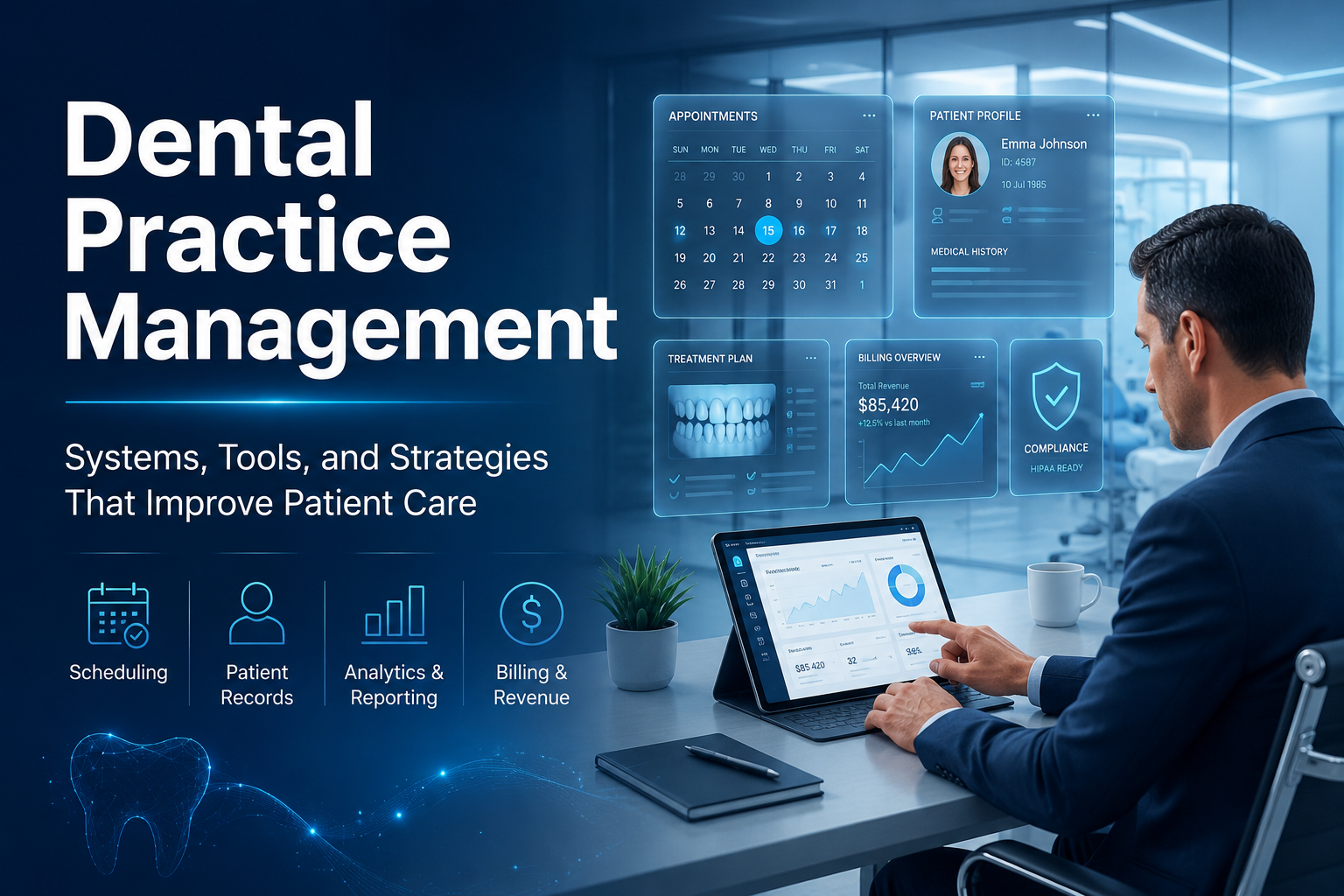
Dentists need to be familiar with all of the practice management components in order to maintain a productive and profitable business.
Practice management dental administration refers to the management of all aspects of a dental practice, ranging from patient scheduling and billing to improving clinical operations and collaborating with staff to provide high-quality care to patients.
What is practice management dentistry?
- The Intersection of Business and Clinical Dentistry.
One of the most difficult areas to balance in order to provide high-quality care while maintaining a profitable practice is front-office operations.To address this, contemporary dental practices employ practice management dental software (PMS) to organize and standardize processes while ensuring that staff adheres to established procedures.
- Why Most Dental Practices Leak Money
Most dental practices suffer from avoidable overhead expenses because they do not have a systematic approach to practice management dental operations. It is critical to have a systematic approach to running the practice in order to avoid wasteful overhead costs and increase profitability.
The 4 Pillars of Efficient Practice Management Dental Software.
1. Automated Patient Scheduling and Retention Systems
- Modern practice management dental software frequently employs AI-powered predictive scheduling to help front-desk staff maximize production and reduce gaps. AI can help you identify no-show tendencies by analyzing patient data.
2. Efficient Billing, Coding, and Insurance Processing
- Establishing standard cleaning and collection procedures is critical to achieving this pillar. In addition, to avoid patient dissatisfaction, make sure to verify insurance before scheduling appointments.
- Efficient dental billing, coding, and insurance verification are essential components of twenty-first-century practice management dental operations.
3. Team/Staff and Office Training
- Using AI claim scrubbing tools, dental practices may automatically detect missing codes or radiographic data, reducing claim rejections. Practice management dental front office training can help personnel learn the procedures, reducing errors and ensuring that they understand their roles.
4. Regulatory Compliance and Patient Privacy (HIPAA)
- Modern practice management dental operations necessitate a comprehensive strategy to patient data privacy and security. It is recommended that you invest in practice management dental software with encryption capabilities to safeguard patient data
- Additionally, with AI-powered EHR systems, clinical documentation becomes significantly easier.
How to Make Your Dental Practice More Efficient – A Step-by-Step Guide.
Step 1: Centralization of Workflow Through Practice Management Dental Software
- It is critical to reduce the number of disparate software programs used in the practice. Practice management dental software can be utilized to unify the front and back offices, minimizing the possibility of errors.
Step 2: Going Digital With Patient Intake and EHR
- It is a good idea to encourage patients to complete the registration process online rather than on paper. Paperless patient registration and electronic health records can help streamline things.
Step 3: Reducing No-shows Through Text and Email Reminders
- Most dental practices have a 15-20% no-show rate due to the lack of an efficient practice management dental system. SMS/email reminders can help decrease this rate. It’s essential to remind patients of their appointments.
Step 4: Monitoring the KPIs for Practice Management Dental
- The majority of dental practices have key performance indicators (KPIs), such as collections, active patients, and hygiene reappointment rates, that they utilize to evaluate their success. Tracking the KPIs for dentists can assist in determining whether the practice’s income is on track.
The field of practice management dental operations is being transformed by cutting-edge technologies such as artificial intelligence (AI). Approximately 35% of dentists use AI in their practice management dental operations.
What are the 4 types of AI?
There are 4 main types of AI. Here is how they apply to the dental industry:
- Reactive Machines: These systems operate entirely in the present, making decisions based on previous data. This kind of AI is employed in chatbots on practice management dental websites that respond to patient questions.
- Limited Memory: This type of AI utilizes data from previous experiences to make predictions about the future. It’s used in practice management dental systems that analyze thousands of x-rays to identify caries and in software that learns from prior scheduling data to maximize production.
- Theory of Mind: A “Theory of Mind” AI would be able to understand the emotions of patients. For example, if a patient has dental anxiety, the AI would recognize it based on their facial expressions, speech patterns, or how they move in the dental chair. The dentist would then be able to respond appropriately.
- Self-Aware AI: This type of AI has consciousness. This type of AI would be able to perform surgeries on its own. It would be similar to having a dental practitioner in the back office who could think and act independently.
What are the 3Cs of AI?
The development and execution of artificial intelligence in dentistry rely on the 3 Cs:
- Compute: Dental practices would need powerful computers to run sophisticated AI programs that allow for rapid 3D CBCT scan viewing or allow AI to analyze massive image files without lagging.
- Code (Algorithms): Code is a form of AI that analyzes data to detect patterns. Dental AI code examples include algorithms that can identify margin lines for CAD/CAM, measure bone height, and identify periapical radiolucencies.
- Content (Data): Content refers to the data that is utilized to train AI algorithms. For practice management and diagnosis, this includes vast amounts of patient health data, bitewing x-rays, panoramic x-rays, and insurance data.
What are the 5 pillars of AI?
The 5 pillars of AI are critical to implementing AI in a dental practice:
- Data: This refers to the information that will be used to train the AI In dentistry, this includes high-resolution intraoral images and patient health data.
- Analytics: This refers to the process of extracting information from data. For example, dental AI analytics can be used to identify patients who are at danger for periodontal disease or analyze the financial health of a dental practice.
- Integration: This refers to the ability of AI to connect with other systems. The most effective diagnostic dental AI will be useless if it cannot be connected to your practice management dental software.
- Automation: This refers to the ability of AI to perform tasks without human assistance. AI can help with automating dental operations, such as verifying insurance, writing notes, and sending out patient emails.
- Security: This refers to the safeguards that ensure that only authorized persons have access to data. Because dental AI systems handle patient health information, they must have robust encryption to ensure that data is not accessed by unauthorized individuals.
What is the 30% rule of AI?
The 30% rule of thumb in business management is that implementing AI can reduce administrative and repetitive tasks by 30%. This has a significant impact on the front office. If your front desk staff spends 30% less time on the phone with insurance companies or calling patients, they will have more time to focus on higher-value tasks. This might involve improving patient interactions, which will result in more patients accepting treatment and referring friends, allowing your dentists to spend more time delivering excellent care to patients.
How to Choose the Best Practice Management Dental Tools
- Cloud-Based vs. On-Premises Software
- Most dental practices are gravitating towards cloud-based solutions. Before transitioning to a PMS that runs on the cloud, it is critical to conduct a cost-benefit analysis. Cloud-based practice management dental software typically decreases the number of IT expenditures associated with running a dental practice.
- Essential Features to Look For: Telehealth, Imaging, and RCM
- When selecting practice management dental software, it’s a good idea to define your practice’s requirements. For example, if your dental practice provides telehealth services, you’ll need to ensure that the practice management dental software you choose has compatible tools. When it comes to RCM, it’s critical to have the appropriate tools in place to ensure that your practice’s financial operations are running smoothly.
Conclusion: Delivering Quality Patient Care while Maximizing Profits
Practice management dental operations are essential to maximizing profits while optimizing clinical procedures.
To do so, it is critical to conduct a practice management dental audit in order to identify areas that may benefit from additional technology. This is when the value of modern all-in-one solutions becomes apparent. scanO Engage, for example, is a powerful practice management dental software that enables you to streamline patient communications while also implementing intelligent scheduling systems that will assist you in reducing no-shows. With scanO Engage, you may transform your front-office operations, increase productivity, and prepare your practice for the future of dentistry.