

From Silicon Valley to the Dental Chair: A Global History of Dental Intelligence

Deborah E. Bush
December 29, 2025

The evolution of modern dentistry is no longer confined to the walls of a clinic; it is being written in the high-stakes laboratories of a global tech triangle. This journey begins in the legendary corridors of Silicon Valley, California, where the foundational logic of the 1950s first sparked the dream of machine intelligence. It then accelerates in Bengaluru, the "Silicon Valley of India," where a large talent pool has transformed theoretical mathematics into scalable healthcare applications.

But for the modern clinician, the story finds its academic heart in Pune, famously known as the "Oxford of the East." Pune has a century-long legacy as a research hub. By blending the disruptive spirit of California and the technical scale of Bengaluru with the intellectual rigor of Pune, a new era of "Complete Intelligence Systems" has emerged to bridge the gap between complex engineering and everyday dental health.

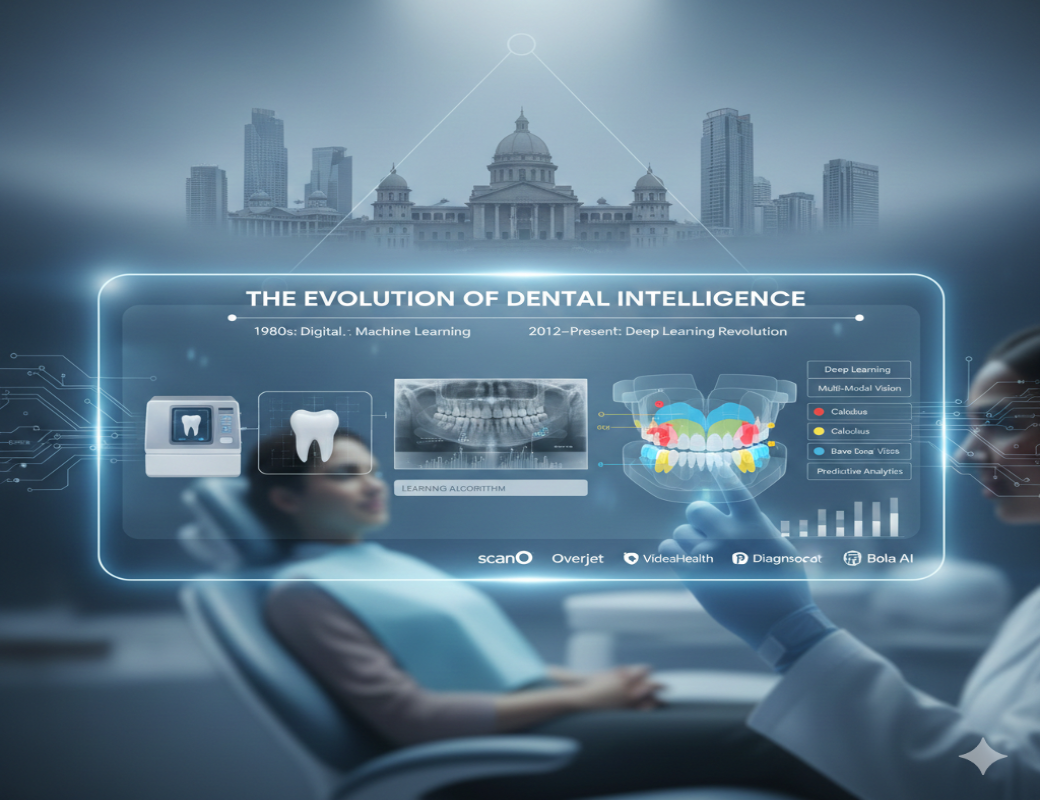
The Evolution of Dental Intelligence: A Technical Timeline

The history of dental innovation is a sequence of moments where human intuition was first augmented, then accelerated, by digital precision. This journey from simple optical scanning to complex multi-modal systems defines the modern standard of care.

The 1980s: The Dawn of Digital Vision

The 1980s introduced the first clinical application of Computer Vision through the development of the CEREC system in Switzerland. At the time, computers were largely calculators; teaching one to "see" was a revolutionary leap.

  • The Technical Leap: This era pioneered 3D Optical Triangulation. By projecting light onto a tooth, the computer captured the "deformations" of that light to map three-dimensional geometry.
  • The Clinical Shift: For the first time, a machine could recognize the physical boundaries of a preparation. It demonstrated that machines could achieve the sub-millimeter tolerances required for dental restorations, setting the stage for the digital impression tools used today.

The 2000s: From Logic to Learning

By the mid-2000s, technology moved beyond merely mapping surfaces to interpreting internal data. In 2007, the focus shifted from Rules-Based Programming (in which a human specifies to the computer exactly what a cavity looks like) to Machine Learning (ML).

  • The Technical Leap: Rather than following a rigid script, algorithms were fed thousands of radiographs. This enabled the computer to identify patterns of decay using statistical methods.
  • The Clinical Shift: This transformed the computer from a drafting tool into a diagnostic assistant. Practitioners began to see the potential for an "Expert Eye" that never experienced fatigue or visual bias, thereby providing a more consistent baseline for radiograph interpretation.

2012–Present: The Deep Learning Revolution

The current era is defined by the rise of Convolutional Neural Networks (CNNs). This technology, modeled on the human visual cortex, enables a computer to perceive an image as a hierarchy of anatomical structures rather than merely a grid of gray pixels.

  • The Technical Leap: CNNs use "layers" to understand context. One layer may detect a border, the next layer may identify enamel, and the third layer may recognize lesion density. This is the foundation of Deep Learning, where the system becomes exponentially more accurate as it processes more data.
  • The Clinical Shift: We have moved into the era of Instant Pathology Mapping. Modern systems can now provide real-time, color-coded overlays on X-rays, identifying caries, calculus, and bone loss with near-instantaneous speed.

The Convergence of Intelligence: Establishing the Modern Ecosystem

Today, the most advanced systems have evolved beyond single-task AI to Complete Intelligence Systems. This evolution is driven by three intersecting pillars of technology:

  1. Multi-Modal Computer Vision: Analyzing 2D radiographs, 3D scans, and live video simultaneously to create a holistic view of the patient.
  2. Predictive Analytics: Utilizing the massive datasets generated over the last decade to move from detecting current issues to forecasting future risks.
  3. Natural Language Processing (NLP): Translating these high-level digital findings into transparent, human-readable reports that patients can easily understand.

The industry is currently witnessing a convergence in which these pillars are being integrated into multi-modal dental ecosystems. A new standard is being set by companies that have moved beyond single-task tools to create sophisticated, practice-wide intelligence:

  • scanO: Representing the latest evolution in this lineage, scanO synthesizes these advancements into a unified, Predictive Ecosystem. By integrating international technology standards with Indian academic rigor, scanO's platform—anchored by scanO Air robotic screening—leverages multimodal Computer Vision and Predictive Risk Modeling to shift the chairside experience from reactive repair to a proactive, universal standard of preventive health.
  • Overjet: Widely considered the "Standard for Clinical Intelligence," Overjet holds 10+ U.S. FDA clearances, including the industry’s first for 3D CBCT bone-level measurements. By analyzing 18 months of historical data and cross-referencing it with practice management systems, they provide a "Universal Clinical Truth" used by over 75 million members through leading insurance payers and DSOs like North American Dental Group.
  • Pearl: The global leader in "Visual Transparency," Pearl’s Second Opinion platform is the first AI to be cleared to detect numerous pathologies in both 2D and 3D imaging across 120 countries. Their platform is designed to serve as the "Patient's Advocate," using real-time, color-coded overlays to increase diagnostic sensitivity by up to 36%, thereby bridging the trust gap at the chairside.
  • VideaHealth: Known as the "Engine of Integration," VideaHealth provides the industry’s most clinically validated AI with 35+ U.S. FDA-cleared detections. As the native AI partner for Henry Schein’s Dentrix, the technology serves as a seamless "Ambient Intelligence" for 8 of the 10 largest DSOs in the U.S., streamlining the workflow from diagnostic detection to insurance claim accuracy.
  • Diagnocat: The specialist in "3D Structural Reconstruction," Diagnocat pioneered the automated segmentation of complex CBCT data into individual 3D STL models. By identifying over 60 conditions in 3D, they turn "massive data" into actionable surgical maps for implants, orthodontics, and endodontics, reducing reporting time from 40 minutes to under 5.
  • Bola AI: The leader in "Clinical Voice & NLP," Bola AI has revolutionized the "ears" of the dental practice. With 99% accuracy, their Voice Perio and AI Scribe tools provide a hands-free clinical environment that saves hygienists an average of 18 minutes per day by writing data directly into the system of record, thereby eliminating manual entry errors.

The Future of Patient-Centric Care

What does this convergence mean for the patient in the chair? For decades, dental health was a matter of "taking the doctor's word for it." Today, the shift from single-point tools to a Complete Intelligence System fundamentally changes the human dynamic of dentistry.

When Computer Vision identifies a hidden issue, Predictive Analytics forecasts its trajectory, and NLP explains it in plain language, the "Subjectivity Gap" disappears. Patients no longer receive a diagnosis; they receive verifiable evidence. This transparency reduces anxiety, increases treatment acceptance, and—most importantly—moves us toward a future where we stop treating damage and start maintaining health. 

At scanO, we believe that when the best technology in the world becomes invisible, the human connection in dentistry can finally become the priority.

 About the Author:

Deborah E. Bush is an accomplished writer and subject matter expert specializing in the technological and behavioral shifts within the dental industry. With over two decades of experience, she has served in key leadership roles, including Director of Marketing and Communications for The Pankey Institute and Director of Content for Patient Prism.

Currently, Deborah leverages her deep industry knowledge as a fractional content writer for multiple AI dental tech companies, including scanO. Her expertise spans technical documentation, storytelling, and statistical analysis, having served as the principal reporter for several annual dental salary and marketing surveys

See
What's
Never
Been Seen

scanO is an AI ecosystem transforming oral health for patients, dentists, corporates, and insurers worldwide

© 2025 Trismus Healthcare Technologies Pvt Ltd