
For over a century, the dental checkup has followed a predictable, if imperfect, script. You sit in the chair, a clinician peers into your mouth with a mirror and probe, and perhaps they snap a few grayscale X-rays. Then comes the verdict: "You have a cavity starting here," or "We should keep an eye on this spot." But behind this routine lies a profound challenge known as the Subjectivity Gap.
Even the most seasoned dentist is human, limited by the resolution of the naked eye and the inherent ambiguity of traditional imaging. Research has shown that diagnostic consistency among dental professionals can vary significantly—what one dentist sees as a "wait and see" lesion, another might see as an urgent intervention.
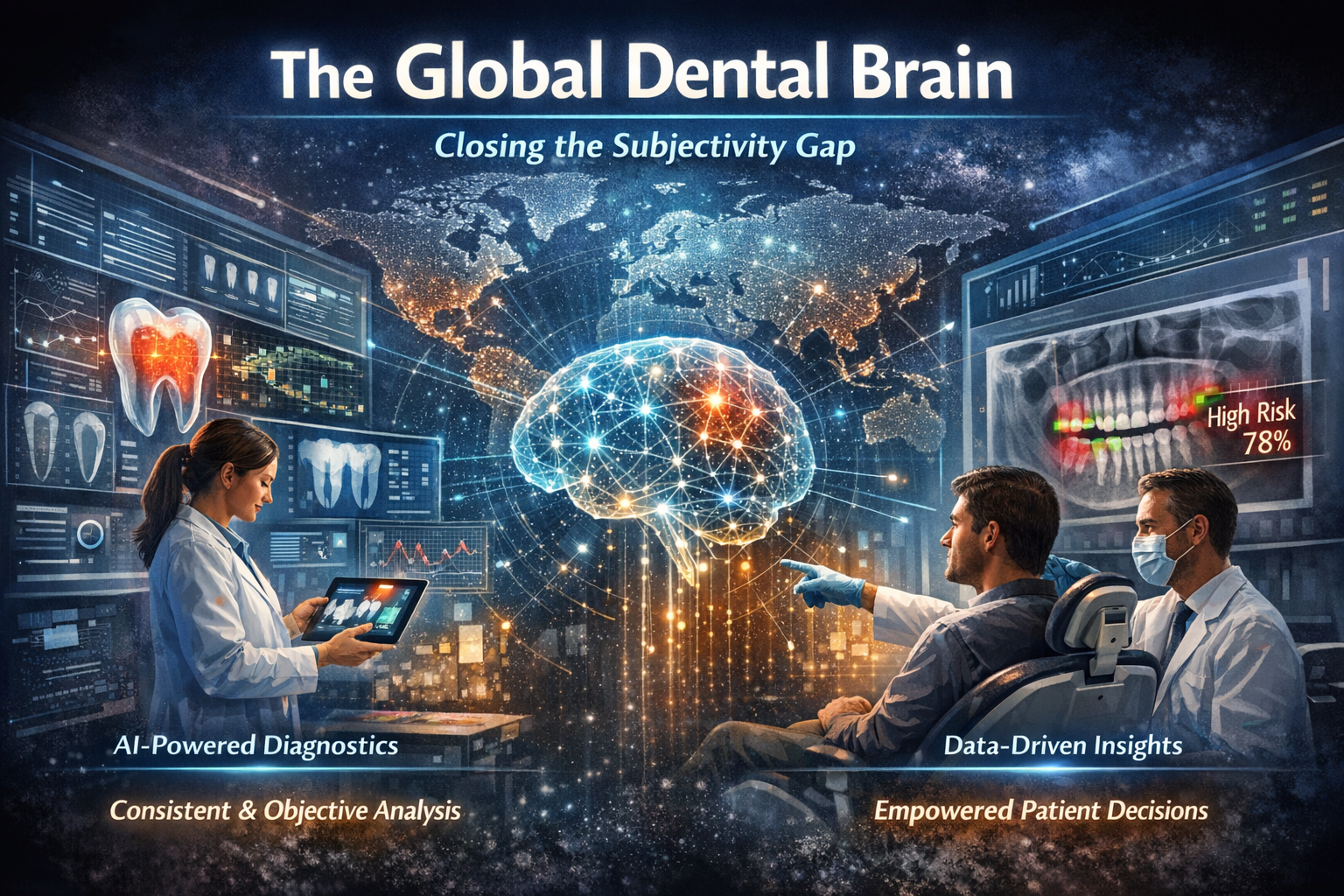
To solve this, the industry is moving toward a new universal standard: The Global Dental Brain, the term coined by industry expert is describe a multimodal AI ecosystem that aggregates billions of data points from clinical cases worldwide. Rather than relying on the isolated experience of a single practitioner, the “global” dental brain represents a collective, centralized clinical intelligence. It is a "living" diagnostic engine that provides every dentist with a tireless, data-driven second opinion based on the highest global academic standards.
The Subjectivity Gap is not merely a chairside nuance—it is a barrier to consistency, trust, and access. According to the World Health Organization, oral diseases affect nearly 3.5 billion people worldwide. Yet diagnostic pathways remain heavily dependent on individual expertise, training, and experience, with no shared baseline for interpretation.
This results in three persistent challenges:
The Global Dental Brain seeks to reduce—not eliminate—this variability by introducing a consistent, objective layer of analysis alongside clinical judgment.
Importantly, the Global Dental Brain is not a monolithic supercomputer. It is a multimodal ecosystem—a convergence of technologies trained on millions of successful diagnoses and continuously refined through real-world clinical input. Across the industry, different companies are contributing to this shift through complementary approaches, including software-based diagnostic platforms and integrated screening systems.
Together, these systems typically combine three core technological frontiers:
Together, these modalities form a “complete intelligence” layer that augments, rather than replaces, the clinician’s expertise.
One illustrative example of how the Global Dental Brain is being applied in practice is scanO. Founded with a mission to improve access and consistency in oral health screening, scanO emerged from a collaboration between clinical dentists and data scientists, with academic partnerships including the Manipal College of Dental Sciences.
scanO’s approach integrates AI-driven diagnostics into a hardware-based screening platform, designed to deliver consistent assessments across diverse care settings. The scanO air system—often described as a “Global Dental Brain in a box”—combines automated image capture, multilingual voice assistance, and data-informed analysis to support early detection and triage. In doing so, it demonstrates how collective clinical intelligence can be embedded directly into frontline care environments, from rural clinics to urban practices.
scanO represents one model within a broader ecosystem that also includes software-based platforms such as Overjet, Pearl, VideaHealth, and Diagnocat—each contributing to the same underlying goal: reducing subjectivity by scaling insight.
The implications of this shift extend beyond efficiency and accuracy. Today, diagnostic quality is often influenced by geography, infrastructure, and provider availability. In regions with low dentist-to-patient ratios, limited access to advanced imaging or specialist expertise can delay diagnosis altogether.
By enabling AI-assisted screening and analysis, the Global Dental Brain could decouple diagnostic quality from physical location. A healthcare worker in a remote setting, supported by data-trained intelligence, can perform assessments informed by the same aggregated clinical knowledge used in high-resource environments. While technology alone cannot solve systemic inequities, it can meaningfully raise the diagnostic floor and expand access to early care.
A profound impact of closing the Subjectivity Gap is its reshaping of the patient experience. Traditionally, dentistry has been a largely passive encounter: the clinician evaluates, explains, and decides. Objective, data-augmented diagnostics change that dynamic.
When patients see clear visual evidence—color-coded overlays, quantified risk scores, and understandable summaries—the “problem” becomes tangible. It is no longer an abstract opinion, but a shared reality. This transparency creates a psychological shift from spectator to stakeholder.
With greater visibility comes accountability. Patients begin to understand how daily habits influence measurable outcomes, and treatment acceptance becomes less about persuasion and more about alignment. In this model, the dentist remains the trusted guide and decision-maker, while the patient becomes an informed partner in protecting their own oral health.
A profound impact of this universal standard is found in the subtle shift within the patient-doctor relationship. Historically, the dental chair has been a place of passive experience—the patient sits back, and the dentist "fixes" the problem. By removing the Subjectivity Gap, the Global Dental Brain shatters this passivity.
When clinicians provide patients with a clear, data-driven view of their health, the "problem" is no longer an abstract opinion held by the doctor; it is a visible, quantifiable reality. When a patient sees a color-coded map of their own demineralization or a risk score predicting future decay, a psychological pivot occurs. They move from being a spectator to a stakeholder.
Data-driven insight carries an inherent weight of accountability. When the Global Dental Brain provides a personalized health score, it clarifies a fundamental truth: while the dentist is the facilitator of care, the patient is the primary guardian of their own biology.
Because they can finally see the objective clinical need, patients move past hesitation and readily accept the necessary treatment. By seeing a direct visual correlation between their daily habits and the data on screen, patients naturally understand that it is their responsibility to improve their oral health.
The rise of the Global Dental Brain marks a defining moment for dentistry—not because machines are replacing clinicians, but because collective intelligence is enhancing them. As this category continues to evolve, the responsibility lies with the profession to adopt these tools thoughtfully, ethically, and in the service of better care.
By narrowing the Subjectivity Gap, dentistry has the opportunity to deliver more consistent diagnoses, more transparent conversations, and more equitable access—while preserving the art and judgment that define clinical excellence.
Deborah E. Bush is an accomplished writer and subject matter expert specializing in the technological and behavioral shifts within the dental industry. With over two decades of experience, she has served in key leadership roles, including Director of Marketing and Communications for The Pankey Institute and Director of Content for Patient Prism.
Currently, Deborah leverages her deep industry knowledge as a fractional content writer for multiple AI dental tech companies, including scanO. Her expertise spans technical documentation, storytelling, and statistical analysis, having served as the principal reporter for several annual dental salary and marketing surveys