
If you’ve ever spent time inside a dental office, you know the pace never really slows down. There’s always someone waiting to check in, someone waiting to check out, someone calling about insurance, and someone running five minutes late because they couldn’t find parking. Dentists are moving from room to room, assistants are wiping down chairs, hygienists are juggling X-rays and charting. It’s organized chaos on a good day.
This is exactly why software for dentist has become such an unexpected lifesaver. Not because it magically fixes everything, but because it trims away all the tiny time-wasters you normally don’t even notice. At first you barely feel the difference. A week or two goes by, and someone says, “Hey, is it just me or are our days running smoother lately?” And that’s when it clicks.
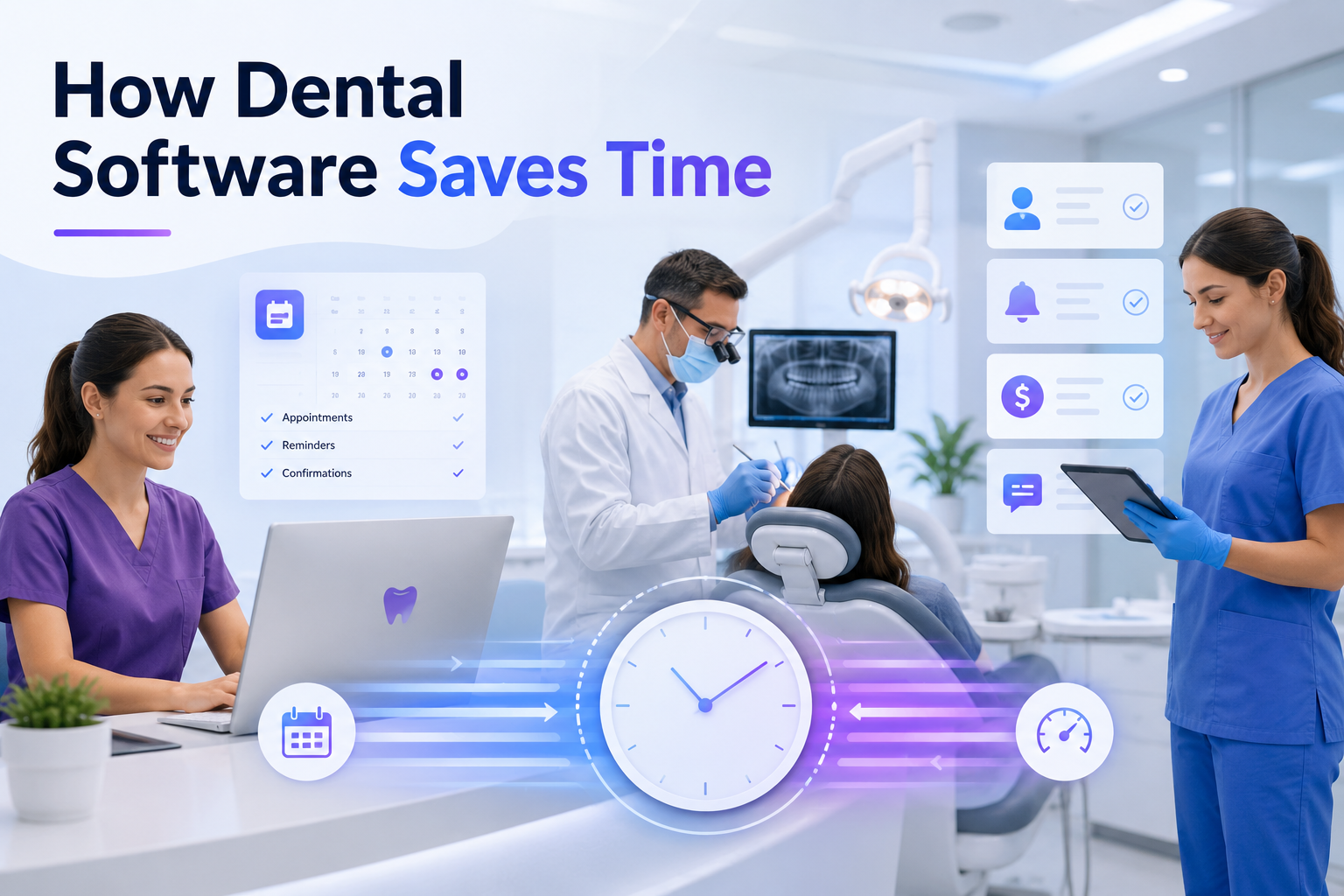
Dental software doesn’t change the job - it changes the pace. Here’s how.
1) Appointment Scheduling That Doesn’t Feel Like a Mini Negotiation
Before practices leaned on dental scheduling software, scheduling an appointment sometimes felt like negotiating a peace treaty. “Can you do 3 p.m.?” “No.” “How about next Thursday morning?” “Maybe.” It could take five minutes just to find a time.
Modern systems handle a lot of this automatically. Patients pick from available openings online. The software suggests the best slots for certain procedures. Staff no longer shuffle through multiple calendars while trying to keep someone on the phone.
The automated reminders are a blessing too. Texts go out, people confirm, and no-show rates drop without the front desk having to call half the patient list every day. The office suddenly breathes easier - and nobody really notices until they do.
2) Insurance and Billing Without the Daily Headache
Insurance is probably the part of dentistry nobody signed up for but everybody gets stuck dealing with. A single missing code or attachment can eat up half an afternoon.
With dental software doing most of the heavy lifting - codes, eligibility checks, claim submissions—the process becomes much less of a time vampire. Errors get flagged early. The claim goes out clean the first time. Staff don’t have to jump between three programs or chase paperwork around the office. It doesn’t eliminate the insurance chaos entirely, but it does shrink it to a manageable size.
3) Digital Charting That Feels More Like a Workflow and Less Like Homework
Paper charts had personality, but they also had a way of disappearing exactly when you needed them. Digital charts solve that problem instantly. Everything is in one place, searchable, clean, and most importantly - fast.
Hygienists can chart periodontal measurements with a click instead of scribbling numbers in tiny boxes. Assistants can type (or use shortcuts for) standard notes. Dentists pull up past radiographs in seconds. Treatment plans are built on the fly rather than after the patient leaves.
The real time savings come from avoiding repetition. No rewriting, no deciphering handwriting, no flipping pages. Just click and go.
In real practice, platforms like scanO help make this workflow even smoother. Instead of juggling separate tools for imaging, patient records, and clinical documentation, scanO connects these elements into a single ecosystem. When a patient arrives, their scans, charts, and treatment information are already synced and accessible. Radiographs don’t need to be manually uploaded or searched for, and clinical notes flow directly into the patient record. The team spends less time switching screens and more time staying focused on patient care—without changing how they actually practice dentistry.
4) Team Communication That Doesn’t Rely on Shouting Down Hallways
Most dental offices aren’t designed with communication in mind. Walls, doors, operatories—it’s not easy to see what’s happening everywhere. So people yell. Or walk back and forth constantly. Or guess.
Internal messaging changes that. Suddenly, the dentist knows when a room is ready. The hygienist can ask for help without leaving a patient alone. The front desk doesn’t need to hunt people down to answer a simple question. It’s quiet. It’s efficient. And it adds back minutes that would’ve leaked out of the schedule otherwise.
Patients Get What They Need Without Flooding the Phone Lines
Phones used to ring nonstop: “Can you send me my forms?” “Do I have a balance?” “Can I change my appointment?” “Do you take my insurance?” It wore people down - staff and patients both.
Now patients handle most of it online. They fill out their forms at home, update their info, pay bills, and send messages without ever calling. And because automated reminders and follow-ups go out on time, there’s much less scrambling to keep patients on track with their care.
The funny part is patients often think the office “got more organized.” Really, it just got smarter tools.
5) Fewer Errors = Fewer Time-Consuming Fixes Later
Time gets wasted not just in doing tasks, but in redoing them. Redoing claims. Redoing notes. Redoing consents. Redoing scheduling. It’s exhausting.
Software quietly removes many of these redo moments. Missing signatures get flagged. Incomplete notes pop up as reminders. Incorrect codes get caught before claims go out. The less the team has to fix later, the smoother the day feels. And the fewer mistakes they need to solve at 6 p.m. when they'd rather be home.
Payments That Don’t Turn Into a Half-Hour Project
Collecting payment shouldn’t take long, but somehow it always did. Printing statements, folding them, mailing them, waiting for checks… all of that is fading away.
Now people pay on their phones while they’re walking to their car. The payment logs itself into the system without anyone typing numbers. End-of-day reconciliation stops being a mini audit and becomes a quick review. It’s small, but small changes stack up fast.
Reports You Don’t Have to Build by Hand
Trying to figure out production, hygiene reappointment rates, or cancellations used to mean pulling numbers from different places and hoping they matched. Software creates those reports automatically. A few clicks, and the dentist or office manager sees what’s working and what needs attention. No spreadsheets. No guessing. No wasted hours.
Less Stress, Fewer Fire Drills, and a Workday That Flows
When people talk about “saving time,” they often picture dramatic changes - an hour shaved off here, a whole task eliminated there. But in a dental practice, time savings come in small doses. A minute saved on charting. Two minutes saved on scheduling. Five minutes saved on insurance. A few interruptions avoided throughout the morning.
A room turned over faster because someone got the message sooner. By the end of the day, those little bits of time add up to a smoother pace, fewer backups, and a team that doesn’t feel drained by constant catch-up.
That’s what good software for dental does: it gives the whole office a bit of breathing room. And in a field as busy as dentistry, that breathing room is everything