


Dental AI has changed what clinics can do. Tissue AI can now detect soft tissue conditions during a routine scan that were easy to miss before. Clinical capabilities have genuinely improved.
But at the end of that same consultation, most dentists are still writing prescriptions by hand. Ninety seconds. Prescription handed over. Clinic moves on.
That ninety seconds is not the cost. What follows is.
The patient calls back three hours later because they cannot read the drug name. The pharmacist rings because the dosage is unclear. Someone pulls out the physical file to check what was prescribed. Three weeks later, a complication returns to the chair because the patient lost the chit and skipped the medication entirely.
None of this shows up on a profit and loss statement. But in a clinic seeing thirty patients a day, it accumulates into something real, and most owners have no idea how much.
The question most clinic owners ask is: what does e-prescription dental software cost?
The more useful question is: what does not having it cost?
Compliance requirements are tightening across India, Singapore, and the UAE. Patient acquisition costs have risen. Chair time is more expensive to waste. Staff turnover increases training overhead. In this environment, the cost of undocumented prescribing is not hypothetical. It is a slow, consistent drain that compounds over time.
Software subscription: A connected electronic dental prescription management software in India typically runs between Rs. 12,000 and Rs. 50,000 per year depending on what it includes alongside the prescription module.
Setup: Loading the formulary before go-live takes a few hours for a standard dental drug list. If the vendor provides onboarding support, this is minimal. If it is self-managed, budget a half-day.
Training: One session covering the dentist, front desk, and clinical assistants. Two weeks of adjustment afterward. A real cost, but a one-time one.
That is the full direct cost picture. Straightforward and bounded.
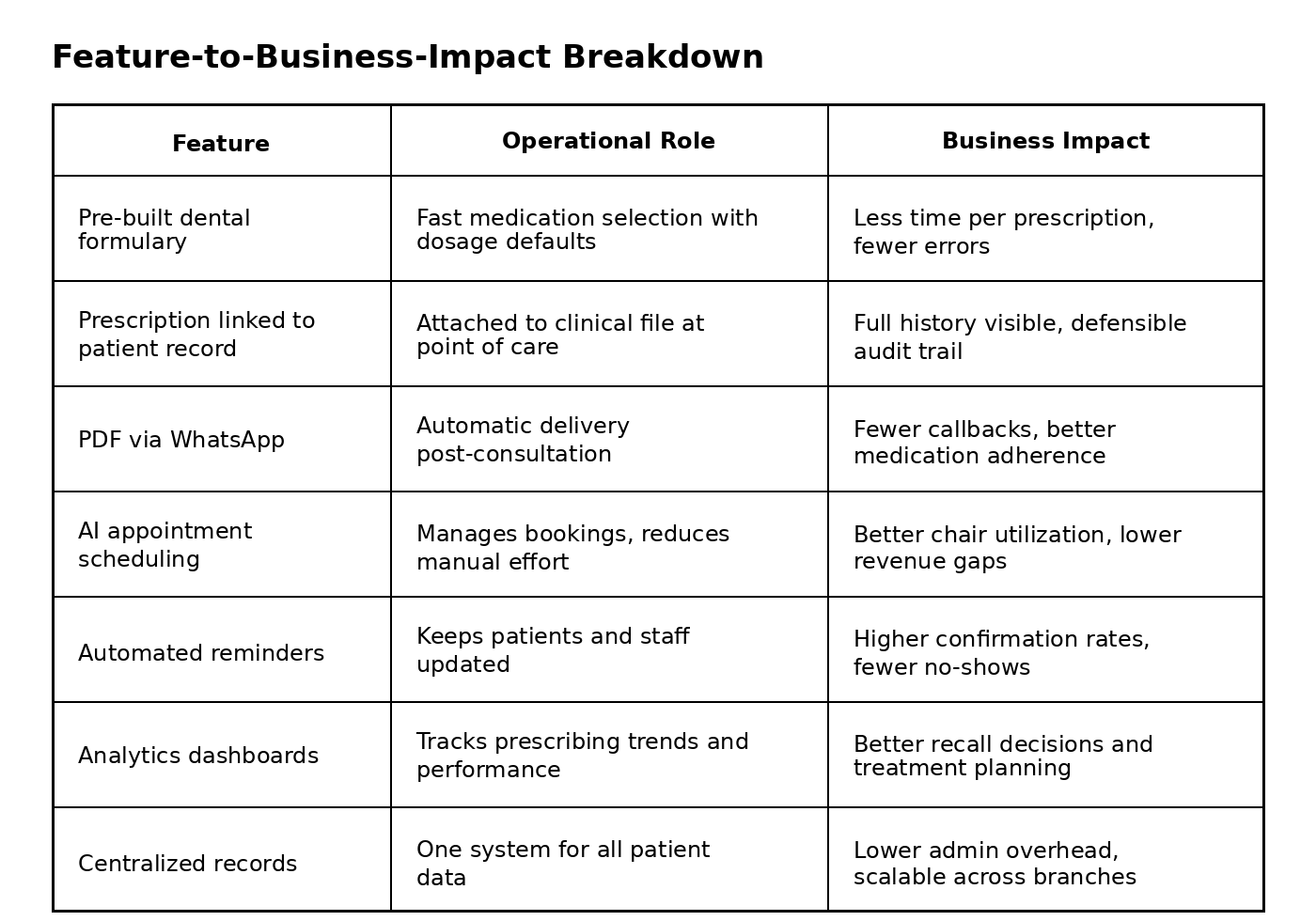
Time per prescription. A pre-loaded formulary inside a good e-prescription tool for dental practice takes 20 to 30 seconds to complete. A handwritten prescription takes 60 to 90 seconds plus manual filing. For 20 patients a day, that is 15 to 20 minutes recovered daily. Across 300 working days, roughly 75 to 100 hours per year.
Callback reduction. When the prescription arrives on the patient's WhatsApp as a PDF, they do not call back to ask what the medication was. They do not call to request a repeat. At 10 callbacks a week averaging 5 minutes each, that is over 40 hours of front desk time saved annually.
Avoided complications. A prescribing error or a skipped medication course can result in an unplanned return visit. That visit displaces scheduled revenue and absorbs clinical time. In a worst case, it becomes a complaint. One defended complaint typically costs more than two to three years of subscription fees for any e-prescription dental software.
Paper and storage. Physical prescription pads, printing, and years of physical file storage carry a direct cost that disappears entirely with a digital system.
Clinic seeing 25 patients a day, prescribing to 15 of them.
Time saved: 1 minute per prescription multiplied by 15 patients multiplied by 300 days equals 75 hours per year.
Callbacks avoided: 10 percent of prescriptions generate a callback at 5 minutes each, roughly 37 hours of front desk time annually.
Complication visits avoided: One per month at 30 minutes of chair time equals 6 hours of recovered productive time per year.
Annual cost of a connected platform: Rs. 25,000 to Rs. 50,000.
The time savings alone, without counting legal risk or compliance value, covers the subscription cost in most mid-size practices within the first year.
Compliance exposure. Choosing the best e-prescription software for dentist use creates a timestamped, searchable prescribing record that holds up in any regulatory review, insurance audit, or patient complaint. A paper file, or no file, does not. The cost of building defensible documentation proactively is small. The cost of being without it when a formal review arrives is not.
Patient trust. A patient who receives a branded PDF prescription on WhatsApp alongside their clinical report and treatment plan perceives the clinic differently from one who walked out with a handwritten chit. That perception affects whether they come back, whether they accept the next treatment recommendation, and whether they refer others.
This is where AI-enabled dental e-prescription software changes more than just the prescribing workflow. Platforms like scanO Engage connect prescription data to appointment scheduling, automated reminders, real-time confirmation tracking, and disease-wise analytics in one system. The dentist walks into every consultation with full patient context, including AI scan findings from the scanO air robot. Treatment acceptance improves because the conversation is grounded in data.
Scalability. A paper-based clinic cannot add a second branch without duplicating every administrative process. A connected system makes the second location a managed extension of the first. Patient records, prescription history, and clinical data are accessible across both branches from day one.
I run a single-chair clinic. Can I justify a full platform just for e-prescriptions?
Look at what comes alongside the prescription module. If the subscription covers appointment scheduling, automated reminders, patient records, and WhatsApp report delivery, the cost per feature drops considerably. A solo practitioner who cuts daily callbacks by thirty minutes is recovering time worth more than the monthly subscription cost.
What is the realistic legal risk of staying on paper in India right now?
Low frequency, high cost when it happens. Most paper-based clinics go years without a formal compliance event. When one arrives, an insurance dispute or dental council query, the absence of a clean prescribing record from your electronic dental prescription management software significantly weakens your position. Defending one undocumented prescribing event typically costs more than several years of subscription fees.
We already use separate tools for appointments and records. Why not just add a prescription app on top?
A third disconnected tool creates a third silo. The prescription exists digitally but is not visible when you open the patient's clinical record. Switching between systems adds friction and increases the chance something gets missed. A connected platform delivers meaningfully better ROI because the data works across every function rather than sitting isolated within one.
How do I calculate whether this makes sense for my specific clinic?
Three numbers: prescriptions written per day, post-prescription callbacks per week, and unplanned follow-up visits per month linked to medication issues. Assign a time cost to each, then compare that total to the annual subscription cost. For most clinics, time savings alone justify the investment within six months.
An AI-powered co-author focused on generating data-backed insights and linguistic clarity.
Dr. Vidhi Bhanushali is the Co-Founder and Chief Dental Surgeon at scanO . A recipient of the Pierre Fauchard International Merit Award, she is a holistic dentist who believes that everyone should have access to oral healthcare, irrespective of class and geography. She strongly believes that tele-dentistry is the way to achieve that.Dr. Vidhi has also spoken at various dental colleges, addressing the dental fraternity about dental services and innovations. She is a keen researcher and has published various papers on recent advances in dentistry.