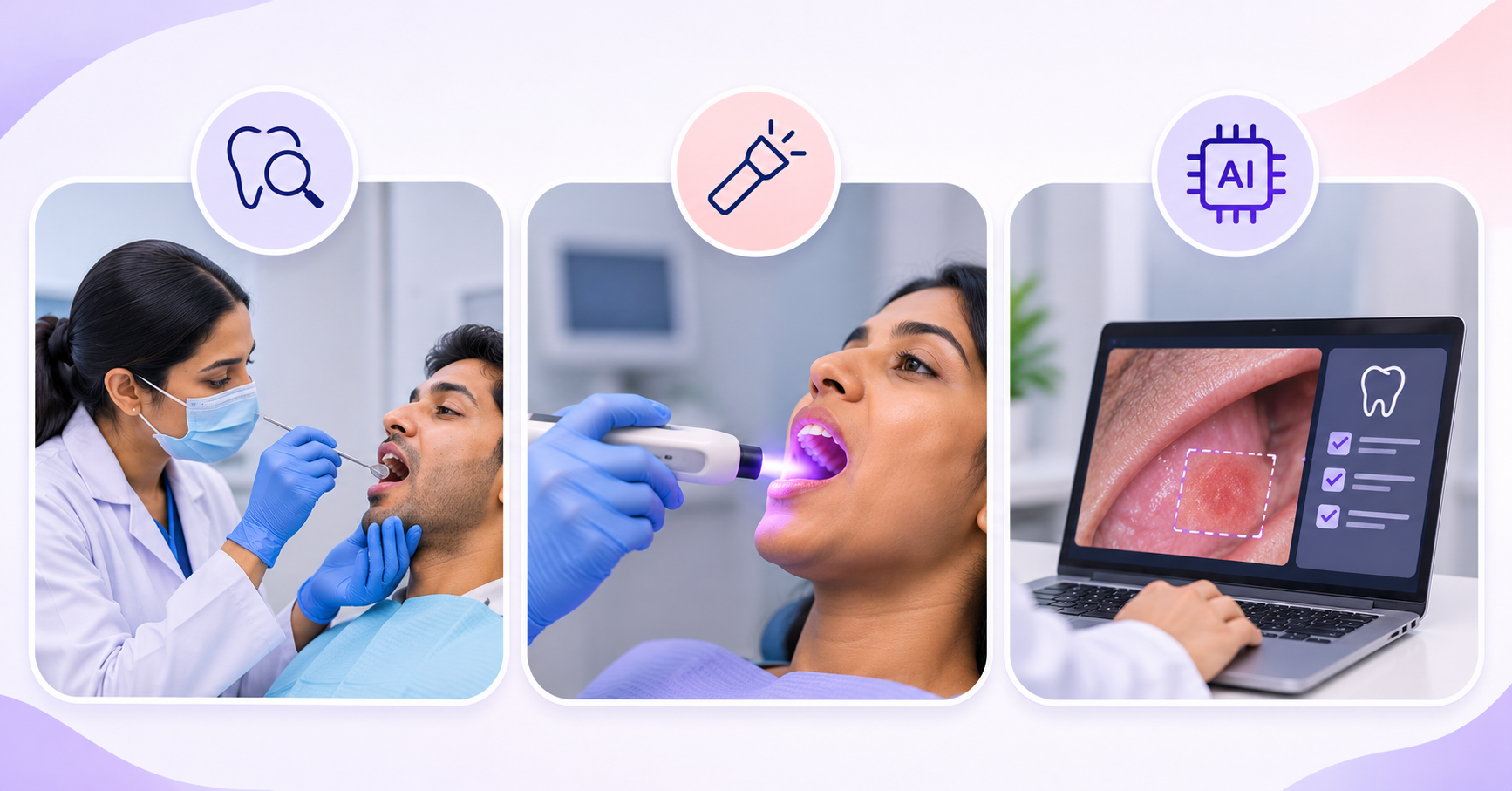



Quick answer: There is no defensible single oral cancer screening device price covering examination tools, optical adjuncts and AI systems. Request dated, model-specific quotes and compare the total pathway cost. This guide does not publish unverified competitor prices or suggest that a higher-priced device can diagnose cancer independently.
Clinics often receive quotes that look comparable until installation begins. One includes software and training, another excludes the display, and a third has an annual renewal. A meaningful comparison starts by defining the clinical task and the exact bill of materials.
An examination light, a documentation camera, a light-based adjunct and an AI product perform different jobs. Do not compare them as interchangeable cancer detectors. The clinician should approve the proposed role before procurement compares prices.
The ADA's current oral cancer guidance is a useful starting point for the clinical decision. A suspicious finding still needs appropriate assessment. Equipment procurement must not create a rule that a patient receives referral only after an adjunct produces a particular result.
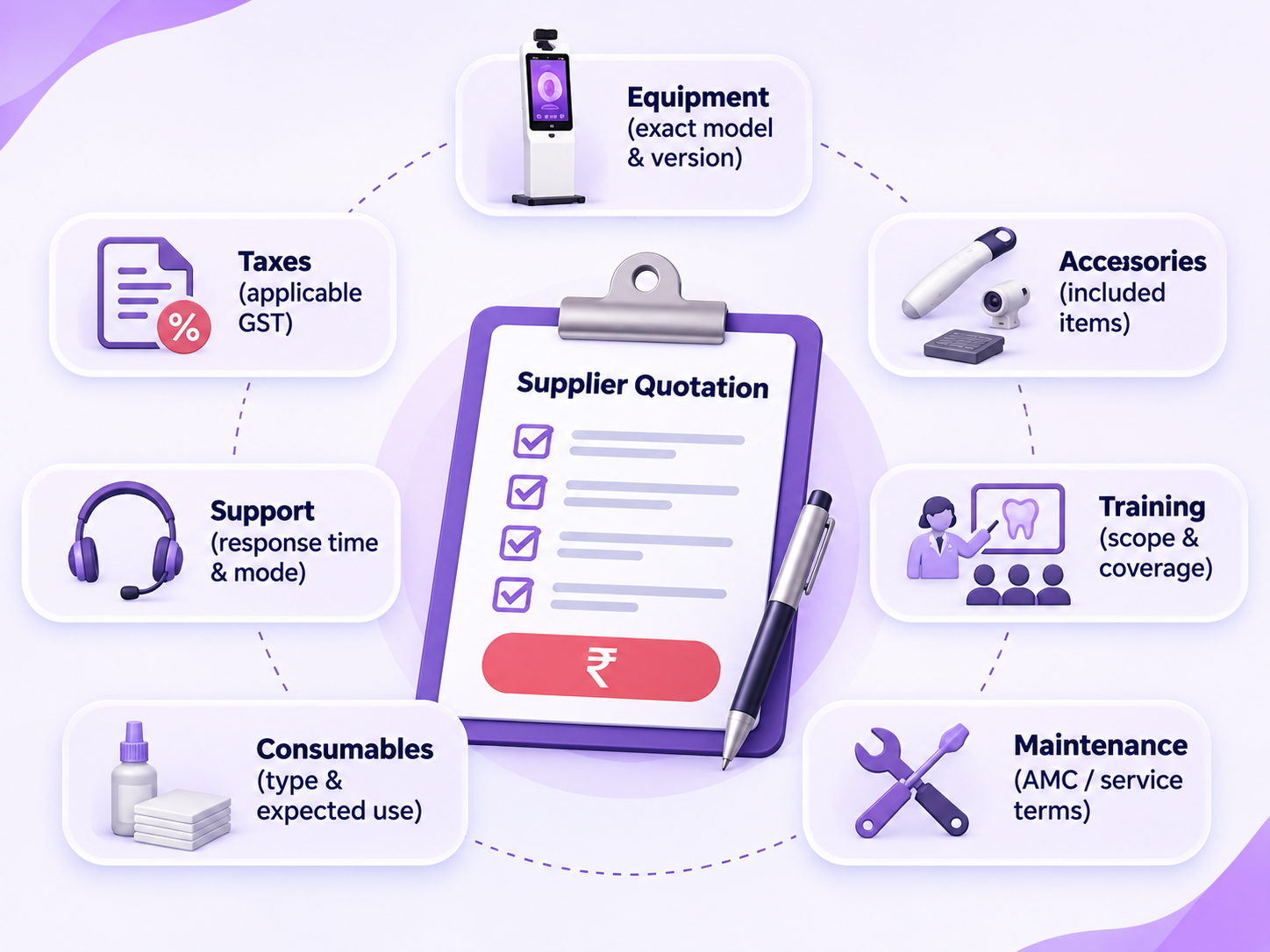
Send every supplier the same short request: exact model and version, intended use, components, taxes, installation, delivery, training, warranty, software term and recurring costs. Ask the seller to list exclusions. Record the quote date and expiry because a promotional listing is not a permanent price promise.
Specify the location and proposed workload. Transport to a camp, shared use between branches and a fixed chairside installation may have different support requirements. Ask whether travel, demonstrations, installation accessories and replacement parts are included or separately charged.
Capital cost is the acquisition and setup needed to make the system usable. Operating cost includes consumables, subscriptions, staff effort, service and repeat work. Do not omit an existing laptop simply because it is already owned: document whether it can support the workflow without disrupting another task.
Budget staff time in rupees as well as minutes when comparing operational options. Use the actual clinic payroll basis and observed workflow time. Do not turn a supplier's claimed capture time into a complete patient encounter time. Consent, examination, counselling and referral are separate tasks.
Suppose a fictional clinic compares two documentation setups. Setup A has an illustrative acquisition cost of ₹60,000 and annual service/software of ₹6,000. Setup B has an illustrative acquisition cost of ₹90,000 and annual service/software of ₹2,000. Over three years, those inputs produce ₹78,000 and ₹96,000 respectively before other costs.
These are arithmetic inputs, not market prices. The comparison is still incomplete until training, tax, downtime, staff time and consumables are added. A cheaper option is not automatically clinically suitable, and a more expensive option does not automatically improve outcomes.
Spread the full cost over a conservative number of completed encounters. If three-year cost is an illustrative ₹90,000 and the clinic completes 900 relevant encounters, allocated equipment cost is ₹100 each. At 300 encounters, it becomes ₹300. Neither figure is a recommended screening fee or proof of profitability.
Test whether the clinic can absorb maintenance and service payments during quiet months. Do not assume that identifying a finding creates a treatment sale. Clinical decisions, patient choice and actual collections must remain separate from the device's financial model.
Clarify whether the camera, display, battery, cable and accessories have the same warranty. Ask who pays courier charges, whether a loaner exists and how service time is measured. Request written terms for data export when a subscription ends.
For scanO air, obtain a current written commercial proposal rather than borrowing a festival or webinar offer. Confirm what screening access includes, whether other scanO products are separately priced and which financing charges apply. This guide makes no claim that scanO air is a cancer detection device.
Use a quote comparison that separates the device's claimed intended use from the workflow the practice actually needs. Ask the seller to identify the manufacturer and exact model, the method used to evaluate performance, the current instructions for use, service coverage in your city, and the limitations disclosed to patients. A demonstration can show whether the team can operate the equipment; it cannot establish clinical sensitivity or rule out disease.
For each quote, document which costs are paid once, which recur, and which depend on volume. Include software subscriptions, consumables, installation, training, support travel, renewal charges, repair contingencies and taxes confirmed by the seller. Have a clinician assess whether the result changes examination or referral decisions in an appropriate and evidence-supported way.
Suppose two suppliers submit quotes with different licence terms. Do not compare only the first invoice. Request a three-year schedule for both, including what happens if the clinic stops renewing software and whether records remain exportable. Use a separate clinical suitability decision before price ranking. These are evaluation steps, not endorsements or price estimates.
Keep the quote, evidence review and decision together. Record why the selected configuration fits the intended use and who approved it. If there is no verified price, write quote required rather than publishing a guessed range.
Use the worksheet below to obtain comparable offers. Review the device evidence comparison before comparing the totals.
For further practical context, see AI dental screening workflows and dental camp operations. These resources support planning; adapt decisions to your clinic and review clinical requirements with qualified professionals.