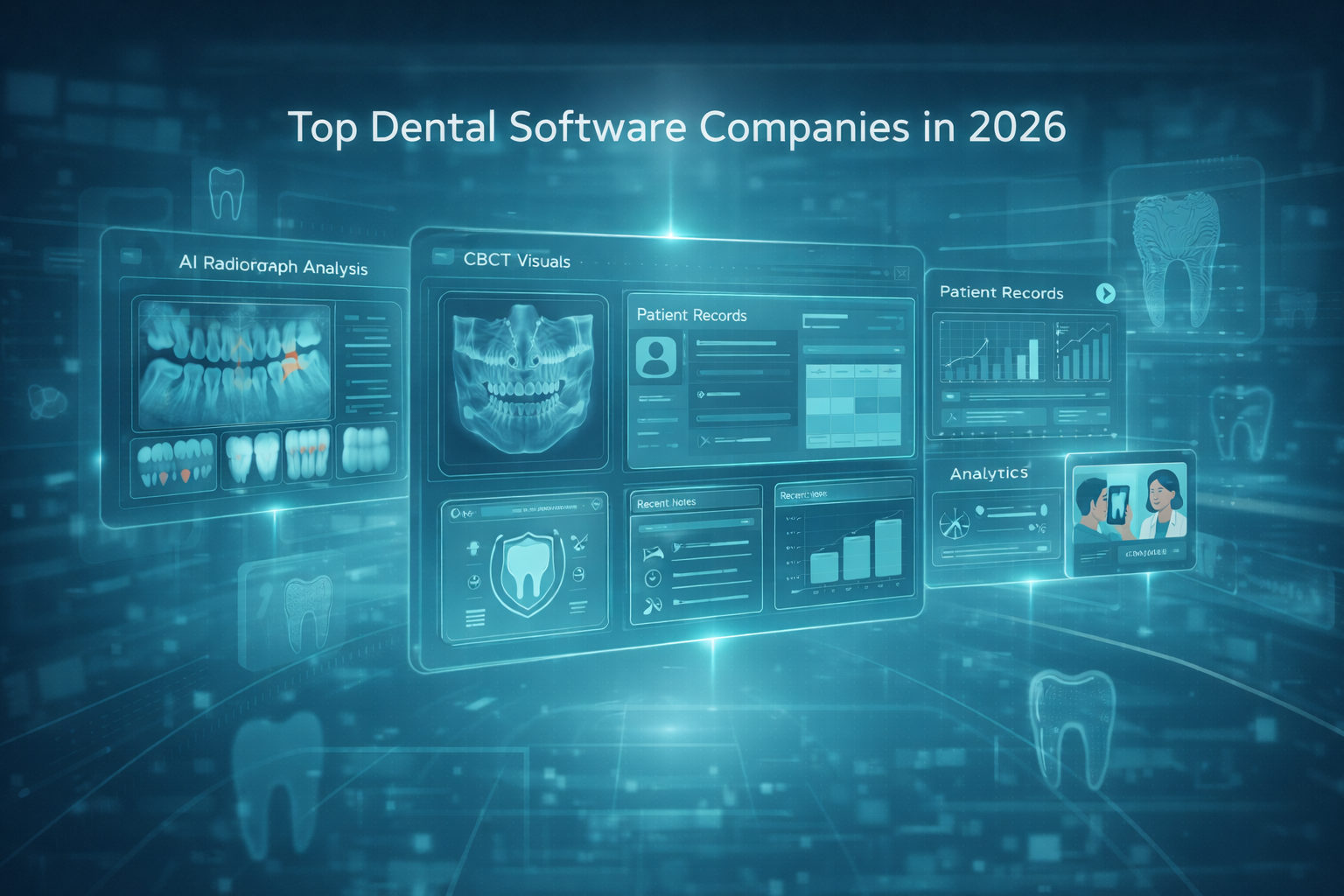
Top Dental Software Companies in 2026: Global & Indian Leaders
Dr G. Lakshmi Barathi
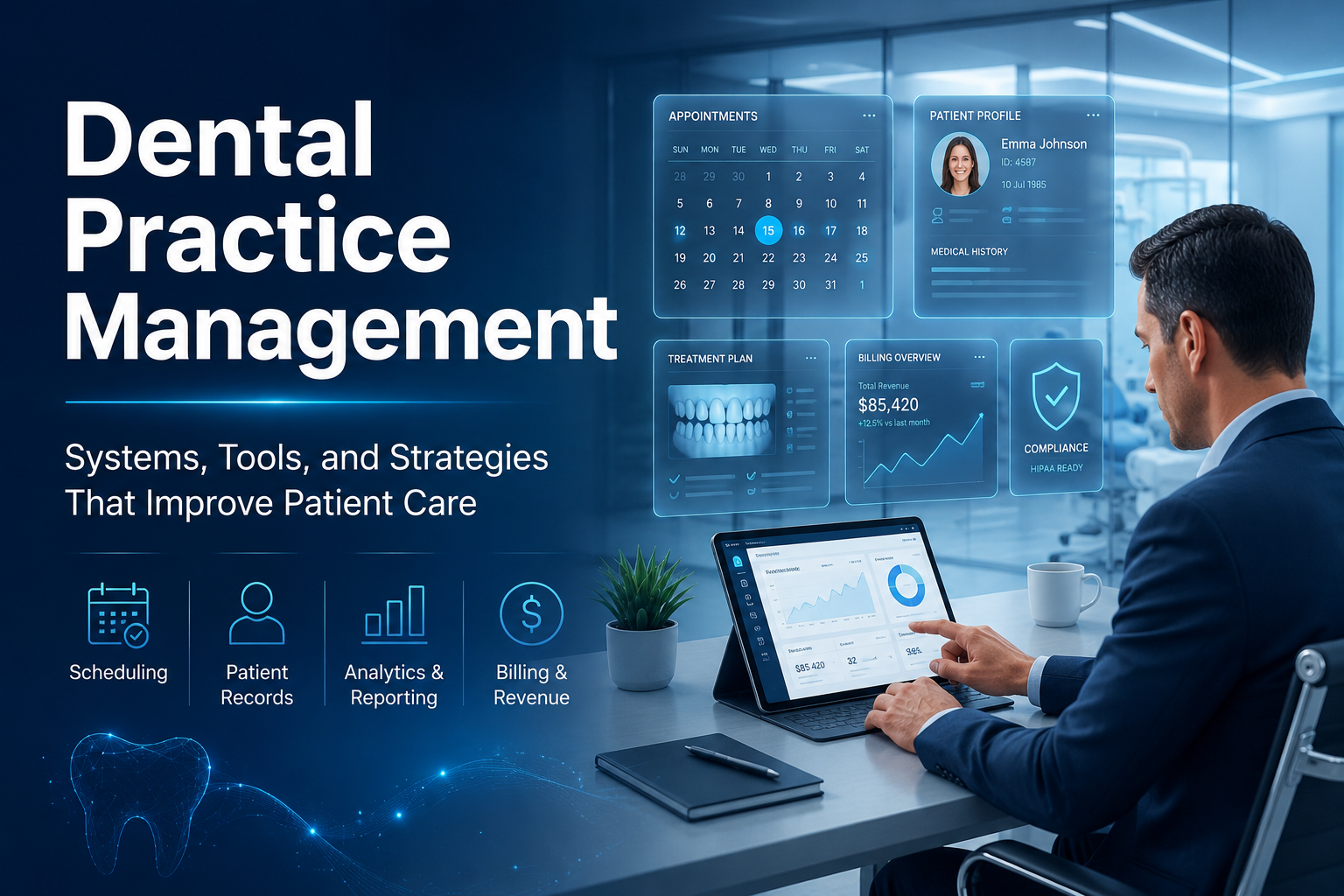
Dental software is being widely adopted, with the global market expected to grow 8.75% over the decade. Clinics are upgrading mainly because these tools are patient-centric and reduce paperwork for dentists. Driven by AI, these tools automate workflows, manage appointments, streamline records and even diagnose diseases.
Let’s explore the top global dental software companies leading the industry and the fast growing Indian leaders shaping dental innovation.
Why Dental Software Matters
The dental system has improved rapidly focusing more on patient care spending less time on paperworks. They offer:
AI-powered radiology
Cloud-based scheduling & billing
Digital treatment planning
Intraoral scanning + CAD/CAM
Automated patient communication
The biggest turnaround came with the arrival of AI dentistry, where tools no longer just schedule appointments, they guide dentists in treating patients. They can automate tasks, diagnose, and even help in preventing cancer.
What Exactly Is Dental Software?
Dental softwares are digital tools that help in managing clinical, administrative, and diagnostic tasks within the dental practice. These systems can be broadly categorized into:
Practice management software: Handles appointment scheduling, billing, and consent forms
Imaging Software: Used to analyse X-rays, RVGs, CBCTs
AI Diagnostics: Detects caries, lesions, bone loss and pathologies
Intraoral scanning: Enables digital impressions, aligners, crown and design management.
Patient communication: Patient support by remainders, marketing and analysis.
Most top companies offer integrated platforms combining two or more of these features.
Features to Look For in 2026
Before we explore the leaders, here are the must-have features modern clinics should look for:
AI-assisted diagnosis (radiology + charting)
Cloud-based access (work from anywhere)
Integration with scanners, RVGs, CBCTs
E-prescriptions and digital consent forms
Automated reminders & WhatsApp communication
Treatment planning dashboards
Cybersecurity + encrypted patient data
Inventory management
Multi-branch scalability
Affordable pricing aligned with your practice size
Considering the above criteria let us look at the top global and Indian players in this field.
Top 10 Dental Software compaines in 2026: From PMS to AI-Powered Diagnosis
Dental software is transforming the way that dentists look at practicing dentistry. They are more focused on patient centric approach.
Let's peek into the top 10 dental software platforms to watch in 2026.
1. scanO (AI + Preventive Dental Ecosystem)
Overview
scanO (by scanO AI) is an Indian deep-tech company building an AI-powered dental screening ecosystem. It offers fast, contactless scans, real-time AI diagnosis, and clinic management features.
Key Products / Modules
scanO Air: A contactless intraoral scanning system that captures images in ~2 minutes, enabling quick, painless exams.
scanO Mobile App: Patients or dentists can scan using the app; AI analyzes for hard-tissue issues (caries, lesions); reports are generated.
TissueAI: A newer AI model to detect soft-tissue (oral lesions, pre-cancerous or cancerous conditions) via scan data.
Strengths
Indian-made, cost-sensitive for local clinics.
Preventive-first: helps dentists catch issues early, even before symptoms.
Patient-friendly reports and overlays make diagnosis transparent.
Scalable: scanO claims wide adoption; real-world validation in many clinics.
Growing AI sophistication: moving from hard tissue (tooth, bone) to soft tissue screening.
Limitations
Requires hardware for “scanO Air” (though mobile apps can help).
AI is only as good as its training data, and may need real-world calibration.
May need training/staff adaptation for the new workflow.
Choosing the right mix depends on what your clinic needs today — and where you want to go tomorrow. If you adopt the right software now, you won't just save time and reduce errors; you'll build a foundation for smarter, more scalable, future-ready dentistry.
2. Dentrix (Henry Schein One)
Overview
It is one of the widely used practice management software systems (PMS) in dentistry. It was developed by Henry Schein One. It supports dentists in appointment scheduling, billing, charting and imaging operations.
Key Features
Cloud-based PMS with multi-location access and no server setup
Detect AI (VideaHealth) for automated X-ray analysis
Dentrix Voice for voice-to-charting
Built-in insurance verification and claims tools
Real-time dashboards and performance reports
SOC-2 Type II security for strong data protection
Strengths
A widely adopted; well-supported ecosystem.
Strong integration with hardware (imaging, radiography).
Good for single clinics as well as multi-branch practices.
Limitations
Licensing and subscription costs can be high for smaller practices.
On-premise versions require IT infrastructure.
AI (via VideaHealth) is powerful but still needs clinical validation by the dentist.
3. Open Dental
Overview
This is an open source PMS that offers on-premise and hosted deployment. It is known for its flexibility as it allows deep customizations and third party integrations.
AI integration: Pearl’s “Second Opinion” radiograph AI can be used in Open Dental to provide diagnostic overlays.
Strengths
Highly customizable to suit specific clinic workflows.
Cost-effective, especially for clinics comfortable with technical setup.
Active developer and user community.
Limitations
The self-hosted version requires IT setup / maintenance.
Customization potential is great, but without planning, it can become messy.
Non-technical staff training required.
4. CareStack
Overview
CareStack is a cloud-native, all-in-one dental software that helps in clinical workflows, patient management, billing, revenue cycle management (RCM), and analytics. It’s designed for all modern digital-first practices.
Key Features
AI Automation for insurance verification and documentations.
Payments & CRM helps in payment processing, and patient membership plans.
Analytics for practice performance, revenue trends, and more.
Security with HIPAA-compliant, SOC-2 Type II, and ISO 27001-certified.
Strengths
Truly unique platform, very little need for additional tools.
Scalable and works well for single practices, groups, and DSOs.
Strong support and regular feature updates.
Limitations
Cloud subscription cost may be a barrier for some small practices.
Migration from another PMS can involve significant effort.
5. tab32
Overview
Tab32 is a cloud-first PMS designed with group practices, DSOs, and data-driven management in mind. It combines clinical, financial, and analytical capabilities under one roof.
Key Features
Real-time cloud charting with radiograph integration.
AI-powered diagnostics (tab32 has integrated Pearl AI for image analysis).
May be overkill for very small, single-chair practices.
6. Practice-Web
Overview
Practice-Web is a longstanding PMS tool for dental clinics, known for its simplicity, reliability, and affordability. It’s especially popular among traditional practices looking for robust but straightforward management software.
iPad-based forms: check-in, consents, custom forms, patient data collection.
Pay-by-text payments, e-prescriptions, and tele-dentistry support.
Reputation management: Reviews module for automated review requests.
Strengths
Lightweight and easy to use.
Cost-effective, particularly for small or solo clinics.
Reliable and well-established support system.
Limitations
Not as feature-rich as modern cloud-native systems.
Limited AI or advanced automation.
On-premise use means maintenance is on you (unless using a hosted version).
7. Pearl (AI Diagnostic)
Overview
Pearl’s flagship AI product is Second Opinion®, an FDA-cleared AI tool that analyzes dental radiographs (bitewing, periapical, panoramic) to highlight and flag potential pathologies.
Key Features
Detects caries, bone loss, calculus, periapical lesions, and other anomalies.
Annotated overlays to help dentists and patients visualize issues.
Practice Intelligence®: operational insights synthesizing imaging + practice data to highlight efficiencies, treatment outcomes, and workflow bottlenecks.
Integration: works with PMS like Open Dental, helping bring AI into existing workflows.
Strengths
Clinically validated: high precision, FDA clearance.
Strong patient-education value: visual overlays make discussions easier.
Helps reduce diagnostic variability and ensures early detection.
Limitations
Subscription cost; ROI depends on volume of radiographs.
Must be used as a decision-support tool, not a replacement for the dentist’s clinical judgment.
8. Overjet (AI Clinical Intelligence)
Overview
Overjet is an AI-native clinical intelligence platform that integrates with imaging, practice workflows, and insurance to optimize diagnosis and operations.
Key Features
IRIS: Their imaging engine enhances dental X-rays using AI (noise reduction, sharper images).
Pathology detection for caries, bone loss, etc., on bitewing and periapical images.
Useful for both clinical and business decisions (e.g., underserved treatment acceptance).
Helps standardize diagnosis across providers in DSOs.
Limitations
Requires integration with existing imaging and PMS.
AI outputs need cautious interpretation.
Subscription infrastructure cost.
9. VideaHealth
Overview
VideaHealth specializes in AI solutions for dental radiography. Their tools aim to support pathology detection and diagnosis within existing PMS systems.
Key Features
Detect AI: Analyzes X-rays to flag potential pathology (caries, bone loss, etc.).
Integrates with Dentrix: Direct integration allows clinicians to review flagged images in their workflow.
Cloud-based inference: radiographs are processed securely in the cloud, and results are returned to the PMS.
Compliance and security built in to support sensitive imaging data.
Strengths
Leverages AI without requiring a full PMS switch.
Helps reduce diagnostic oversight, especially in high-volume clinics.
Easily adoptable within familiar workflows (e.g., Dentrix).
Limitations
Requires subscription / per-image pay model.
As with any AI, it should augment—not replace—clinical decision-making.
May need internet access for cloud inference.
10. Toothsi (by MakeO):
Overview
ToothSi, by MakeO, is a consumer / patient-facing aligner company in India that uses digital 3D scanning and remote monitoring via its app. While not a traditional PMS or AI-diagnostic software, it represents how digital technology is reimagining orthodontics.
Key Features
3D At-Home Scans conducted at home or experience centres
Virtual Treatment Planning with custom aligner plan and smile preview
Remote Monitoring to track progress and consult via MakeO app
FDA-cleared, ISO 13485 3D-printed aligners
Flexible Delivery and follow-ups in-person or via app
Strengths
Makes aligner treatment more accessible and affordable in India.
High convenience: home scan and remote check-ins reduce clinic visits.
Good for patients looking for clear aligners at relatively lower cost than some premium brands.
Considerations / Risks
Multiple user-reported customer service issues with delays in aligner delivery.
As with any aligner-based model, treatment effectiveness depends heavily on patient compliance (wear time, check-ins).
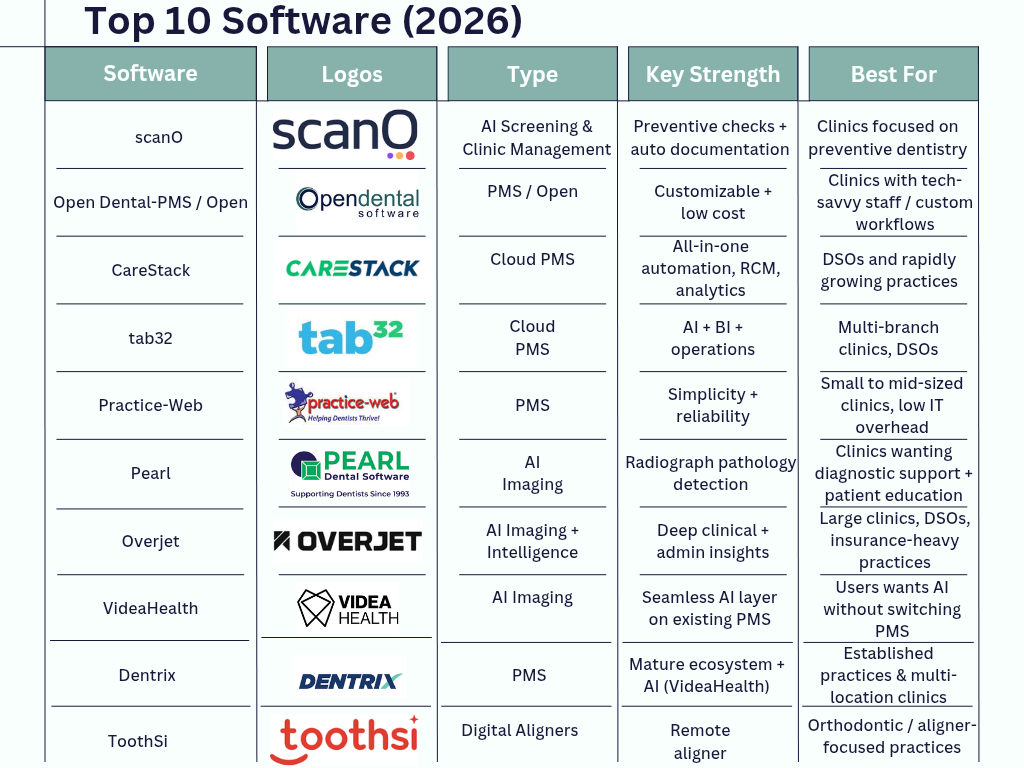
Comparison Table: Top 10 Software (2026)
How to Choose the Right Software (2026)
Practice Size
Single chair: Practice-Web, Open Dental
Growing/Multichair: CareStack, tab32
DSO: CareStack/tab32 + Overjet
AI Needs
X-ray diagnosis: Pearl, Overjet
Preventive checks: scanO
AI add-on: VideaHealth
Ortho/Aligners
Use ToothSi if you offer aligners; high-volume clinics may need dedicated aligner-planning tools.
Budget
Cloud PMS: subscription
Self-hosted: upfront + IT
AI: per-license/per-image
Integration & Training
Check PMS–AI compatibility and imaging hardware.
Ensure staff onboarding for cloud, AI, or scanning tools.
Future Trends (Beyond 2026)
Preventive AI: Tools like scanO and soft-tissue AI will enable early detection of issues, shifting dentistry toward prevention.
Voice Charting: NLP tools will simplify charting and cut documentation time.
Remote Monitoring: Aligners + AI apps will reduce in-clinic visits.
AI Insights: Platforms like Overjet/Pearl will enhance diagnosis and boost clinic efficiency.
All-in-One Systems: More unified platforms combining PMS, AI, imaging, and communication are expected.
Conclusion
The dental software landscape in 2026 is diverse, blending legacy practice-management systems, cloud-native platforms, and AI-powered diagnostic tools. The top 10 tools listed here are shaping not just how dental practices operate, but how they deliver care.
For practice management, Dentrix, Open Dental, CareStack, tab32, and Practice-Web are leaders.
For AI diagnosis, Pearl, Overjet, and VideaHealth are driving precision.
For preventive screening, scanO offers a genuinely innovative, AI-first ecosystem.
For digital orthodontics, ToothSi brings remote scanning and treatment planning into mainstream Indian practice.
Choosing the right mix depends on what your clinic needs today — and where you want to go tomorrow. If you adopt the right software now, you won't just save time and reduce errors; you'll build a foundation for smarter, more scalable, future-ready dentistry.
Author: Dr.Apeksha Awari
Dr. G. Lakshmi Barathi is a dentist and medical writer with a keen interest in patient education and creative health communication. With clinical experience and a growing digital presence, she now crafts content that bridges the gap between technical knowledge and real-world understanding—especially for students and early-career professionals. When not writing, she’s likely sketching dental doodles or designing brochure.