
A dentist told me about the time his clinic tried switching to digital prescriptions. New software, good intentions, zero planning.
Week one, the drug list was not set up. Finding amoxicillin took longer than writing it by hand. Week two, two staff members were using it, one was not. By week three, the prescription pad was back on the desk and the software subscription was quietly forgotten.
This is more common than most vendors will admit. The tool was probably fine. The implementation was not.
Dental AI has changed what clinics can do clinically. Tissue AI can now flag soft tissue conditions during routine screening. AI-enabled dental e-prescription software can eliminate paper-based prescribing entirely. But even the right technology fails without a proper rollout plan.
Here is how to make the switch without breaking your daily workflow.
Patients expect digital communication now. Booking confirmations on WhatsApp. PDF reports on their phone. Prescriptions they can actually read at a pharmacy.
On the compliance side, insurance providers want documented prescribing records. ABDM frameworks are pushing Indian healthcare toward structured digital health data. A paper prescription that a patient loses is not a recoverable clinical record.
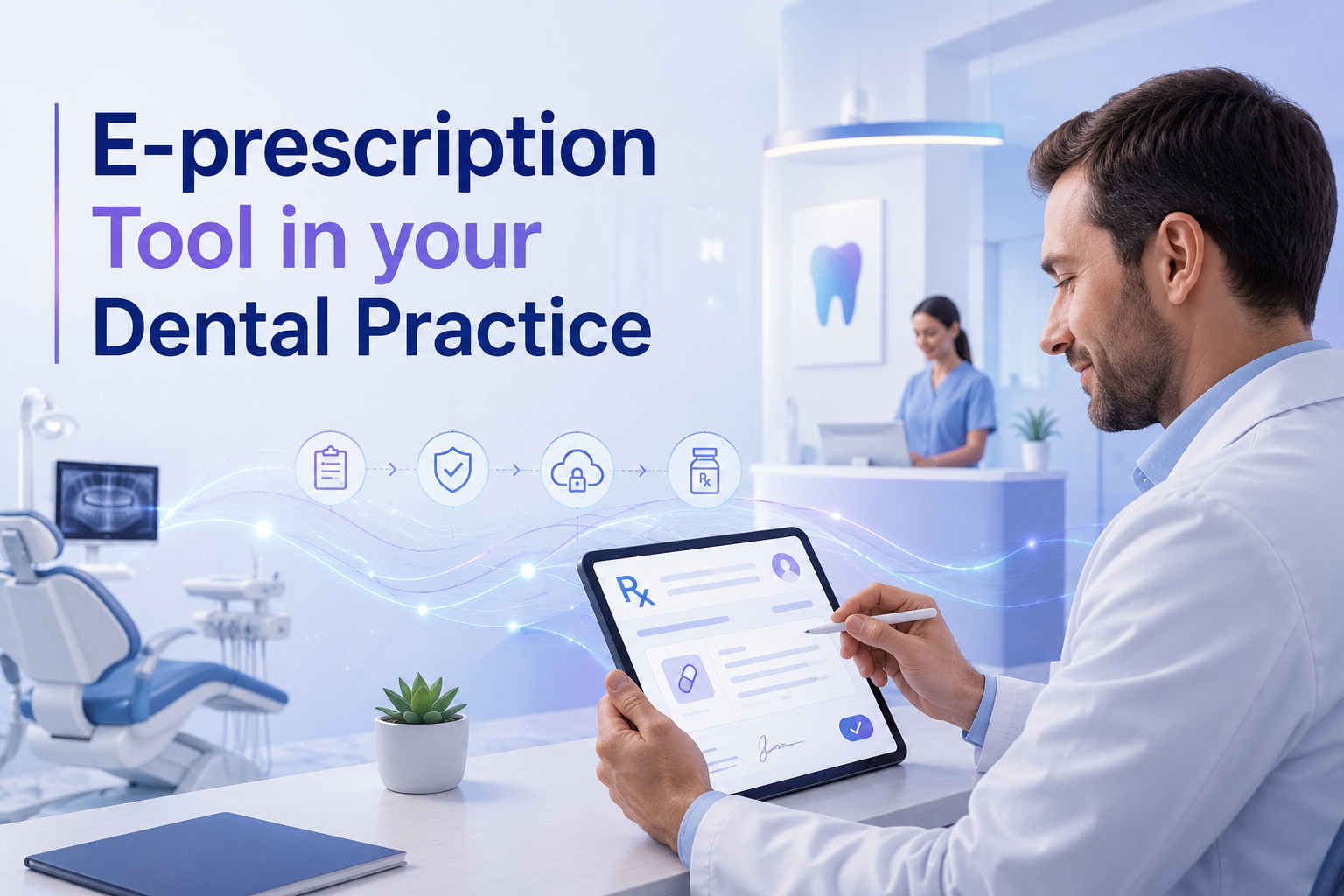
Most dentists already know e-prescription for dental practice is the direction things are heading. Where clinics go wrong is rushing the change mid-week with a full appointment book and no preparation.
The drug list is not configured before go-live. This is the single most common failure point. If your dentist has to scroll through a generic database to find metronidazole, the e-prescription dental software is slower than paper. The formulary must be built before the first real patient uses it.
Staff are not trained together. The dentist is not the only person this affects. Your front desk needs to know what a digital prescription looks like when a patient asks about it. Your assistant needs to know how to pull prescription history. When some people know the system and others do not, the confusion reaches the patient.
The tool sits disconnected from everything else. A standalone electronic dental prescription management software that does not connect to your patient records creates a new silo. The prescription exists digitally, but the next time that patient visits, whoever sees them has to check a separate system to find it. That is fragmentation in a different format, not an actual improvement.
Patients are not told what changed. A patient who has always received a paper chit and suddenly gets a WhatsApp PDF may not trust it. One sentence at checkout resolves this entirely. Skipping that step creates confusion that takes longer to fix than the sentence itself.
Before touching any software, spend one week observing your current prescribing workflow. How many prescriptions do you write daily? Which medications come up every time? How often do patients call back about something prescription-related?
This gives you the configuration data you need and a baseline to measure improvement against.
Load your 15 to 20 most prescribed medications with standard dosage defaults. The antibiotics, analgesics, and anti-inflammatories you write from memory every day.
When evaluating the best e-prescription software for dentist use, this is one of the first things to check. Does it come with a pre-built dental formulary or do you have to build everything from scratch? A dentist who finds the right medication in two taps and confirms a prescription in under 30 seconds will not miss the notepad.
Write both a paper prescription and a digital one for every patient for the first two weeks. No speed pressure. No expectations.
It sounds like extra work. It is not. It builds team confidence without any consequences for getting it wrong. Most clinics drop the paper on their own before the two weeks are finished because the digital workflow is already faster.
This is where the real value of e-prescription for dental practice shows up.
A prescription that sits inside the same platform as appointment history, treatment notes, and clinical scan data is a different thing entirely from a standalone app. Platforms like scanO Engage connect prescriptions to the patient's full clinical profile, including AI scan data from the scanO air robot. The dentist opens one screen and sees everything before the consultation begins.
Because AI appointment scheduling, automated patient reminders, and real-time confirmation tracking also run within the same platform, the prescription does not exist in isolation. It becomes part of a complete patient record that builds over time, visible at every future visit, across every dentist in the practice.
Set up automatic WhatsApp PDF delivery from day one. The completed prescription leaves the system and arrives on the patient's phone without extra steps. The clinic keeps a delivery log. Post-visit callbacks asking for a repeat prescription drop within the first month.
For patients who want a physical copy, in-clinic printout support is standard in most electronic dental prescription management software. Both options can run simultaneously.
Pull the prescribing records at three months. Are there dosage inconsistencies across dentists? Which drugs appear most? Are there patterns worth standardizing?
This clinical governance step is only possible because the data exists in a structured, searchable form. Paper records cannot give you this picture. AI-enabled dental e-prescription software does.

The prescription pad stays in the drawer. That is the first thing.
The second thing is harder to see but more valuable. When prescription data sits alongside appointment records, scan findings, and treatment history in one platform, every future consultation runs better. The dentist has context. The patient has continuity. The clinic owner has visibility into patterns that paper records could never surface.
For practices thinking about a second branch, building this infrastructure before expanding is significantly easier than retrofitting it after. A connected system covers both locations from day one. A manual workaround at branch two doubles the admin overhead rather than sharing it.
The switch from paper to e-prescription dental software takes about ninety days to feel completely natural. After that, the question most clinic owners ask is why they waited so long.
How long before the digital workflow actually feels faster than handwriting?
For most dentists, two to three weeks, provided the formulary is configured properly before go-live. The first few days feel slower. By day ten, selection from a pre-built list is faster than writing from memory.
One of our dentists does not want to change. How do we handle that?
Run the parallel period without making it mandatory. Let the workflow prove itself alongside the current process. Most resistance disappears once the system is visibly faster in daily use. Forced adoption on a rushed timeline is what creates lasting pushback.
Do we need to migrate all historical records before we start?
No. Start with new patients and current visits. Old records can be added gradually as patients return. Trying to migrate everything before launch delays the rollout and adds very little immediate value.
What if the internet goes down during a consultation?
Good e-prescription dental software caches the drug formulary locally so prescriptions can still be written offline. Records sync when connectivity returns. Confirm this specifically before committing to any platform.
An AI-powered co-author focused on generating data-backed insights and linguistic clarity.
Dr. Vidhi Bhanushali is the Co-Founder and Chief Dental Surgeon at scanO . A recipient of the Pierre Fauchard International Merit Award, she is a holistic dentist who believes that everyone should have access to oral healthcare, irrespective of class and geography. She strongly believes that tele-dentistry is the way to achieve that.Dr. Vidhi has also spoken at various dental colleges, addressing the dental fraternity about dental services and innovations. She is a keen researcher and has published various papers on recent advances in dentistry.