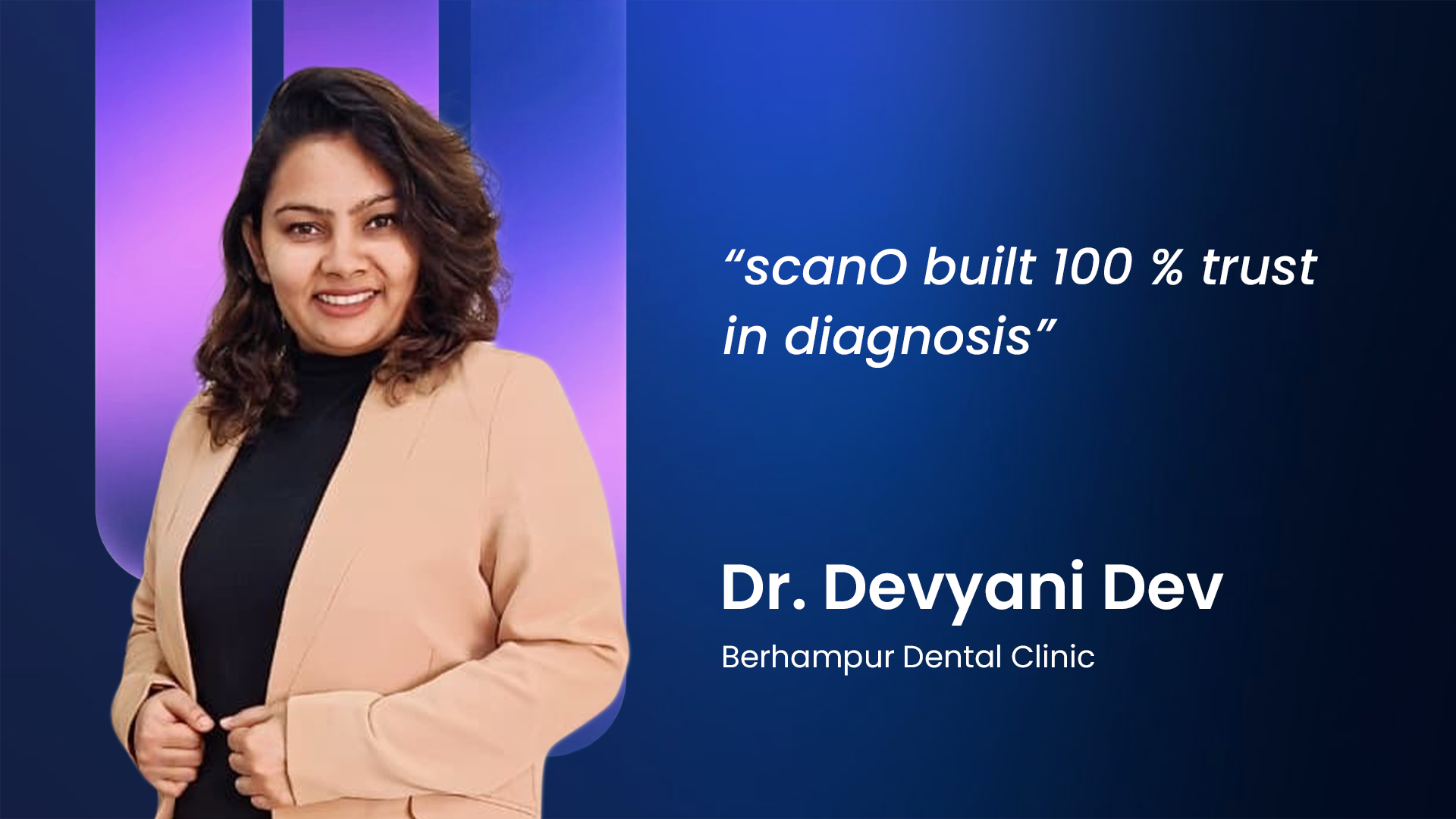





Dr. Sudharson is a periodontist with 25 years of practice behind him. Kumaran Dental Clinic in Tamil Nadu is a well-established, multi-dentist setup - 7 doctors, a loyal patient base built over two and a half decades, and a reputation that brings in both returning families and walk-in patients from across the city.
The clinic was already technology-forward before scanO arrived. Intraoral cameras and digital scanners were part of the workflow. Patients here were educated, engaged, and used to seeing their own oral conditions on a screen before the doctor explained what needed to be done.
Which made what happened next even more telling.
Dr. Sudharson didn't come to scanO through a sales call. He came through his network.
A friend - Mr Vinod from Chennai - was already part of the scanO ecosystem. And when Dr. Sudharson started looking around, he found more people he trusted using it: Dr. Stephen, Dr. Bhaskaran, Dr.Rekha Raj Mohan from Thanjavur, Dr. Mustafa from Vellore. The signal was consistent. These were clinicians whose judgment he respected, and they were all pointing in the same direction.
The camp's angle was the deciding factor. Like many high-volume clinics, Dr. Sudharson's team conducts community outreach regularly - and the idea of a tool that could do meaningful preliminary screening without requiring a dentist to be present for every patient was exactly what he was looking for.
Most clinics treat the scanO device as a shared resource. Someone uses it when they remember to. The front desk offers it sometimes. The doctor occasionally opens the report.
Dr. Sudharson did something different.
He hired a dedicated person - one staff member whose sole responsibility is the scanO device. She sets it up, operates it, manages the Wi-Fi, dismantles it for camp transport, reassembles it on-site, and handles every patient who comes through for a scan.
The result? scanO became a protocol, not an option. Every new patient and every patient returning after a gap goes through the scan first — before they ever sit in the dental chair.
"All new patients, all patients coming after a few months - they have to go for the scanO consultation first. They do the scan, the report is taken to the dentist, and then the physical consultation happens."
Midway through the conversation, Dr. Sudharson paused and said something that every scanO relationship manager should hear - and every new clinic should be told before installation:
In one observation, Dr. Sudharson had diagnosed the single most common reason scanO underperforms in clinics that have it: not the product, not the AI, not the Wi-Fi - the absence of ownership.
Dr. Sudharson reframes the time-saving question in a way that is more honest and more valuable than a simple percentage.
Consultations at Kumaran Dental Clinic haven't become shorter - they've become smarter. The doctor walks in already knowing what the scan flagged. The patient walks in already knowing what to expect. What used to be an explanation becomes a confirmation.
"When the doctor tells them what's needed and the patient says - 'Yes sir, the machine already told me that' - that has a different impact altogether."
Before scanO, treatment acceptance depended on how well the doctor could describe an invisible problem. After scanO, the patient has already seen it.
Scaling treatments in particular see fast acceptance - the scan identifies calculus and the patient, seeing it themselves, agrees on the spot.
The most telling signal of patient trust isn't what patients say in the chair. It's what they do after they leave.
Dr. Sudharson now captures patient testimonials specifically from patients who engaged with scanO - and uses them across the clinic's communications and displays. Patients who see their own oral condition on screen, in their own image, tell their families. Families come in wanting the same experience.
Among all the cases Dr. Sudharson has seen one stands out.
A patient came in with a missing tooth. Not a new problem - the gap had been there for a while, and the patient wasn't particularly concerned about it. Verbally told about the issue, he brushed it off. It wasn't painful. It wasn't bothering him.
When the AI flagged the missing tooth and the patient saw - on the screen, in his own mouth - the gap that everyone around him had been seeing for years, something shifted. He saw what his smile looked like from the outside. He felt the embarrassment of that realisation.
No lengthy explanation. No repeated consultations. One scan, one mirror moment - and a patient who had been refusing treatment for years said yes.
Kumaran Dental Clinic runs at least one community camp per month, and scanO goes to every one of them. The same dedicated staff member who manages the device in the clinic packs it up, travels with the team, sets it up on-site, and manages the screening queue.
The camps have revealed an interesting social dynamic: adults in public settings are sometimes hesitant to open their mouth in front of others, with a camera pointed at them.
Children, on the other hand, are the opposite.
Which points to something larger - the earlier patients encounter oral health screening as a normal, technology-driven, non-threatening experience, the more likely they are to engage with dental care throughout their lives.
When asked what his clinic would miss most if scanO disappeared, Dr. Sudharson's answer pointed back to where he started - the 50% of the consultation that now arrives before the consultation even begins.
The inputs. The head start. The patient who walks into the chair already knows what the doctor is about to tell them.
That's not just a workflow improvement. That's a fundamentally different relationship between a patient and their own health.
.png)
.png)
.png)


.png)
.png)



.png)


.png)

.png)
.png)
.png)