.png)


Walk into Prime Dental Clinic on any normal day and the floor is busy. Twelve to thirteen specialists, thirteen dental staff, a receptionist, a dedicated patient care executive - multiple specialities running side by side on a single floor, somehow without colliding.
Patients show up steadily. Some with pain, some with sensitivity, some only because someone told them to come.
And almost all of them bring someone along - a parent, a sibling, a friend.
That person is the protagonist of this story.
They didn't come to be treated. They came to keep someone company. They probably haven't seen a dentist in years. And until recently, the clinic had nothing to offer them except a chair to sit on.
Before scanO, the waiting area was just a waiting area.
Today, the patient care executive walks up to the attendant and offers something simple: a free AI scan, no instruments, no discomfort, no obligation. Just curiosity.
The shift afterward is what the team didn't expect. People who walked in convinced they were "fine" suddenly aren't sure - because for the first time, they aren't being told something is off, they're seeing it.
A stain they'd ignored. A misalignment they'd never noticed. An early warning sign they couldn't yet feel.
Most don't book an appointment that day. But the thought sits with them. Something needs attention.
Dr. Akanksha, the floor manager, was the first to notice the second-order effect.
Patients walking into consultations were no longer starting from zero. By the time they sat in the chair, they had already seen their scan, heard a basic explanation from the patient care team, and started turning the question over in their head.
That meant the doctors could skip past the basics and spend their time on what actually needed a doctor - Focused diagnosis and treatment planning.
It wasn't a workflow change anyone had explicitly designed. It just emerged.
The thing that's easy to miss in a story like this is that the technology isn't doing the work alone.
The patient care executive sets context before the consultation. The clinical team builds on that awareness during diagnosis. The front desk holds the journey together. scanO is a tool inside a choreographed handoff - and without the people, the scan would just be a printout.
Here is the part we didn't see coming.
The biggest impact at Prime isn't on the patients who walked in for treatment. It's on the people who didn't.
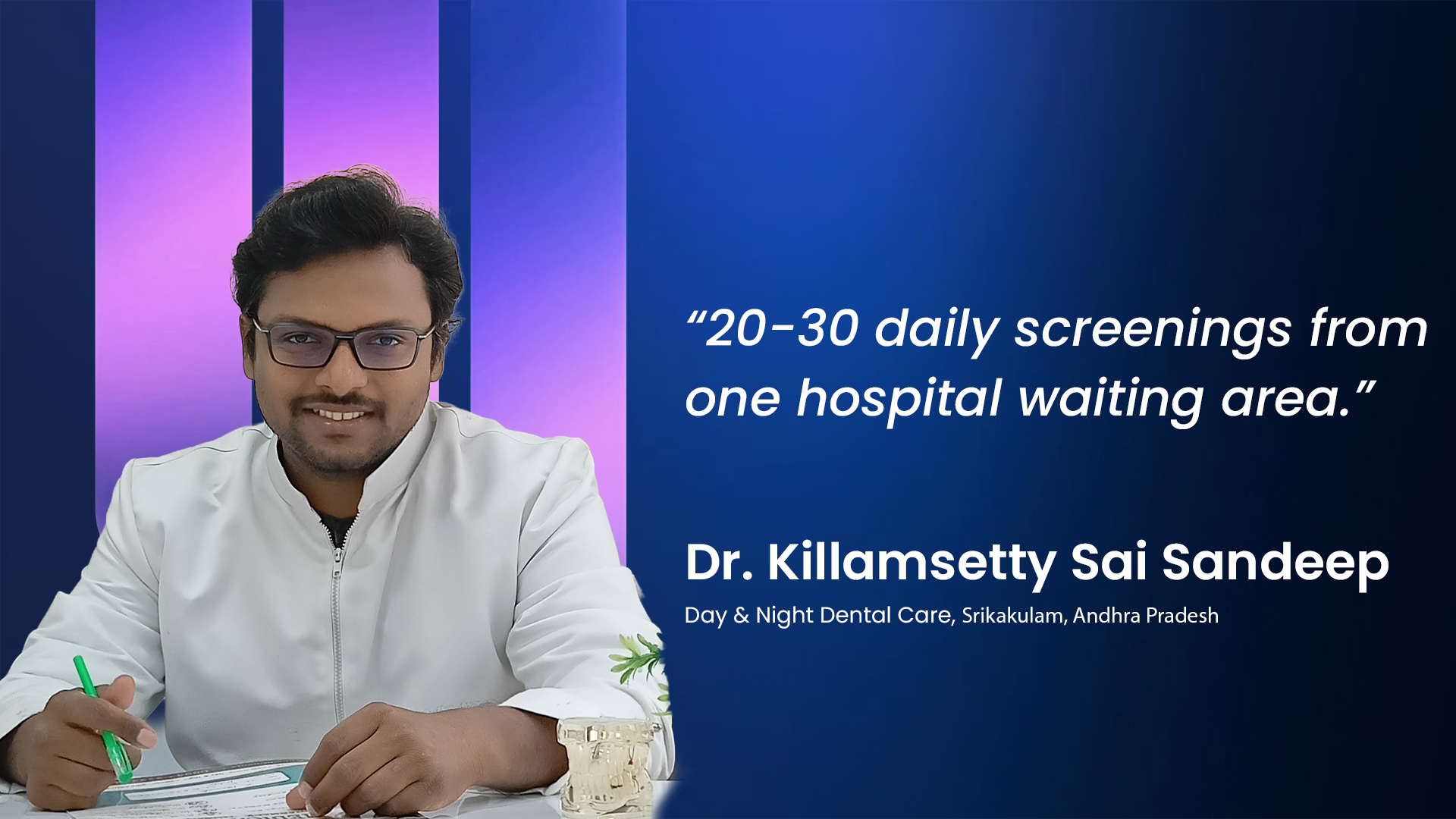
The same pattern shows up at scale in the clinic's corporate screening camps: 100+ screenings in a single day, with roughly 10–20% eventually converting into clinic visits. Not in the same week. Not always in the same month. But consistently, over time.
It didn't replace diagnosis. It didn't take any decision out of the doctor's hands.
What it became was something quieter and, in retrospect, more useful: a starting point. A visual conversation tool. A nudge toward looking after something before it starts hurting.
We're not interested in pretending the system is something it isn't.
The strength of the system isn't in being the final word. It's in being the first word - the one that gets the conversation started at all.
Here is the part we didn't see coming.
The biggest impact at Prime isn't on the patients who walked in for treatment. It's on the people who didn't.
The same pattern shows up at scale in the clinic's corporate screening camps: 100+ screenings in a single day, with roughly 10–20% eventually converting into clinic visits. Not in the same week. Not always in the same month. But consistently, over time.
It didn't replace diagnosis. It didn't take any decision out of the doctor's hands.
What it became was something quieter and, in retrospect, more useful: a starting point. A visual conversation tool. A nudge toward looking after something before it starts hurting.
We're not interested in pretending the system is something it isn't.
The strength of the system isn't in being the final word. It's in being the first word - the one that gets the conversation started at all.
Most patients in India still visit a dentist only when something hurts.
What's happening at Prime, slowly, is a small change in that pattern: people are starting to look before it hurts.
That's the whole case study.
scanO didn't optimise Prime Dental Clinic's workflow so much as it changed who entered the dental journey, and when. Because sometimes the most important patient in the building is the one who didn't plan to become one.
.png)
.png)
.png)


.png)



.png)


.png)

.png)
.png)
.png)