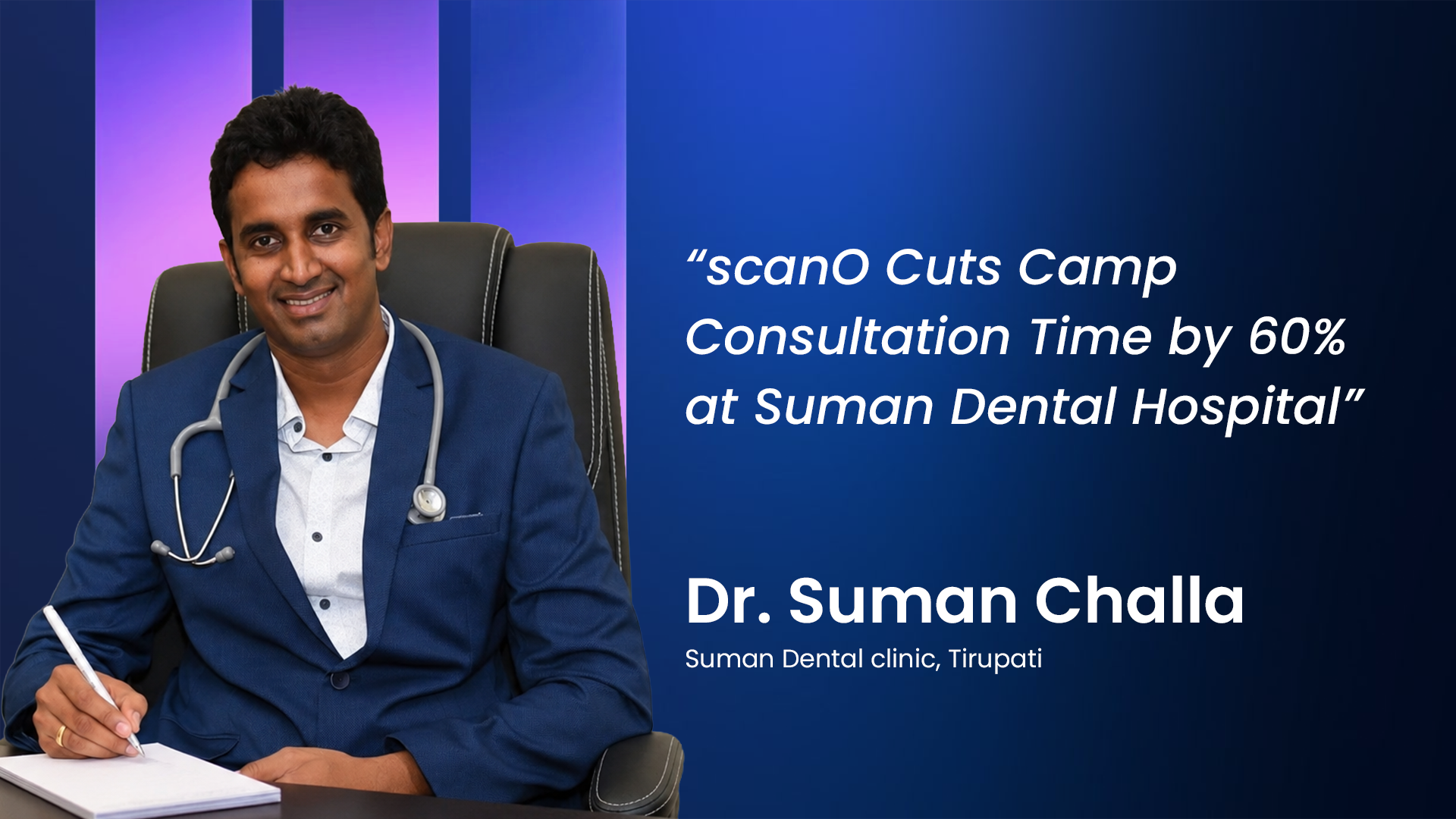



Dr. Suman Challa does not run a typical dental clinic. He runs a movement.
Suman Dental Hospital in Tirupati District, Andhra Pradesh is a three-floor, five-chair comprehensive dental care unit with a nine-member team, five full-time doctors and four rotating specialists, each assigned a dedicated day. Monday is endodontics. Tuesday is surgery. Wednesday is lasers and flaps. Thursday is more surgery. Friday is implants. Saturday rounds it all out.
But what defines Dr. Suman Challa more than his clinic is what he does outside of it.
In 17 years of practice, he has conducted more than 275 community dental camps, reaching schools, rural communities, and tribal areas across the Tirupati region. Long before scanO arrived, dental outreach was already the core of his identity as a clinician. He is not someone who discovered the value of community health through a product. He built that value from the ground up, one camp at a time.
When he saw scanO on Facebook, he did not see a gadget. He saw an upgrade to something he had already spent two decades building.
Dr. Challa has been conducting camps since the beginning of his practice. He is tied up with local trusts and service organisations who organise the camps. His team shows up, screens patients clinically, explains conditions verbally, and refers them onward.
By the time scanO entered his life, he had already run more than 250 camps without it.
The challenge with conventional camp screening is universal: you are asking patients who have often never visited a dentist, who are anxious about instruments, who have deep-seated mistrust of clinical authority, to sit still, open their mouths, and trust what a doctor tells them about conditions they cannot see or feel.
The instruments create fear. The clinical examination creates defensiveness. The verbal explanation creates doubt.
The anxiety flips. The fear becomes curiosity. The reluctance becomes enthusiasm. And it happens the moment the patient realises there are no instruments coming near them.
Dr. Challa saw scanO on Facebook. The moment he understood what it did, the decision was immediate.
He had already conducted more than 250 camps before purchasing. He did not need convincing about the value of outreach. What scanO gave him was a tool that made outreach measurably better, faster, more engaging, more trusted, and more impactful.
Dr. Challa uses scanO exclusively for camps, two dedicated camp days every week, Wednesday and Saturday, running 5 to 6 camps per month minimum.
The workflow is clean and deliberate. The scanO device goes to the camp location. Patients line up, not out of obligation but out of curiosity, because most of them have never seen anything like it. The scan happens. The report lands on the patient's WhatsApp. Then the doctors step in.
The scan is not a replacement for clinical examination. It is the conversation starter, the thing that turns a reluctant camp patient into an engaged one before the doctor says a single word.
In a conventional camp, bringing a patient to a chair, conducting a clinical examination, explaining findings, and managing anxiety takes 15 minutes minimum per patient.
With scanO, the patient arrives at the doctor already holding their report.
That is a 50–60% reduction in per-patient consultation time. At a camp with 50 patients, that is the difference between a 12-hour day and a 6-hour one. At 5–6 camps a month across Tirupati's rural communities, that saved time translates directly into more patients being reached, more conditions detected, and more lives impacted.
Dr. Challa articulates the trust dynamic with the clarity of someone who has spent 19 years navigating it.
Patients in India's rural communities come to dental camps with a specific mindset. They will accept what they came for, their chief complaint, but they are deeply skeptical of anything beyond it. Tell a patient verbally that they also need scaling, or that a seemingly fine tooth has early decay, and the immediate suspicion is that the doctor is after money.
The machine changes this entirely.
When a patient's own teeth appear on the screen, when the AI flags a condition in colour, when the report arrives on their phone, the clinical recommendation stops being the doctor's opinion and becomes objective evidence. The trust gap that has defined dentistry's relationship with India's underserved populations begins to close.
"Definitely, definitely. They ask more questions. They are more engaged."
Dr. Challa does not give a conversion percentage. What he gives instead is more telling.
Patients who receive their report at a camp go home and show their families. Family members who never attended the camp call the clinic. The WhatsApp report becomes a referral engine, not through any marketing mechanism, but through the natural human impulse to share something surprising and useful.
In a rural community where word of mouth is the primary driver of healthcare decisions, this is how a camp at one school becomes patients from five surrounding villages.
Dr. Challa does not point to one dramatic clinical moment. He points to something that happens at every camp, with every patient, every single time.
The surprise. The moment a person who has never thought about their oral health sees their own teeth on a screen, with conditions colour-coded and explained, with a report appearing on their personal WhatsApp in real time.
That moment of surprise is the entire point. It is the thing that converts a camp attendee into a patient, a skeptic into an engaged participant, and a single camp visit into a long-term relationship with dental health.
When asked what would happen if scanO disappeared from his camps, Dr. Challa's response was unambiguous.
Not a measured assessment of operational impact. Not a list of features he relies on. Just a flat refusal to entertain the idea. After 35 plus camps with scanO, it has become inseparable from how he thinks about outreach.
When asked for his top three advantages of scanO, Dr. Challa does not talk about efficiency metrics or conversion rates. He talks about people.
First: Patient awareness. The scan makes visible what was invisible, to the patient, not just to the doctor. That awareness is the foundation of every treatment that follows.
Second: Reduced fear. "In the camp, everybody feels interesting, showing their teeth." The contactless, instrument-free nature of scanO removes the single biggest barrier to dental camp participation: fear.
Third: Trust. The machine is trusted precisely because it has no financial interest in the diagnosis. In a country where the dentist-patient trust gap is a real and documented barrier to care, an impartial AI report changes the dynamic of every clinical conversation.
Dr. Challa's feature request came without prompting and it was specific.
He was referring to Tissue AI, the ability to screen for precancerous and cancerous oral soft tissue lesions using the scanO engage app. Considering that his camps serve rural and tribal populations in Andhra Pradesh, communities with significant tobacco and betel nut use where oral cancer is caught late almost universally, this request is not a wish for a feature. It is a clinical imperative.
The good news: Tissue AI is already live on the scanO engage app. Dr. Challa is now equipped to screen 13 soft tissue surfaces using his phone's camera at every camp, detecting leukoplakia, OSMF, erythroplakia, and cancerous lesion probabilities with confidence scoring. Starting from his next Wednesday camp.
There is no ambiguity about where Dr. Suman Challa stands.
"100%. 1,000%. Not only 100, 1,000%. Definitely it is very, very good."
Nineteen years of practice. More than 275 camps before scanO. Thirty-five plus camps after. Two dedicated camp days every week. Rural communities, tribal populations, children who have never seen a dentist.
And a recommendation that does not leave room for any other interpretation.
.png)
.png)
.png)


.png)
.png)



.png)


.png)

.png)
.png)
.png)