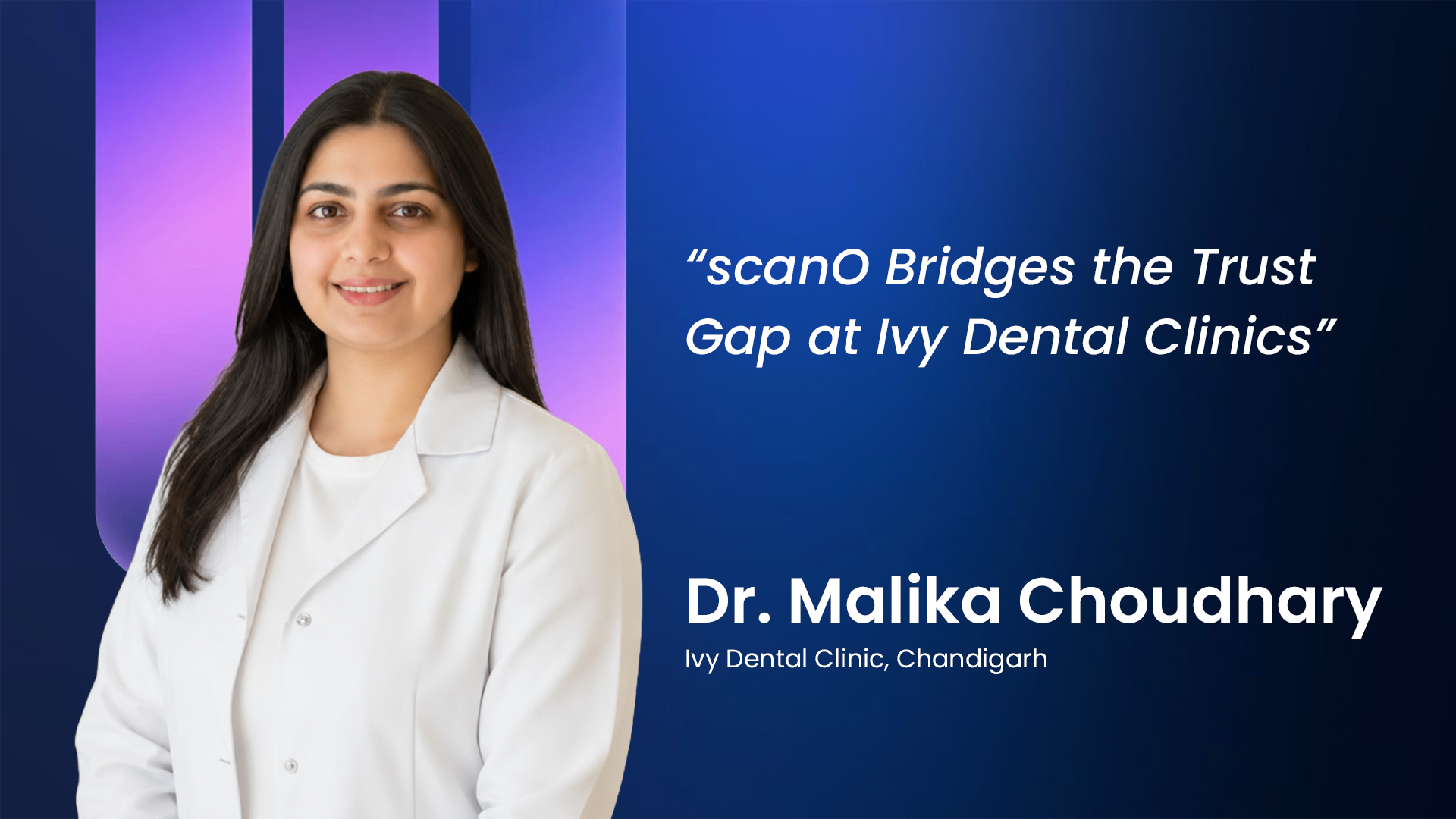








Dr. Malika Choudhary is an endodontist with a philosophy that is quietly radical in Indian dentistry: she does not push treatments. She does not pitch. She diagnoses, presents options, and lets the patient decide.
She is the Clinical Head at Ivy Dental Clinics in Sector 8, Chandigarh, a startup corporate dental chain operating in one of the city's most elite locations. The clinic has been operational since October 2025 and has been building steady footfall in an appointment-based, ethics-first model. She brings seven years of combined clinical experience to a practice that from day one made a deliberate, considered decision: install scanO air at the reception. Not in the operatory. Not as a doctor's tool. At the reception. Where the patient arrives.
That decision is the story.
Before scanO, Dr. Malika faced a challenge that every honest dentist in India knows intimately: the trust gap.
A patient comes in with a painless tooth that needs a root canal. The doctor knows it. The X-ray confirms it. But the moment the treatment recommendation is made, something shifts in the room.
This is the perception that ethical practitioners spend careers fighting. The more you insist on a treatment the patient cannot feel the urgency of, the more the trust erodes. Verbal explanations hit a wall. Clinical authority alone cannot cross it.
The solution, as Dr. Malika discovered, was not to explain differently. It was to show instead.
scanO made this automatic. Before the patient even reaches Dr. Malika’s chair, they have already seen their own teeth, their own calculus, their own caries; flagged by an AI, in colour, on a screen.
Dr. Malika was the first person scanned by the scanO air device when it arrived at her clinic.
But what struck her was not just the clinical output. It was the psychological mechanism. The machine does something that a doctor's words cannot fully replicate . The finding is not coming from someone who benefits financially from the treatment. It is coming from a machine. An impartial, uninterested, AI-powered machine.
This is the trust gap being closed, not by a better sales conversation, but by removing the sales dynamic entirely.
The workflow at Ivy Dental Clinics is thoughtfully designed. When a patient walks in, they are greeted by the receptionist and the dental assistant. They fill in a patient registration form with their consent and demographic details. And then, before they wait, before they sit in a chair, before they meet the doctor, they are guided to the scanO air.
By the time the patient reaches Dr. Malika’s chair, the consultation has already begun, on the patient's terms, through the patient's own curiosity, triggered by the patient's own image on a screen.
She then reviews the scan on her PC, conducts a clinical examination using her intraoral camera, takes additional images, and if required, moves to OPG or diagnostic videos. The AI report is the first layer. The clinical examination is the second. Together, they are more powerful than either alone.
The clinic also runs a dedicated AI screening advertisement, they ran it for free consultations and patients walked in specifically because of the AI diagnostic offer.
The reach of scanO at Ivy Dental Clinics has extended well beyond the patients themselves.
The clinic shares space with a skin branch. The skin therapist, the dental therapist, the office boy; they all scan themselves. Regularly.
Then there are Dr. Malika's children.
A machine that a child finds magical is a machine that removes dental anxiety at its root. For a profession that loses patients to fear before they even sit in the chair, this is not a small thing.
Dr. Malika gives an honest, nuanced answer on consultation time; and it is more interesting than a simple percentage.
This is the observation of a doctor who sees time differently because she runs an ethics-first, no-pressure practice. The time saved is not in explanation, it is in persuasion. The conversation that used to require convincing now begins with the patient already partially convinced. The scan has done the groundwork. The doctor walks in to confirm, not to sell.
A 10 percentage point improvement in case conversion for an ethics-first practice that does not push treatments is not a small achievement. This is not conversion driven by pressure, it is conversion driven by evidence. Patients who see their diagnosis convert at a higher rate because they believe it.
Dr. Malika's observation on patient trust is one of the most thoughtful in this entire series.
"For sure it builds trust. But patients need both things - a human touch and a machine second viewpoint - to make sure that yes, this is it. They need assurance from both sides."
This is the new model of patient trust in dentistry: the doctor's clinical authority validated by the machine, and the machine's AI output validated by the doctor. Neither alone is sufficient. Together, they create a level of confidence in diagnosis that neither can achieve independently. The machine is impartial. The doctor is human. The patient needs both to feel completely sure.
Dr. Malika has a protocol for attendees and bystanders - everyone who accompanies a patient to Ivy Dental Clinics gets offered a free AI scan. Every single one.
And the WhatsApp report travels.
One in five patients who share their report with a family member generates a new patient visit. Without any marketing spend. Without any follow-up call. Just a report on WhatsApp, shared at the dinner table.
One day, the scanO device had a network issue and went offline for a short period.
Patients noticed immediately.
A device that patients ask about when it is not there is not a nice-to-have. It has become part of what patients expect from the clinic. It is part of the experience of coming to Ivy Dental. Its absence is felt.
The scan's sensitivity to early-stage findings, stains, slight misalignment, early pit and fissure caries; gives Dr. Mallika had a clinical conversation she could not easily have before. Not because she did not know these things needed attention, but because patients could not feel what she was describing.
Now they can see it. And seeing something early, before it becomes painful, is the entire point of preventive dentistry.
She also has a specific placement recommendation from experience: position the device so the patient faces a wall, not the waiting room.
And her bigger vision: create a dedicated AI screening area within the clinic, a space that signals to every patient walking in that this is a practice that takes diagnostics seriously.
Dr. Mallika has an engineering-minded observation; she holds one patent of her own, so she thinks in terms of design and mechanism.
She also flags the image quality for posterior teeth - a consistent field observation across high-volume users that the product team should take seriously.
When asked what she would say to a dentist on the fence about scanO, Dr. Mallika brought it back to the fundamental problem it solves:
That is the case for scanO in one sentence; from a doctor who built her entire practice on the principle of earning trust rather than demanding it.
.png)
.png)
.png)


.png)
.png)



.png)


.png)

.png)
.png)
.png)