







Most dental colleges treat the population around them. Bhojia Dental College covers three states.
Sitting at the crossing point of Punjab, Haryana, and Himachal Pradesh, just 25 kilometres from Chandigarh, the institution sits inside Baddi, one of North India's busiest industrial belts. Factory workers, migrant labour, rural families from the surrounding hills, urban patients driving in from Chandigarh's outskirts. The OPD does not see one demographic. It sees all of them, every single day, in numbers most colleges would consider a record month.
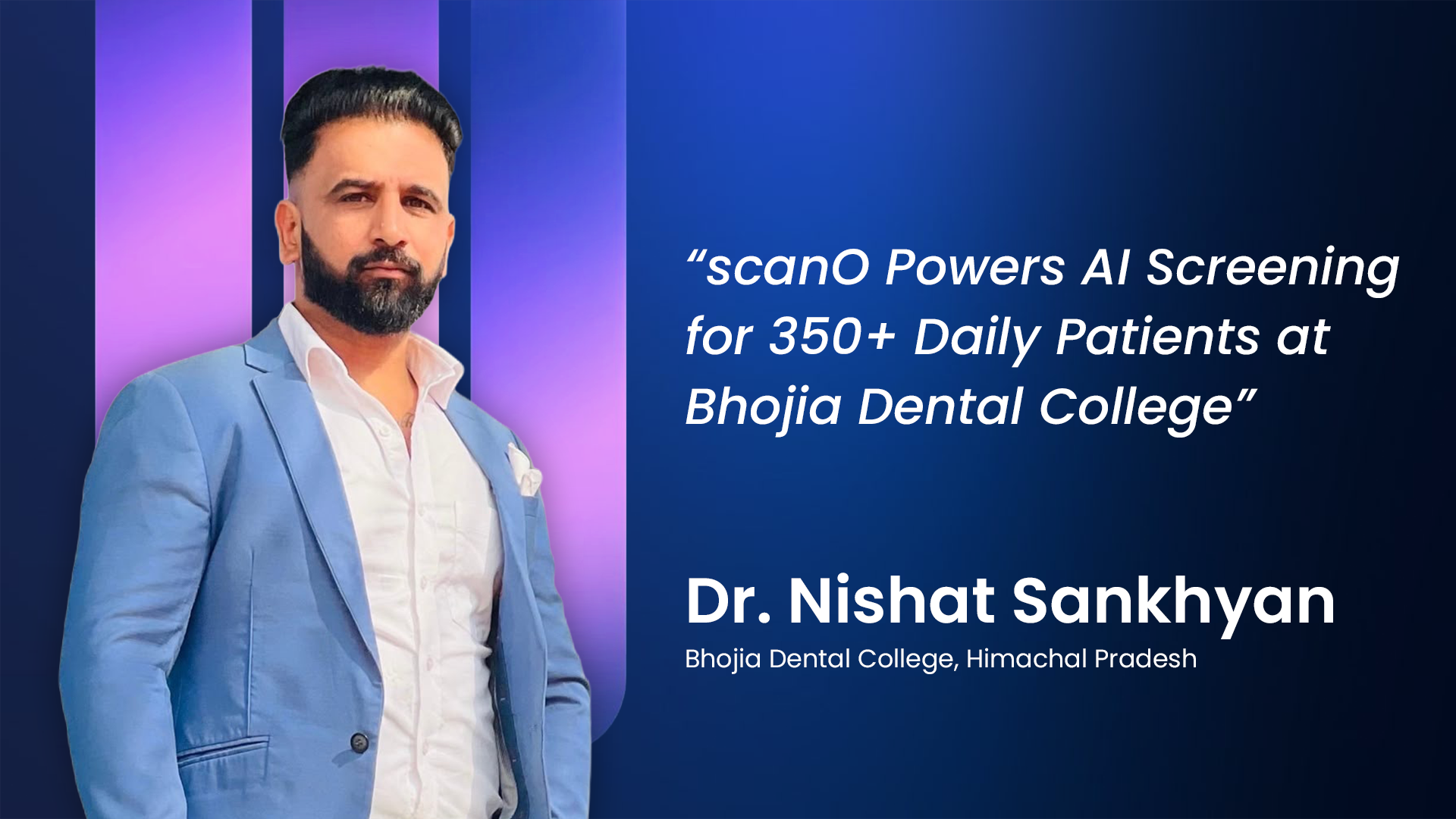
Three hundred and fifty patients a day. Up to 100 of them are brand new, walking into a dental setting, in many cases, for the very first time in their lives.
This is the canvas scanO was placed on. Not a controlled environment. Not a curated patient base. A live, high-volume, three-state border institution where every design decision either works at scale or breaks.
The decision to bring scanO into Bhojia did not come from a procurement committee. It came from the top, and it came from someone who still sees patients himself.
The principal of Bhojia Dental College practices clinically in Chandigarh and Mohali. He understands what a waiting room does to a patient, the boredom, the anxiety, the dead time before anyone has told them anything useful. So when he looked at his own institution's reception area, he saw an opportunity that had nothing to do with technology for its own sake.
That single observation reshaped the building. A dedicated cabin now sits between the entrance and the Department of Oral Medicine, not an afterthought, not a side room, but a deliberate checkpoint built into the architecture of patient flow itself.
Every new patient at Bhojia follows the same sequence now. They register. They are guided into the scanO cabin. They are scanned. The AI report reaches their phone. Only then do they walk into Oral Medicine for clinical examination and documentation.
One dedicated dental assistant runs the cabin full time. The system is not improvised session to session, it is owned, staffed, and repeated, day after day, for every one of the 100 new patients who pass through.
At that volume, Bhojia has quietly become one of the highest-throughput scanO deployments anywhere in the country. Over a hundred new AI oral health reports are generated daily. Over a hundred WhatsApp messages landed on patients' phones, many of them holding a digital record of their own mouth for the first time in their lives.
Ask any oral pathology educator what is hardest to teach, and most will say the same thing: comprehensiveness. Students arrive knowing caries, knowing scaling, knowing stains. What takes longer to develop is the habit of seeing the whole mouth instead of just the complaint in front of them.
At Bhojia, every student now begins their clinical interaction with a patient who already has a visual, AI-annotated baseline. The scan does not replace the student's examination. It gives them something to examine against, a reference point that surfaces findings a first-year clinical eye might otherwise miss entirely.
"Discussions become easy. Confidence is better for students."
And because the AI reports everything it sees, not just the patient's stated complaint, students are quietly being trained out of tunnel vision. The machine does not know what the chief complaint was. It reports the whole mouth. Over time, that habit transfers.
Baddi's patient base carries a familiar weight, the same quiet mistrust of clinical recommendations that shows up across working-class India. A patient comes in with a toothache. They want the toothache fixed. Anything beyond that, especially anything with a cost attached, tends to be met with suspicion.
A machine does not carry that suspicion in the same way.
There is also a quieter, second-order effect happening in the waiting area itself. Patients watch other patients get scanned. They see the camera move, the screen react, the report arrive. Curiosity spreads through a room before a single word has been exchanged with staff.
"The patient will catch it. The camera moves, they can see the display, no doubt it is catchy."
In a 350-patient daily environment, that visible curiosity is not incidental. It is a quiet, constant engine of engagement that no poster or pamphlet could replicate.
Bhojia's ambitions do not stop at its own reception desk. The Department of Community and Preventive Dentistry runs satellite camps in the villages surrounding Baddi, and the institution has already identified the right tool for taking scanO there.
The recommendation from within the scanO team is to deploy the scanO machine along with the scanO engage app directly on mobile phones at camp sites. The machine enables high-quality AI-powered oral screening, while the engage app ensures seamless patient registration, report generation, and follow-up communication. The same three images. The same AI analysis. The same WhatsApp report. But with the added flexibility of the engage app, camps can continue smoothly even in challenging environments, without relying entirely on moving hardware into villages with uncertain infrastructure.
Given that Baddi's industrial workforce carries elevated tobacco use, the natural next step raised in conversation was soft tissue screening. The faculty member flagged it directly, unprompted.
That is precisely the population Tissue AI was built to reach: communities with real precancerous and cancerous lesion risk, with no specialist on site, screened through nothing more than a phone.
One of the more striking moments in this conversation was not about patients at all. It was about what the institution could publish.
Without being prompted toward it, the faculty member identified a clear research direction sitting inside their own day-to-day data: a comparative study between AI-generated findings and clinical examination across their patient population.
At 100 new scans a day, Bhojia is generating one of the largest real-world AI oral health datasets in North India almost as a byproduct of routine care. With a CBCT machine already in place, the institution has the infrastructure ambition to match. What it now has, almost incidentally, is the dataset to turn that ambition into peer-reviewed evidence on how AI diagnostics perform against trained clinical examination, at scale, in an Indian teaching hospital.
Asked what would happen if scanO vanished from the institution overnight, the answer was measured rather than dramatic, and arguably more honest for it.
Six months is not long enough to claim total dependency. But the trajectory is unmistakable. The cabin is built into the building. The assistant is trained and dedicated. Students are forming new diagnostic habits around it. Faculty are beginning to think about it as a research instrument, not just a screening tool. What started as a reception-desk improvement is steadily becoming infrastructure.
Bhojia does not have the luxury of being the only option for patients in its catchment area. Chandigarh, with its dense concentration of dental institutions and private clinics, is a short drive away. Differentiation is not optional here, it is survival.
A dental college that screens every new patient with AI before they even reach a clinical chair, and is now extending that same technology into the villages around it, is making a statement that travels well beyond Baddi.
.png)
.png)
.png)


.png)
.png)



.png)


.png)

.png)
.png)
.png)