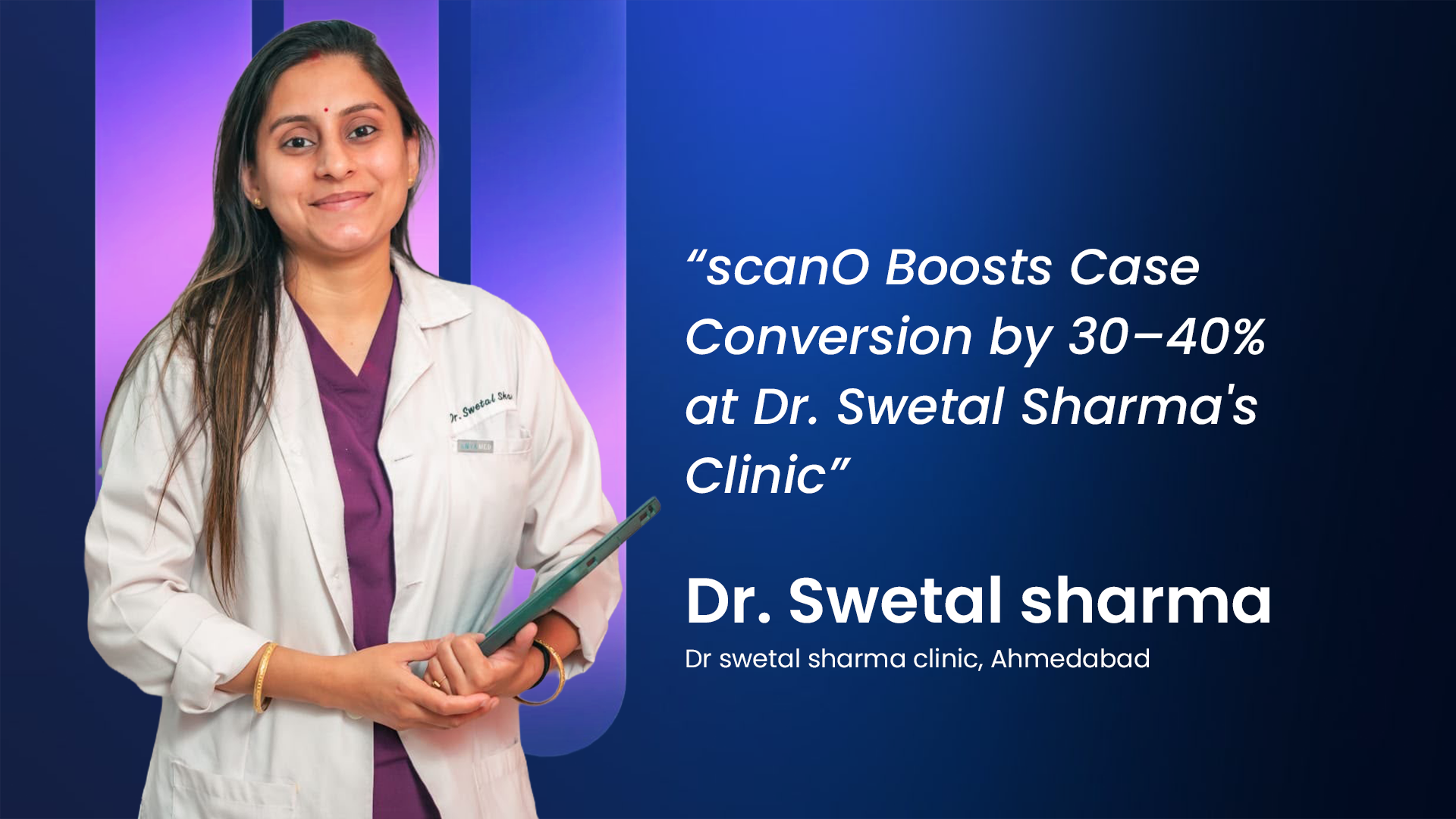








Dr. Swetal Sharma will tell you, without any hesitation, that she is not someone who settles.
In a profession where comfort zones are easy to build and even easier to stay in, she has consistently done the opposite. She started her first clinic in Ghaziabad. Moved to Dehradun to be closer to family when her son was young, built two clinics there from the ground up, grew a team of four dentists, and had reached the final round of NABH accreditation. Then, in 2026, she relocated again, this time to Ahmedabad and started fresh.
And when she set up her new clinic, she made sure it had everything. Portable X-rays. Lasers. Digital workflows. And scanO Air at the reception desk, because in Dr. Swetal's world, if a technology should be there, it will be there, regardless of whether anyone else in the city has it yet.
That sentence, delivered with quiet confidence, tells you everything you need to know about Dr. Swetal Sharma.
Before scanO entered the picture, Dr. Swetal had already identified something that bothered her about the dentist-patient dynamic in India and she had the clarity to name it precisely.
Patients bargain with dentists. They don't bargain with cardiologists. They don't question neurosurgeons. But they negotiate with the dentist, defer treatment, and walk out having convinced themselves they don't really need what was recommended.
Dr. Swetal had never compromised on her clinical standards. She had never reduced treatment quality to close a case. But she knew that without visual, tangible proof of a patient's oral condition, the conversation was always going to be one-sided, the doctor explaining, the patient doubting.
She was looking for something that would make the evidence undeniable. That is what drew her to scanO.
Dr. Swetal first encountered scanO on social media in early 2024. She noticed it, filed it away in her mind, and kept watching. Then in August 2024, a close friend who knew Dr. Vidhi Bhanushali connected the two of them.
What followed was not a sales conversation. It was a meeting of minds, two people who shared a belief that dentistry in India needed to be different, better, and more patient-centric than it currently is.
She was, from the moment she understood what scanO did, entirely sold. Not because a salesperson convinced her. Because the tool solved a problem she had already articulated, in a way she had already imagined.
Dr. Swetal's clinic in Dehradun was, by her own account, one of the first to introduce scanO in Uttarakhand. Possibly one of the rarest of the rare.
She takes visible pride in that.
The reaction from patients was immediate and split in an interesting way. Her IPS officer patients, her professionals, her urban educated patients, they were fascinated. The technology, the camera, the instant report, the idea that a machine was mapping their teeth in real time, it added a dimension of credibility and sophistication to the consultation that nothing else had.
And then there were the Gujarat patients: a market she was navigating fresh in 2026, who needed a moment longer to trust.
The moment of seeing is always the turning point. Without exception, across every demographic, the report changes the conversation.
The integration at Dr. Swetal's clinic is deliberate and clean. The scanO device sits at reception. Every patient, as part of their registration and check-in process, gets screened. The receptionist manages the scan. By the time the patient walks into Dr. Swetal's consultation room, they are already holding their report.
The consultation that follows is a different animal entirely.
That shift from passive recipient of a diagnosis to active participant in their own oral health is what Dr. Swetal believes is scanO's most fundamental contribution. Not the AI. Not the camera. The accountability it creates in the patient.
Dr. Swetal does not deal in vague positivity. When asked about case acceptance, she gave a number.
For a practitioner who never compromised on her standard of care or her pricing, this is significant. The treatments patients were previously deferring, the ones that required convincing, that triggered the bargaining she described, are now being accepted at a measurably higher rate. Not because the pitch changed. Because the patient can see what the doctor is describing.
When asked about time saved per consultation, Dr. Swetal's answer was precise and perhaps surprising.
Not less. One minute more, the time taken for the receptionist to run the scan. But what that one minute buys inside the consultation room is something else entirely.
The time saved is not in the total clock. It is in the quality and efficiency of everything that follows the scan.
One of Dr. Swetal's most telling observations about patient trust came not from a dramatic clinical moment but from a clinical category: bruxism.
Bruxism, teeth grinding, is one of the conditions most patients are completely unaware of until their teeth show significant wear. It is also one of the conditions that scanO's sensitivity surfaces most effectively, because even early-stage attrition patterns are visible to the AI.
That shift , from a patient who came in for one thing and left knowing about another, is the preventive care conversation that Indian dentistry has always struggled to have. scanO makes it possible, not through the doctor's persuasion, but through the patient's own eyes.
Among all the patients who have walked through Dr. Swetal's clinic had their moment of recognition at the scanO screen, one stands out.
A star of the popular web series Tandav, who happened to be Dr. Swetal's neighbour in Dehradun, came in for a routine consultation. She was confident, aware of her appearance, protective of her smile. When the scan was done and the report appeared, she saw something that surprised her.
A television actress, someone whose face is her professional asset, leaving a dental clinic genuinely impressed, not by the treatment, but by the technology that preceded it. That moment of a patient saying "we need this everywhere" is the kind of validation no marketing campaign can manufacture.
Before relocating to Ahmedabad, Dr. Swetal had built an active camp programme in Dehradun: schools, communities, institutions. She had already planned camps at major schools including Woodstock.
The move changed the geography but not the vision. She is now targeting schools in Ahmedabad, and her conviction about what makes scanO uniquely suited for camps is clear.
For school camps, where the patient is a child, and where anxiety about instruments is at its highest, the ability to screen without touching, without a chair, without any of the apparatus that triggers dental fear, is not a convenience. It is what makes the programme possible.
She has already shared camp videos with the scanO team. More are coming.
When asked what her team and patients would miss first if scanO disappeared, Dr. Swetal zeroed in on two things without hesitation.
The WhatsApp report. And the robot itself.
What she describes is a layered experience, the visual encounter at the device, followed by the digital report on the patient's phone, that together create something greater than either element alone. The machine builds the moment. The report extends it into the patient's home, their family conversations, their WhatsApp groups.
People ask Dr. Swetal. She tells them.
But she goes further than the simple recommendation. She frames it in the language of practice growth that every dentist understands.
The conversation with Dr. Swetal always comes back to one thing: dentistry in India is undervalued, under-trusted, and under-leveraged, not because the profession lacks skill, but because patients lack visibility into what they actually need.
scanO, in her framing, is not a gadget. It is an awareness infrastructure. It is the thing that brings the patient into the conversation before the pain begins.
And for a doctor who has spent a decade refusing to settle for less than the best version of her practice, that is exactly what she was looking for.
.png)
.png)
.png)


.png)
.png)



.png)


.png)

.png)
.png)
.png)