








"Most people don't visit a dentist because they think they have a problem. They visit a dentist only when the problem starts hurting."
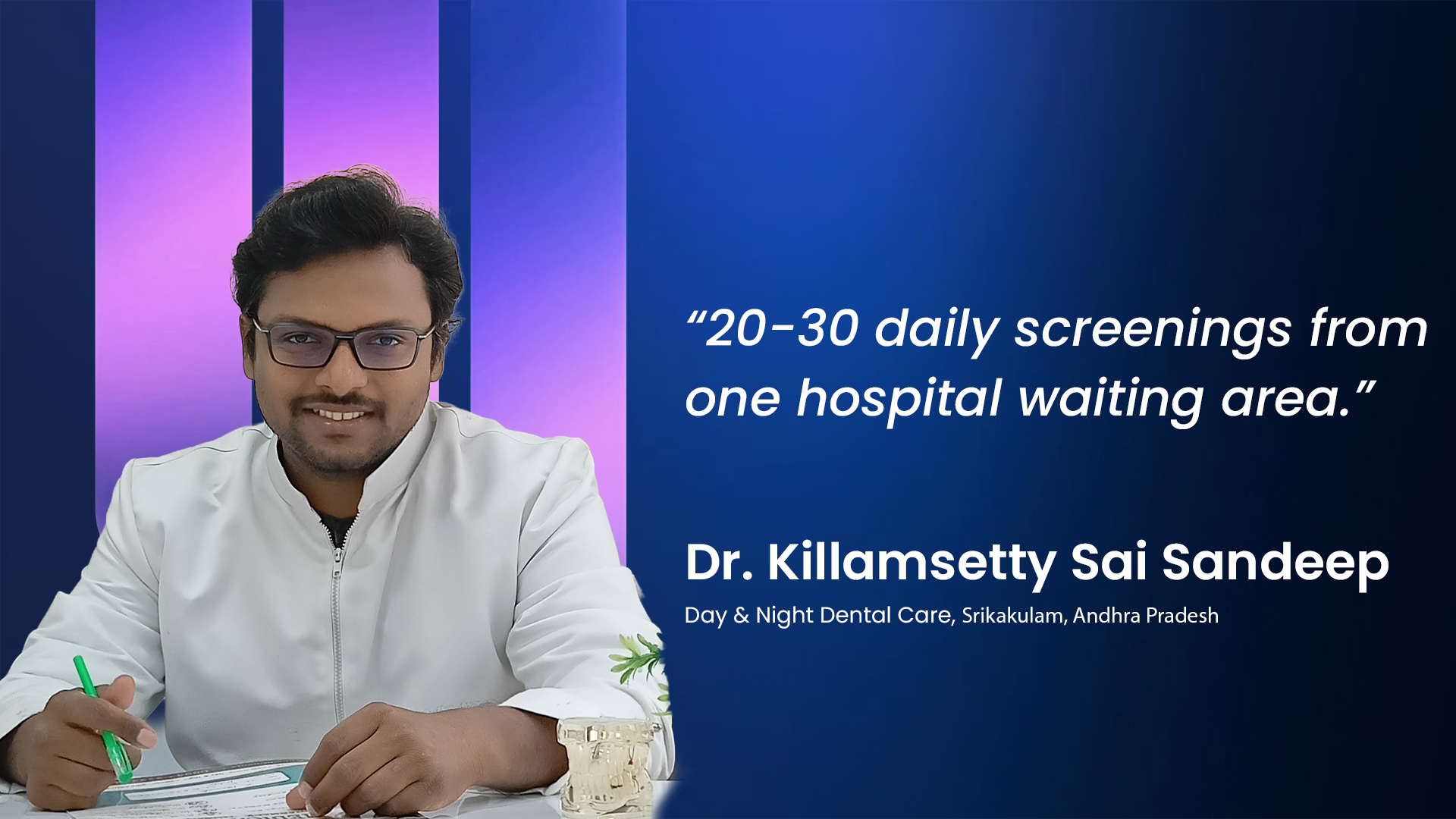
For Dr. Killamsetty Sai Sandeep, an orthodontist practicing in Srikakulam, Andhra Pradesh, this wasn't merely an observation, it was the biggest challenge standing between patients and timely dental care.
His clinic, Day & Night Dental Clinic, sits inside a bustling multi-specialty medical complex that welcomes nearly 100–150 visitors every day.
Ironically, while the hospital remained busy from morning till evening, only a handful of those patients ever found their way to the dental department upstairs.
That realization became the starting point of a very different approach to dentistry.
Having practiced orthodontics for nearly a decade, Dr. Sai understood the realities of serving a Tier-3 city.
Unlike metropolitan practices where smile makeovers and cosmetic dentistry attract patients proactively, people in smaller towns usually seek dental care only after experiencing pain.
For an orthodontist, this creates an even bigger challenge.
Patients rarely walk in asking about braces or aligners because they often don't recognize malocclusion as something that deserves treatment.
"I knew I couldn't wait for orthodontic patients to walk into my clinic.
I had to find a way to identify them before they even realized they needed treatment."
That thought eventually led him to scanO.
Most dentists install technology inside their clinics.
Dr. Sai did exactly the opposite. Instead of placing the scanO unit inside his dental practice, he positioned it in the hospital's main waiting area, where every patient waiting to consult a physician could access it.
The idea was remarkably simple.
If people wouldn't visit the dentist voluntarily, dentistry would meet them where they already were.
Every day, nearly 20–30 visitors now undergo an AI-powered oral health screening while waiting for appointments unrelated to dentistry.
Many arrive for diabetes consultations.Some for orthopaedic reviews.Others for routine physician visits.
For Dr. Sai, the biggest value wasn't merely screening. It was discovering patients who would otherwise have remained invisible.
As an orthodontist, the AI system identifies people with alignment concerns and malocclusion, allowing him to understand which patients might benefit from orthodontic treatment.
"Earlier I had no way of knowing who needed braces or aligners unless they came directly to my clinic. Now I can identify them much earlier." Every day's screenings generate a database of patients with different oral health conditions. Using these reports, his team reaches out to patients, explains their findings, and encourages them to schedule a consultation whenever appropriate.
One insight from Dr. Sai's experience stood out more than anything else.
Most dentists talk about AI helping patients trust recommendations during the first consultation.His experience was different. For him, trust truly develops after treatment.
Here's how his workflow looks today.
Patients first undergo an AI screening. They review the report before meeting the dentist. After the clinical examination, treatment is completed.
Then comes the interesting part.
Many patients voluntarily return to the scanO unit and repeat the screening after treatment.They want to see whether the issues identified earlier have actually been resolved.
Rather than relying solely on verbal reassurance, patients receive a visual confirmation that reinforces their confidence in the dentist.
That second screening has quietly become one of the strongest drivers of patient trust in his practice.
Before introducing AI, every consultation followed a familiar routine.
A detailed clinical examination.Identifying findings tooth by tooth.
Explaining everything from the beginning. Today, much of that groundwork is already done.
By the time a patient sits in the dental chair, Dr. Sai has already reviewed the screening report.
Instead of spending several minutes identifying obvious findings, he focuses on verifying the AI observations and discussing treatment.
He estimates that what previously required several minutes of examination now takes less than a minute to validate, allowing consultations to become more focused and conversational.
Another noticeable change surprised him.
Patients began asking better questions.
Instead of passively listening, they wanted to understand every section of their report.
"What does this colour mean?" "Why is this tooth highlighted?""Is this something serious?"
These conversations made consultations more interactive and educational.
Patients weren't simply being advised: they were actively participating.
Dr. Sai doesn't believe technology should replace clinical judgement. Instead, he sees AI as a highly efficient assistant.
He estimates scanO's diagnostic accuracy at around 80% in routine practice. Occasionally, factors such as lighting, patient positioning or image quality affect the output.
"In my opinion, most limitations are related to how the image is captured rather than the AI itself."
For him, the role of AI is clear.It performs the initial screening.The dentist confirms the findings.Together, they create a faster and more reliable workflow.
Practicing in a region where many patients have limited literacy has also given Dr. Sai a different perspective on digital health.
He noticed that although patients receive detailed reports, many struggle to understand them independently.
His suggestion is simple but powerful. Imagine every report being accompanied by a short AI-generated video explaining each finding in the patient's local language.
Instead of reading clinical terminology, patients could simply watch a personalised explanation.
It is an idea rooted not in technology, but in empathy.
When asked what would happen if scanO disappeared tomorrow, Dr. Sai didn't mention the hardware.He mentioned the workflow."I would lose three things."
"The first is patient leads."
"The second is the time saved during examinations."
"And the third is the trust patients develop after treatment."
For him, these three advantages have become part of everyday practice.
Would he recommend AI-powered screening to other dentists? His answer comes without hesitation.
"Absolutely."
He believes the greatest beneficiaries will be young practitioners trying to establish themselves. Community camps, educational events and public awareness programmes often consume enormous amounts of time.With scanO, those same initiatives become more efficient, allowing clinics to screen large numbers of people while identifying genuine treatment opportunities.
"It's especially valuable for dentists who are still building their patient base."
For Dr. Sai, AI is no longer just another piece of equipment inside a clinic.
It has become an extension of how he practices dentistry. Not because it replaces diagnosis. Not because it replaces experience.
But because it helps people discover problems they never knew they had and helps them trust the care they receive afterwards.
In a healthcare system where awareness remains one of the biggest barriers to preventive dentistry, sometimes the most meaningful innovation isn't making treatments smarter.
It's making patients walk through the right door in the first place.
.png)
.png)
.png)


.png)
.png)



.png)


.png)

.png)
.png)
.png)